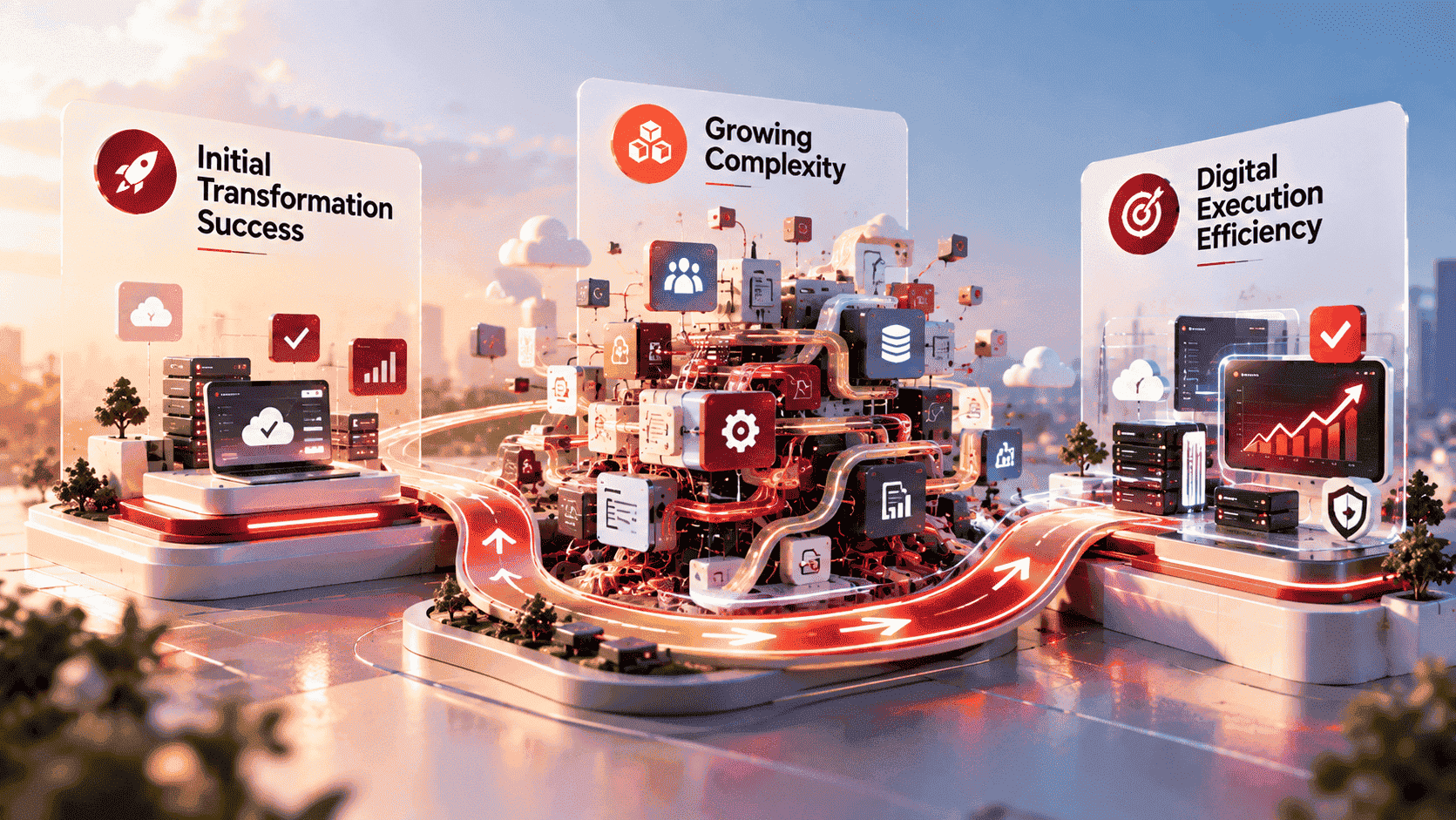












Organizations continue investing heavily in enterprise applications, cloud platforms, automation, data analytics, cybersecurity, and artificial intelligence. These investments are expected to improve productivity, reduce costs, strengthen customer experiences, and support long-term business growth.
While most organizations can identify the technology initiatives they have implemented, far fewer can clearly demonstrate the business returns those investments have generated. Leaders are often confident that technology has created value, yet they struggle to present consistent evidence that validates those assumptions.
This challenge explains why technology ROI remains one of the most difficult aspects of digital transformation. Measuring return on investment requires far more than comparing implementation costs against financial savings. It requires governance, continuous measurement, and clear accountability across both business and technology teams.
Organizations that establish structured approaches to measuring technology ROI gain greater visibility into investment performance and make better decisions about future technology portfolios.
What Is Technology ROI
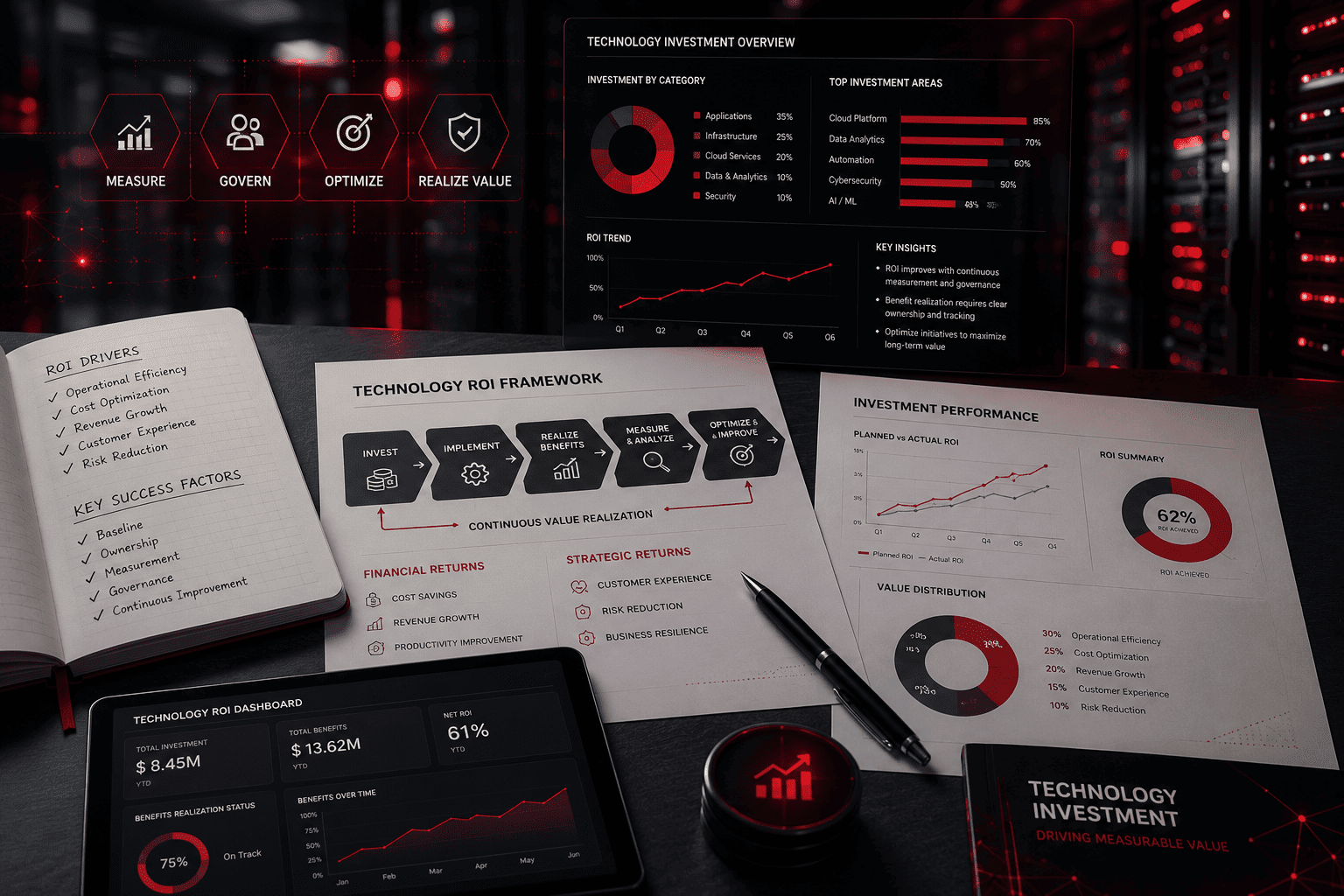
Technology ROI measures the value created by technology investments compared with the resources required to implement, operate, and maintain those investments.
A complete evaluation considers both financial and non-financial outcomes, including operational efficiency, revenue growth, customer experience, organizational productivity, and risk reduction.
Unlike traditional capital investments, technology initiatives often produce benefits that are distributed across multiple business functions and emerge over an extended period. As a result, calculating the ROI of IT projects requires continuous evaluation rather than a single post-implementation assessment.
Without structured governance and ongoing measurement, organizations frequently overestimate expected returns while underestimating the complexity of demonstrating actual business value.
Why Technology ROI Looks Clear During Planning but Difficult After Implementation
Business cases typically present technology investments with well-defined assumptions and projected outcomes.
Organizations commonly estimate:
Expected cost reductions
Productivity improvements
Revenue opportunities
Operational efficiencies
Risk reduction and compliance improvements
Although these projections support investment decisions, many organizations struggle to validate them once technology becomes operational.
Benefits often become distributed across multiple business units, influenced by changing priorities, or difficult to isolate from other transformation initiatives.
As a result, measuring technology ROI becomes significantly more challenging after implementation than it appeared during planning.
Common Reasons Technology ROI Is Difficult to Prove
Organizations that struggle to demonstrate investment value often experience similar challenges regardless of industry or technology platform.
1. Benefits Stop Being Measured After Go Live
Many organizations build comprehensive business cases before technology implementation. Expected benefits are carefully documented, executive sponsors approve projected returns, and success metrics are clearly defined during the planning phase. However, once the project reaches go live, organizational attention often shifts toward the next initiative.
Instead of monitoring whether expected business outcomes are actually being achieved, project teams are disbanded, reporting becomes less frequent, and benefit realization gradually disappears from management discussions. Technology continues operating, but organizations lose visibility into whether the original investment assumptions remain valid.
This commonly results in:
Benefits tracking ending immediately after project closure
Expected outcomes no longer being reviewed against actual performance
Operational metrics replacing business value measurement
Improvement opportunities remaining unidentified over time
Without continuous measurement, organizations cannot determine whether technology investments continue creating value, whether expected returns have been achieved, or whether corrective action is required. Benefit realization should therefore be treated as an ongoing management activity rather than the final step of project delivery.
2. Ownership for ROI Is Unclear
Technology ROI often spans multiple business functions. Finance tracks investment costs, IT manages technology operations, while business units experience the operational improvements created by new systems. Because responsibility is distributed across different teams, accountability for measuring investment outcomes frequently becomes unclear.
When no single owner is responsible for monitoring value realization, organizations may produce conflicting interpretations of project success. Technology teams may consider a project successful because implementation was completed on time, while business leaders remain uncertain whether measurable business outcomes have actually improved.
Organizations frequently experience:
Inconsistent approaches to measuring investment performance
Conflicting definitions of successful outcomes
Limited accountability for realized benefits
Uncertainty regarding who should initiate corrective actions
Clearly assigning ownership ensures that technology ROI remains visible long after implementation. It also enables organizations to respond quickly when investments fail to deliver the expected business value.
3. Baseline Performance Is Never Established
Accurately measuring technology ROI requires understanding the organization's performance before implementation begins. Unfortunately, many projects define expected improvements without establishing reliable baseline measurements.
For example, organizations may expect faster operational processes, improved employee productivity, or higher customer satisfaction without documenting current performance levels. Once technology is implemented, teams have no objective reference point against which improvements can be measured.
This often leads to:
Assumptions replacing measurable evidence
Difficulty validating operational improvements
Inconsistent comparisons between projects
Reduced confidence in reported ROI figures
Establishing baseline metrics before implementation allows organizations to compare actual outcomes with original conditions, making technology ROI significantly more credible and easier to communicate to executive stakeholders.
4. Multiple Transformation Initiatives Overlap
Modern enterprises rarely execute digital transformation through a single technology project. Cloud migration, automation, cybersecurity improvements, data platforms, AI initiatives, and application modernization often occur simultaneously across different business units.
While these initiatives collectively improve organizational performance, they also make it increasingly difficult to determine which investment generated which business outcome.
Organizations frequently encounter situations where:
Multiple initiatives contribute to the same business improvement
Operational changes occur alongside technology implementation
External business factors influence reported results
Financial benefits cannot be attributed to individual investments
As technology ecosystems become more interconnected, isolating the return of a single project becomes increasingly complex. Rather than evaluating projects independently, mature organizations increasingly measure ROI at the capability or portfolio level, where business value can be assessed more realistically across related initiatives.
Why Technology Costs Are Easier to Measure Than Technology Value
Most organizations maintain accurate records of technology expenditure.
They can usually identify:
Software licensing costs
Infrastructure investments
Cloud consumption expenses
Vendor contracts and managed services
Operational support costs
Measuring technology cost vs value, however, is considerably more difficult.
While costs are recorded within financial systems, value is distributed across customer outcomes, operational improvements, employee productivity, business resilience, and strategic capabilities.
This imbalance explains why discussions about technology investments frequently emphasize spending rather than measurable business impact.
The broader challenge of evaluating technology investment outcomes is explored in Measuring Technology ROI Beyond Cost Savings, which explains why financial savings represent only one dimension of technology value.
The Importance of Governance in Technology ROI
Organizations that consistently demonstrate strong technology ROI treat value realization as a governance discipline rather than a financial calculation.
Effective governance includes:
Defining expected benefits before implementation
Assigning ownership for benefit realization
Reviewing investment performance regularly
Adjusting initiatives when expected outcomes are not achieved
This structured approach transforms ROI from a reporting exercise into a continuous management process.
The relationship between investment governance and business outcomes is explored further in Technology Value Framework for Clear and Measurable ROI, which explains how organizations establish repeatable frameworks for measuring and managing technology value.
Signs Your Organization May Be Struggling to Demonstrate Technology ROI
Organizations often recognize weaknesses in ROI management through recurring business challenges.
Common indicators include:
Difficulty justifying technology investments to executive leadership
Increasing technology expenditure without proportional business outcomes
Inconsistent reporting of investment performance
Limited confidence in benefit realization data
Repeated investment in initiatives with unclear strategic value
These signs suggest that organizations may need stronger governance, clearer accountability, and more disciplined approaches to measuring technology value.
Read More: Enterprise Execution Maturity for Scalable Digital Transformation
Key Takeaways
Proving technology ROI requires more than financial calculations after implementation. Organizations need continuous measurement, reliable baseline data, clear ownership, and governance processes that connect technology investments with measurable business outcomes.
By strengthening measuring technology ROI, benefit realization, and investment governance, organizations can improve visibility into IT investment return while making better decisions about future technology initiatives.
Organizations that manage ROI continuously are better equipped to maximize digital investment value and ensure technology contributes meaningfully to long-term business success.

Frequently Asked Questions
What is technology ROI
Technology ROI measures the value generated by technology investments compared with the costs required to implement, operate, and maintain those investments across financial and business outcomes.
Why is technology ROI difficult to measure
Technology ROI is difficult to measure because benefits often emerge over time, involve multiple business functions, lack clear ownership, and are rarely tracked consistently after implementation.
How can organizations improve technology ROI measurement
Organizations can improve technology ROI by establishing baseline metrics, assigning ownership for benefit realization, integrating financial and operational data, and reviewing investment outcomes continuously.
Make Technology ROI Measurable and Actionable
Technology investments create lasting value only when organizations can measure, govern, and continuously improve their outcomes. GSCatalyst helps organizations establish benefit realization frameworks, strengthen investment governance, and improve visibility into technology ROI across the enterprise.
Explore how GSCatalyst can help you demonstrate the true value of your technology investments.