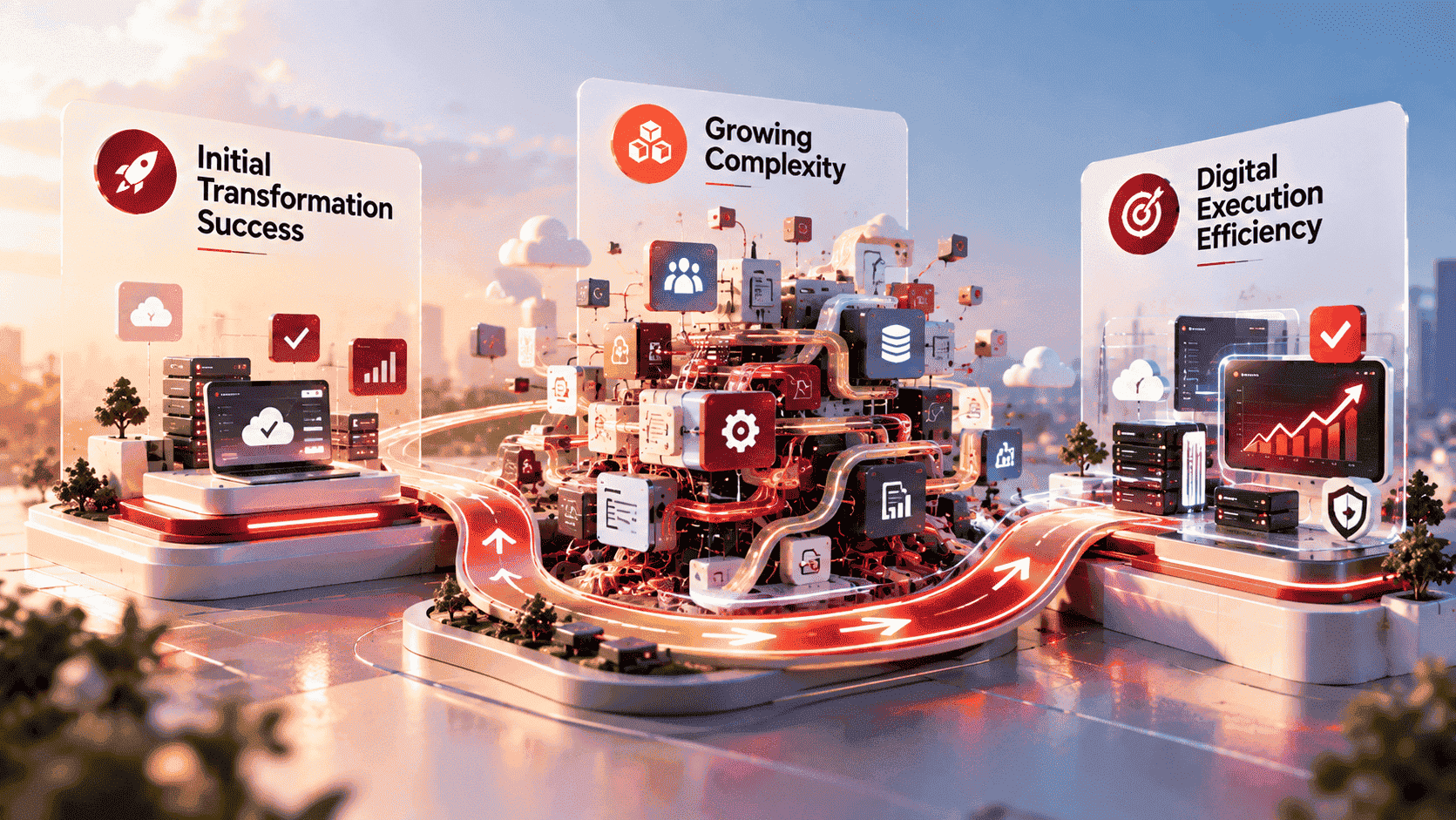












A technology strategy can be well designed, properly funded, and supported by strong leadership, yet still struggle once execution begins. The difficulty often emerges when strategic priorities have to move across business functions, technology teams, vendors, budgets, operational dependencies, and competing initiatives.
This is where the gap between planning and performance becomes visible. A roadmap may define what the organization wants to achieve, but execution determines whether those priorities are translated into coordinated action, effective decisions, controlled delivery, and measurable business outcomes.
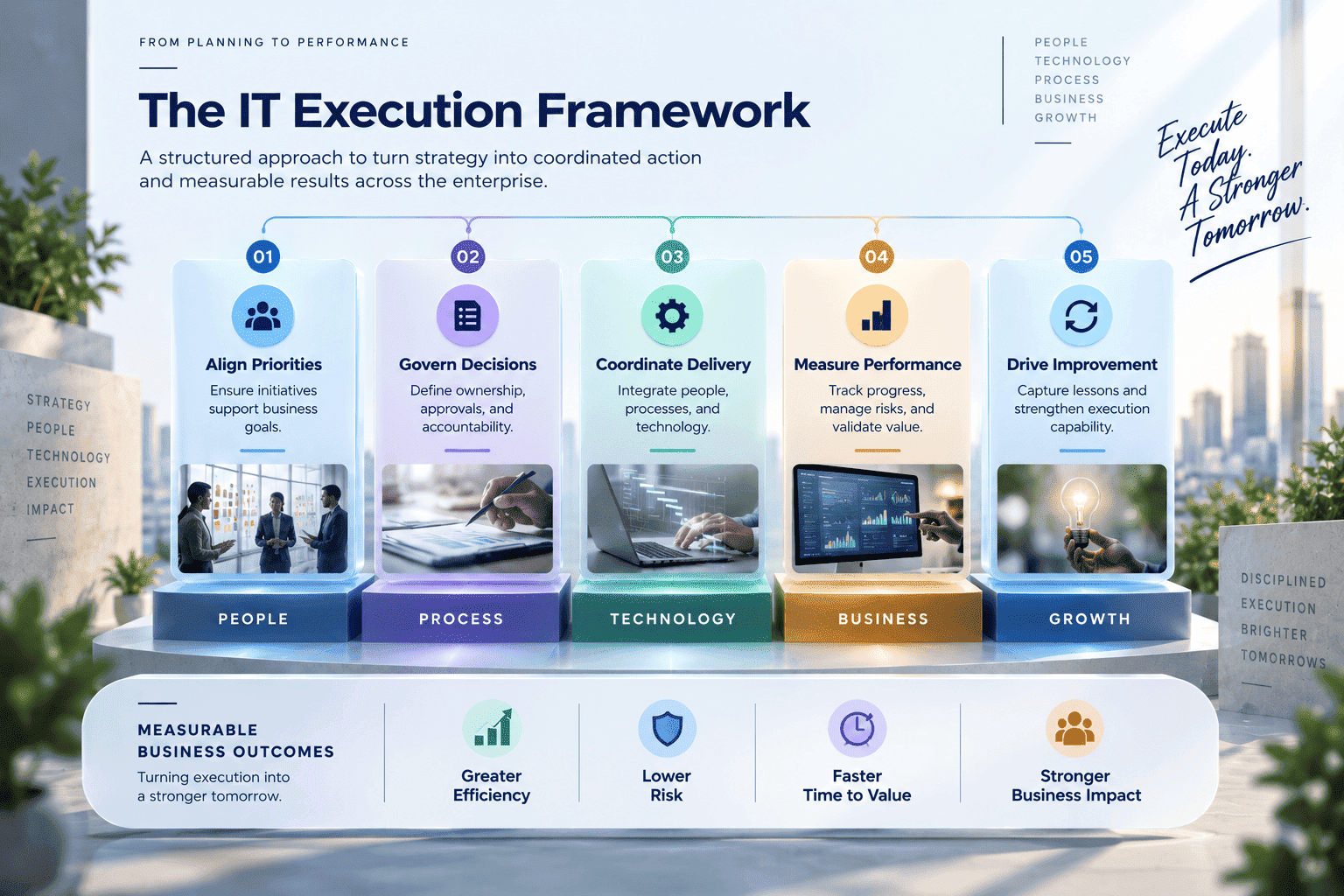
An IT execution framework provides the structure that connects these elements. Rather than treating each technology initiative as an isolated project, it establishes a consistent way to align priorities, govern decisions, coordinate delivery, measure performance, and improve execution capability over time.
Why Planning Alone Does Not Deliver Results
Planning creates direction. It defines priorities, investment areas, capabilities, timelines, and expected outcomes. Execution is what turns those decisions into operational change.
The challenge becomes more significant as enterprises manage multiple transformation initiatives simultaneously. Infrastructure modernization, business platforms, cybersecurity programs, data initiatives, and AI investments may each have dedicated teams, but they still compete for resources, depend on shared capabilities, and create dependencies across the organization.
Without a consistent execution model, these dependencies can result in:
Fragmented ownership
Conflicting priorities
Delayed decisions
Limited visibility across initiatives
Inconsistent delivery practices
Repeated delays and rework
These problems can gradually weaken confidence in technology investments even when individual projects appear to be progressing. A structured execution framework helps the organization manage this complexity through a common approach to accountability, governance, delivery, performance, and improvement.
What Is an IT Execution Framework?
An IT execution framework is a structured approach for planning, delivering, governing, measuring, and improving technology initiatives across an organization. It establishes clarity around who is responsible, how decisions are made, how risks are managed, how performance is evaluated, and how improvements are incorporated into future delivery.
This makes an IT execution framework broader than traditional project management. Project management is generally concerned with delivering a specific initiative, while an enterprise execution framework focuses on building a repeatable organizational capability that can support multiple initiatives over time.
The objective is therefore not simply to complete projects successfully. It is to create an operating structure that consistently connects technology investment with strategic priorities and measurable business value.
The Five Foundations of an Effective IT Execution Framework
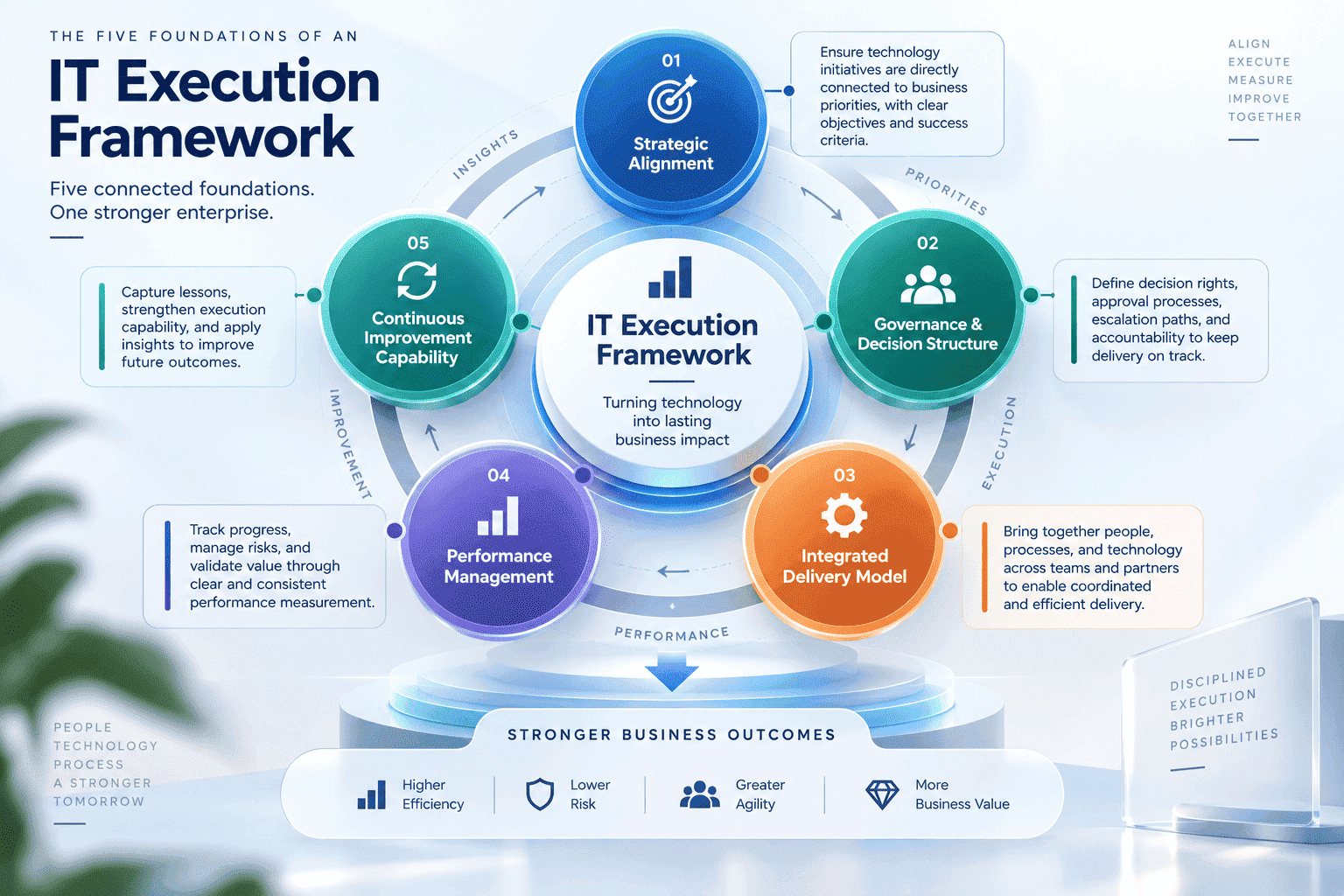
A practical enterprise execution framework is built around five integrated foundations. Each addresses a different execution challenge, but the real value comes from connecting them into one delivery system.
1. Strategic Alignment
Execution starts with clarity about what the organization is trying to achieve. Technology initiatives should have a clear connection to business priorities, defined objectives, and agreed success criteria before significant resources are committed.
This prevents a common enterprise problem where a project can be technically successful while failing to create meaningful business impact. Strategic alignment ensures that delivery teams understand not only what they are building, but why the initiative matters and what outcome it is expected to produce.
For organizations strengthening this foundation, Building a Technology Roadmap provides further context on translating strategic priorities into a structured technology roadmap.
2. Governance and Decision Structure
Execution becomes difficult when decision rights are unclear. Enterprise initiatives often involve business leaders, technology teams, security, finance, procurement, vendors, and other stakeholders, creating situations where decisions can remain unresolved because ownership is not clearly established.
A practical governance model should define approval processes, escalation paths, steering reviews, and reporting responsibilities. The right structure provides enough oversight to control risk and maintain accountability without introducing unnecessary approval layers that slow delivery.
Effective governance is therefore not about adding more meetings. It is about ensuring that the right people can make the right decisions at the right time.
3. Integrated Delivery Model
Complex technology initiatives rarely belong to one team. Business units, internal technology functions, implementation partners, vendors, and operational teams may all contribute to the same outcome.
An integrated delivery model creates a shared structure for coordinating these groups. It typically brings together:
Project planning and scheduling
Resource and capacity management
Vendor coordination
Risk management
Dependency management
The purpose is not to centralize every delivery activity. It is to make relationships between teams visible, clarify responsibilities, and reduce the fragmentation that causes avoidable delays. When delivery is integrated properly, execution becomes more predictable and less dependent on informal coordination.
4. Performance Management
A project can be on schedule and within budget while still failing to deliver the value expected from the investment. This is why execution needs performance management that goes beyond basic project status reporting.
Relevant measures may include:
Delivery milestones
Budget utilization
Quality indicators
Business impact metrics
The important consideration is not how many metrics an organization collects, but whether those metrics support better decisions. Performance information should help leaders identify emerging problems, allocate resources, adjust priorities, and determine whether an initiative remains on track to achieve its intended outcomes.
5. Continuous Improvement Capability
Execution capability should become stronger with experience. After major initiatives, organizations have an opportunity to identify where delivery slowed down, which processes created unnecessary friction, and which capabilities need to be strengthened.
Post implementation reviews, process optimization, capability development, and knowledge management can turn those experiences into reusable organizational knowledge. This reduces dependence on individual expertise and allows improvements from one initiative to influence how future initiatives are delivered.
From Framework to Execution: How Enterprises Put It to Work
The value of an IT execution framework becomes clear when the five foundations are applied to real portfolio decisions rather than treated as separate governance activities.
Consider an enterprise implementing a major business platform while simultaneously running cybersecurity improvements and data modernization. The platform initiative may have its own project team and budget, but it could depend on shared infrastructure, security approvals, data availability, vendor capacity, and business users who are also supporting other initiatives.
Strategic alignment establishes which outcomes matter most and how the initiatives support business priorities. Governance determines who can resolve competing demands and make decisions when dependencies create conflict. Integrated delivery makes those dependencies visible across teams, while performance management shows whether delivery is progressing and whether the expected business outcomes are emerging.
Continuous improvement then ensures that lessons from the initiative are not lost once implementation is complete.
This is what makes the framework different from managing individual projects independently. The organization develops a consistent way to make portfolio decisions, coordinate execution, respond to problems, and improve delivery capability across initiatives.
Making IT Execution Visible Across the Enterprise
As the technology portfolio grows, leadership needs more than individual project reports. Without common standards, one initiative may report success through milestone completion while another focuses on budget performance, technical readiness, or adoption. These reports may all be accurate, yet leadership can still struggle to understand the overall health of the technology portfolio.
A structured execution model creates a shared view of:
What is being delivered
Why each initiative matters
Who owns the outcome
Which risks and dependencies require attention
Where leadership decisions are needed
Whether expected outcomes are being achieved
This visibility changes how leaders manage execution. Instead of reacting after deadlines or budgets have already been missed, they can identify emerging issues earlier and decide where additional resources, intervention, or reprioritization may be required.
Common Mistakes When Building an IT Execution Framework
An execution framework can become ineffective when it is treated as documentation rather than an operating capability. More governance, more reporting, and more process do not automatically produce better execution.
Common mistakes include:
Applying a generic framework without adapting it to the organization
Creating excessive approval and governance layers
Measuring activity instead of business outcomes
Applying identical processes to initiatives with different levels of complexity
Ignoring change management and organizational adoption
Failing to turn lessons learned into future improvements
The strongest frameworks are designed around the organization's actual delivery environment. Governance should reflect the level of risk, delivery practices should match the complexity of the initiative, and performance measures should remain connected to the outcomes that matter to the business.
How IT Execution Supports Technology Strategy
Technology strategy defines where the organization wants to go. IT execution determines whether the organization has the structure and capability to get there.
This is the central connection between strategy and performance. As discussed in Why IT Strategy Execution Fails in Most Enterprises, strategic priorities can lose momentum when ownership is unclear, decisions are slow, resources are fragmented, or delivery is disconnected from business outcomes.
An IT execution framework addresses these gaps by creating a consistent operating structure around strategic priorities. It gives leaders a way to translate strategy into initiatives, assign accountability, coordinate delivery, measure progress, and adjust priorities when business conditions change.
This also makes technology strategy more adaptable. When execution performance and business outcomes are visible, leaders have better information for deciding which initiatives should continue, which require intervention, and where limited execution capacity should be redirected.
Signs Your Enterprise Needs a Stronger Execution Model
An organization may have outgrown its existing execution approach when delivery increasingly depends on informal coordination or repeated executive intervention.
Common indicators include:
Major initiatives regularly require executive escalation
Different teams use inconsistent delivery practices
Leadership receives fragmented performance information
Multiple initiatives compete for the same resources
Delivery risks are identified late
Business stakeholders struggle to understand technology value
Lessons learned rarely influence future initiatives
These signals do not necessarily indicate that the organization lacks capable people. They may indicate that the organization needs a stronger system for coordinating the capabilities it already has.
From Execution Framework to Sustainable Performance
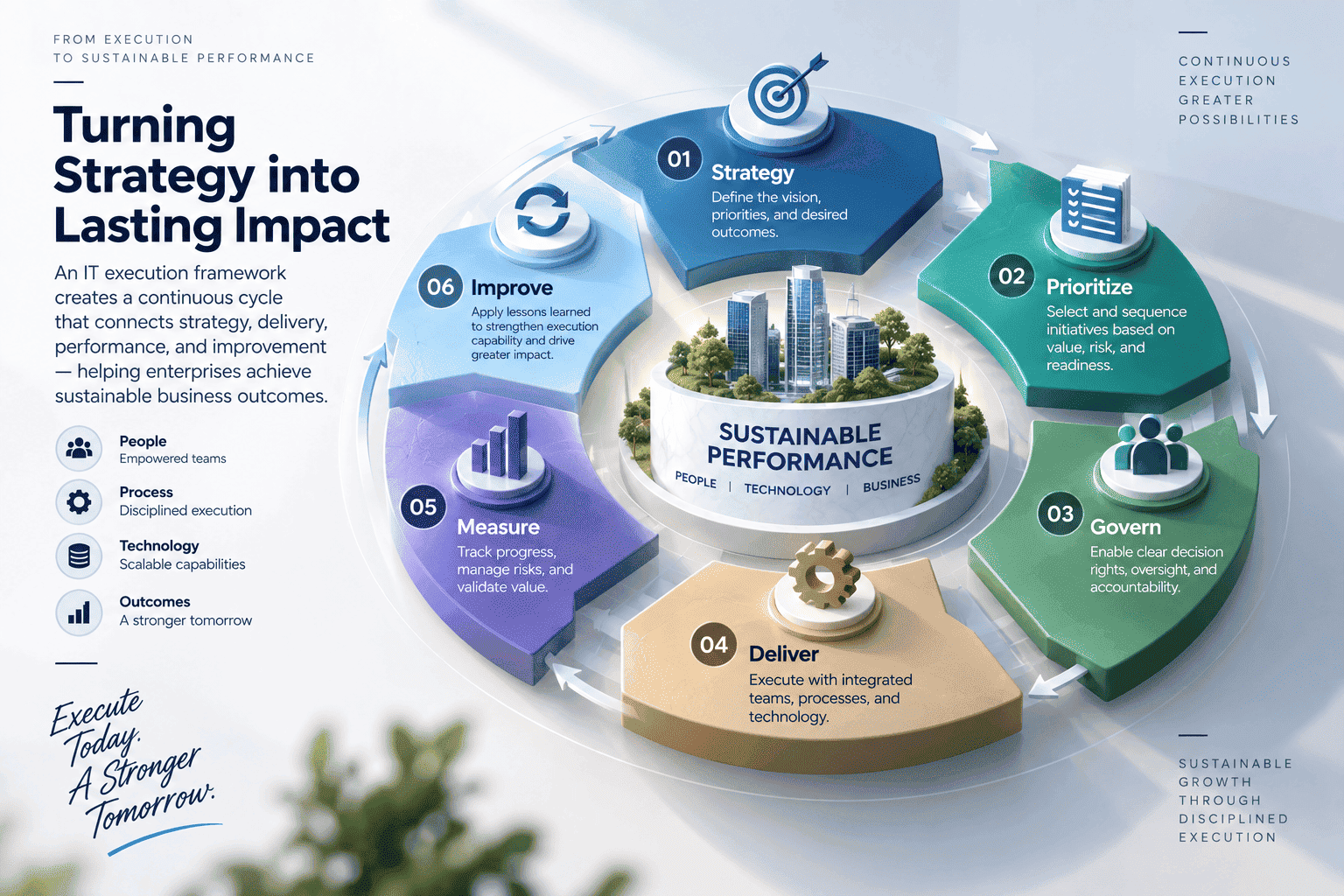
The long term value of an IT execution framework is its ability to make technology delivery more repeatable, measurable, and scalable. When strategic alignment, governance, integrated delivery, performance management, and continuous improvement operate together, organizations become less dependent on individual intervention and informal coordination.
Each initiative can also strengthen the next. Delivery outcomes provide evidence for future decisions, lessons learned improve execution practices, and performance information helps leadership refine technology priorities as business needs evolve.
The result is a more mature connection between planning and performance. Instead of maintaining technology strategy as a roadmap that is reviewed periodically, the organization develops the capability to continuously translate strategic priorities into coordinated execution and measurable business results.
Read More: Measuring Technology Performance and Avoiding Common Mistakes
Key Takeaways
An IT execution framework connects technology strategy with coordinated delivery and measurable business outcomes.
The five foundations are strategic alignment, governance and decision structure, integrated delivery, performance management, and continuous improvement.
Effective execution requires visibility across initiatives, clear accountability, and decision structures that support timely action.
Technology performance should be evaluated through both delivery indicators and business outcomes.
The objective is not to add unnecessary processes, but to build a repeatable enterprise capability for executing technology strategy effectively.
Frequently Asked Questions
What is an IT execution framework?
An IT execution framework is a structured approach for planning, delivering, governing, measuring, and improving technology initiatives across an organization. It connects technology strategy with execution and measurable business outcomes.
What are the five components of an IT execution framework?
The five core components are strategic alignment, governance and decision structure, integrated delivery, performance management, and continuous improvement capability.
How does an IT execution framework support digital transformation?
It provides a consistent structure for coordinating initiatives, managing dependencies, making decisions, measuring performance, and improving delivery capability. This helps organizations move from managing individual projects to developing a repeatable transformation capability.
Is an IT execution framework the same as project management?
No. Project management primarily focuses on delivering individual initiatives, while an IT execution framework establishes the broader organizational capabilities required to execute multiple technology initiatives consistently and connect them with business outcomes.
Ready to Strengthen Your IT Execution Framework?
GSCatalyst helps enterprises strengthen the capabilities that connect technology strategy, governance, delivery, and measurable business performance.
Let’s turn technology strategy into sustained performance.