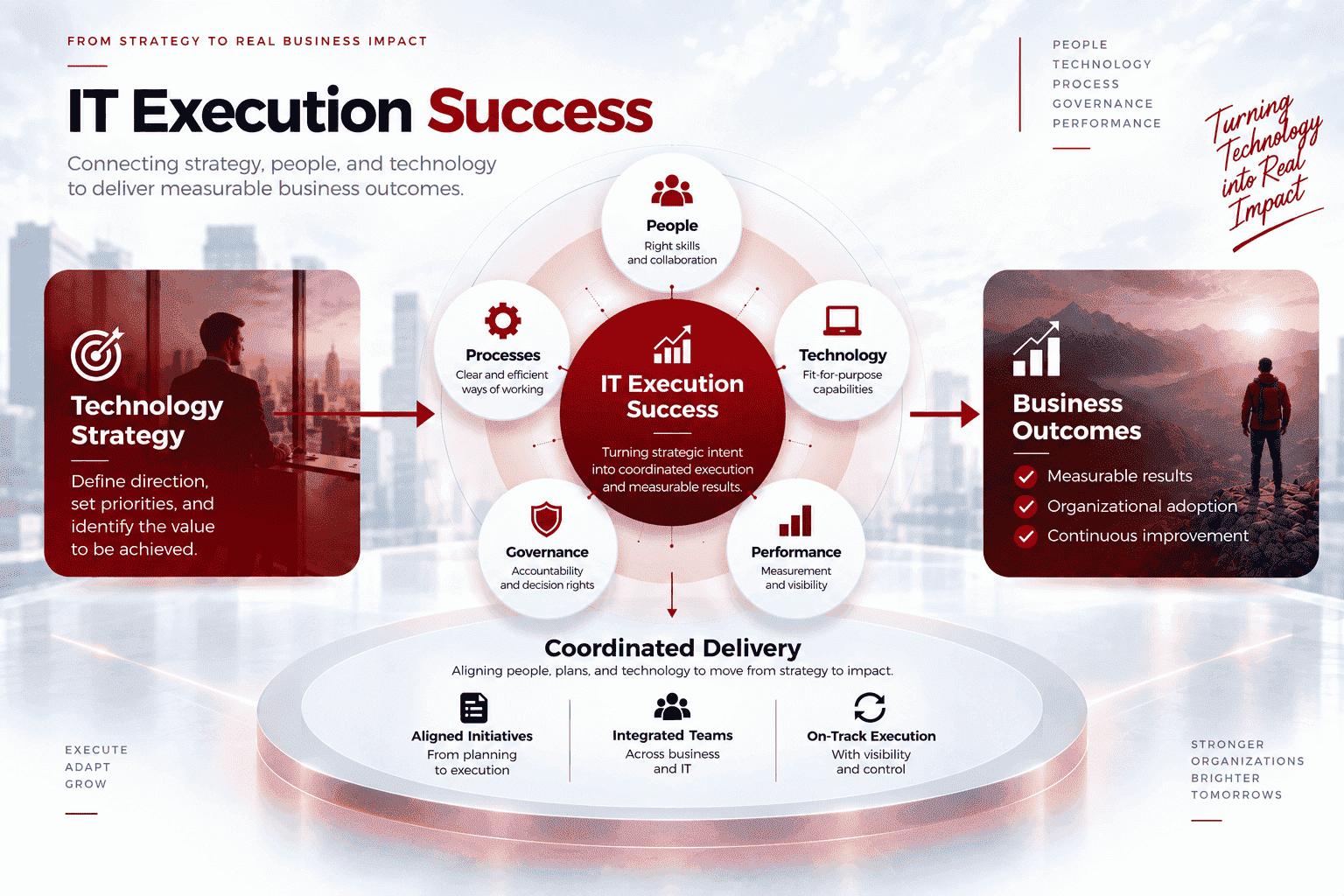












Digital transformation rarely ends when a new platform goes live or a major implementation milestone is completed. In many enterprises, that point marks the beginning of a different challenge: maintaining execution performance once the urgency and concentrated attention of transformation begin to fade.
During the initial phase, transformation programs typically receive strong executive sponsorship, dedicated resources, and close coordination across business and technology teams. These conditions help organizations move quickly and overcome obstacles that could otherwise delay implementation.
The operating environment changes after those early milestones are achieved. New initiatives enter the portfolio, ownership becomes more distributed, teams manage more dependencies, and leadership attention is divided across competing priorities. The organization may still be delivering results, but maintaining that performance can require greater coordination as delivery timelines become less predictable, decisions take longer, and cross-functional issues require more frequent escalation.
This is why digital execution efficiency needs to be treated as an ongoing enterprise capability rather than a temporary outcome of a successful transformation program.

What Is Digital Execution Efficiency?
Digital execution efficiency is an enterprise’s ability to deliver digital initiatives consistently and predictably while effectively managing resources, priorities, dependencies, and decision-making.
It goes beyond completing projects on schedule. For an enterprise, execution efficiency also determines how well business and technology teams coordinate work, resolve dependencies, allocate resources, respond to changing priorities, and maintain delivery discipline across multiple initiatives.
This distinction becomes increasingly important after the initial transformation phase. A program may have delivered its expected milestones, but the organization still needs effective structures to manage the growing number of initiatives and dependencies that follow.
The relationship between planning discipline and execution performance is explored further in From Planning to Performance: A Practical IT Execution Framework for Enterprises, which examines how enterprises can create clearer structures for turning technology plans into consistent execution.
Why Digital Execution Efficiency Declines
The factors that support transformation success during implementation do not always remain effective once the organization enters a more complex operating environment.
One of the most common changes is the shift from concentrated transformation management to distributed ownership. During implementation, leadership may have direct visibility into priorities, risks, and decisions. Once initiatives become part of ongoing operations, responsibility can move across multiple business units, technology teams, vendors, and delivery functions.
At the same time, the portfolio itself often becomes larger. New projects are added while existing platforms require enhancement, integration, support, and optimization. The organization is no longer managing a single transformation effort but an interconnected set of digital initiatives with competing priorities, shared resources, and increasing dependencies.
Several conditions can emerge as a result:
Executive oversight becomes less frequent after major milestones are completed.
Accountability becomes distributed across multiple teams and initiatives.
Different business units adopt different approaches to planning and delivery.
Resources remain committed to existing initiatives while new priorities continue to emerge.
Governance structures designed for an earlier stage of transformation become less effective as complexity increases.
These conditions do not automatically indicate that a transformation strategy is failing. They often indicate that the organization’s execution model has not evolved at the same pace as its digital portfolio.
The result is an execution maturity gap between the way an organization wants to operate and the structures it currently uses to manage delivery.
Structural Patterns Behind Execution Slowdown
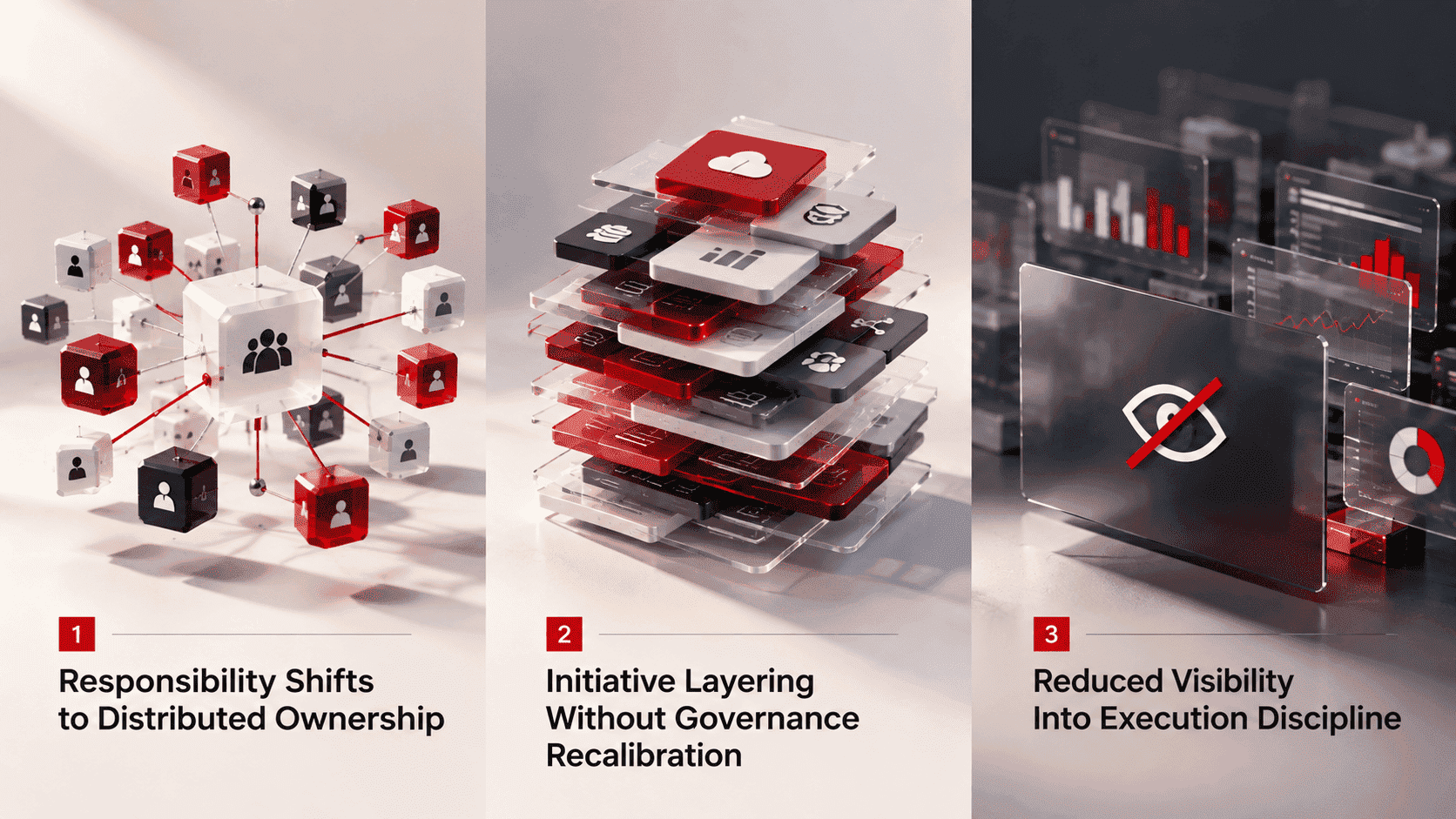
Execution slowdown tends to develop through recurring patterns rather than a single failure. Three patterns are particularly relevant as enterprises move beyond initial transformation success.
1. Responsibility Shifts to Distributed Ownership
As transformation initiatives move into business-as-usual operations, responsibility often shifts from a central transformation team to individual business units, product teams, technology functions, and operational owners.
Distributed ownership can improve accountability when responsibilities are clearly defined. The problem emerges when ownership is distributed without maintaining visibility across the broader portfolio.
A team may successfully manage its own initiative while another team is waiting for a dependency, a business decision, or a shared technology resource. Without clear escalation paths and cross-functional visibility, these issues can remain unresolved longer than expected.
The challenge is therefore not distributed ownership itself. It is maintaining coordinated accountability when multiple teams are responsible for connected outcomes.
2. Initiative Layering Without Governance Recalibration
Enterprise transformation is rarely a linear sequence in which one initiative ends before another begins. New priorities are frequently introduced while existing programs continue to consume resources and require operational support, creating layers of initiatives that compete for attention, capacity, and shared capabilities.
As the number of initiatives grows, the governance model that worked for a smaller portfolio may no longer provide enough visibility or decision-making capacity. Leadership teams may face more prioritization decisions, delivery teams may encounter more dependencies, and shared resources may become increasingly difficult to allocate.
Without recalibrating governance and resource planning, the organization can spend more time coordinating initiatives and resolving conflicts instead of moving delivery forward.
3. Reduced Visibility Into Execution Discipline
Another common pattern is a gradual reduction in visibility into how work is actually being delivered.
Executive reporting may continue to show high-level milestones, budgets, and business outcomes while providing less insight into the operational conditions affecting delivery. Decision delays, unresolved dependencies, resource constraints, and recurring escalations may therefore remain hidden until they affect a major milestone.
Effective execution visibility does not require leadership to monitor every project detail. It requires the right indicators to reveal where delivery is becoming less predictable and where intervention may be needed.
These patterns help explain why execution slowdown can occur even when individual transformation initiatives continue to deliver value. The underlying issue is often the increasing complexity of coordinating delivery across the enterprise.
The Business Impact of Execution Slowdown
Declining digital execution efficiency can affect more than technology delivery.
When decisions take longer or dependencies remain unresolved, business initiatives may also be delayed. Product launches, customer experience improvements, operational changes, and new digital capabilities can become dependent on technology decisions that take longer than expected.
Execution variability can also make investment planning more difficult. If delivery timelines repeatedly shift, leadership has less confidence in when expected capabilities will become available and when associated business benefits can be realized.
The impact can extend to executive capacity as well. Recurring escalations require leadership intervention, taking attention away from strategic priorities and long-term transformation opportunities.
Over time, these effects can weaken confidence between business and technology teams. Business leaders may perceive technology delivery as unpredictable, while technology teams may be dealing with competing priorities and unclear ownership that are difficult to resolve through delivery teams alone.
This is why digital execution efficiency should be viewed as an enterprise performance issue rather than solely an IT operational concern.
Recognizing Early Warning Signals
Organizations do not need to wait for a major transformation failure before addressing declining execution efficiency. Changes in everyday delivery behavior can provide earlier indications that the operating model is under strain.
Useful indicators include:
Delivery timelines becoming increasingly variable across similar initiatives
More frequent escalation of issues that previously could be resolved within delivery teams
Longer decision cycles for cross-functional or business-critical initiatives
Repeated resource conflicts involving shared technology capabilities
Dependencies remaining unresolved across multiple planning cycles
Different portfolios using inconsistent reporting or execution practices
Frequent changes in priorities without corresponding adjustments to resources or timelines
These indicators become more meaningful when viewed together rather than in isolation. A single delayed project does not necessarily indicate an enterprise execution problem. A recurring pattern across multiple initiatives is more likely to indicate that governance, capacity, or coordination mechanisms need to be reviewed.
Early visibility gives leadership an opportunity to address the underlying structure before execution problems become more expensive to resolve.
How Enterprises Can Sustain Digital Execution Efficiency
Maintaining digital execution efficiency does not mean adding more governance meetings or increasing reporting requirements. The objective is to ensure that the organization has enough structure to manage its current level of complexity without creating unnecessary administrative overhead.
Governance should be reviewed as the portfolio changes. Decision rights need to remain clear, particularly when multiple business and technology teams share responsibility for an outcome. Resource planning should also account for existing operational commitments rather than focusing only on newly approved initiatives.
Execution indicators should provide leadership with visibility into the conditions that affect delivery. These can include decision cycle time, dependency resolution, resource capacity, delivery predictability, and escalation patterns alongside traditional project and business outcome metrics.
Regular reviews can then be used to determine whether priorities, resources, governance, and delivery structures remain aligned with the organization’s current transformation agenda.
The goal is not to preserve the operating model that worked during the first stage of transformation. It is to continuously adapt that model as the enterprise becomes more digitally complex.
This perspective also connects directly to business and technology alignment. As discussed in How Enterprises Build Strong Business IT Alignment, clear alignment between business priorities and technology capabilities provides an important foundation for maintaining consistent execution as priorities evolve.
Read More: Enterprise Process Optimization for Sustainable Delivery Performance
Key Takeaways
Digital execution efficiency is the ability to deliver digital initiatives consistently and predictably while managing resources, priorities, dependencies, and decisions effectively.
Execution slowdown often emerges after initial transformation success as ownership becomes distributed and digital portfolios become more complex.
Initiative layering can increase coordination demands when governance and resource planning are not recalibrated.
Early warning signals such as decision delays, resource conflicts, recurring escalations, and delivery variability can reveal execution problems before they become systemic.
Sustaining execution efficiency requires governance, accountability, resource planning, and performance visibility to evolve alongside enterprise transformation.
Frequently Asked Questions
What is digital execution efficiency?
Digital execution efficiency is an enterprise’s ability to deliver digital initiatives consistently and predictably while effectively managing resources, priorities, dependencies, and decision-making.
Why does digital execution efficiency decline after transformation?
Digital execution efficiency can decline when transformation moves into distributed ownership, the number of initiatives increases, resources become constrained, and existing governance structures no longer match the complexity of the digital portfolio.
What are the signs of poor digital execution efficiency?
Common signs include increasing delivery variability, longer decision cycles, recurring resource conflicts, unresolved dependencies, frequent escalations, and inconsistent execution practices across portfolios.
How can enterprises prevent execution slowdown after digital transformation?
Enterprises can reduce execution slowdown by maintaining clear decision rights, reviewing governance as the portfolio grows, aligning resources with priorities, monitoring execution indicators, and addressing recurring dependencies and bottlenecks before they affect major outcomes.
Is execution slowdown a sign that digital transformation has failed?
Not necessarily. Execution slowdown can indicate that the organization’s operating and governance structures have not evolved alongside its growing digital complexity. Strengthening execution discipline can help restore predictability without requiring the transformation strategy itself to be reconsidered.
Ready to Strengthen Digital Execution Efficiency
If your organization is experiencing execution slowdown after early transformation success, GS Catalyst helps enterprises strengthen execution structures, improve coordination, and sustain digital execution efficiency across complex digital portfolios.