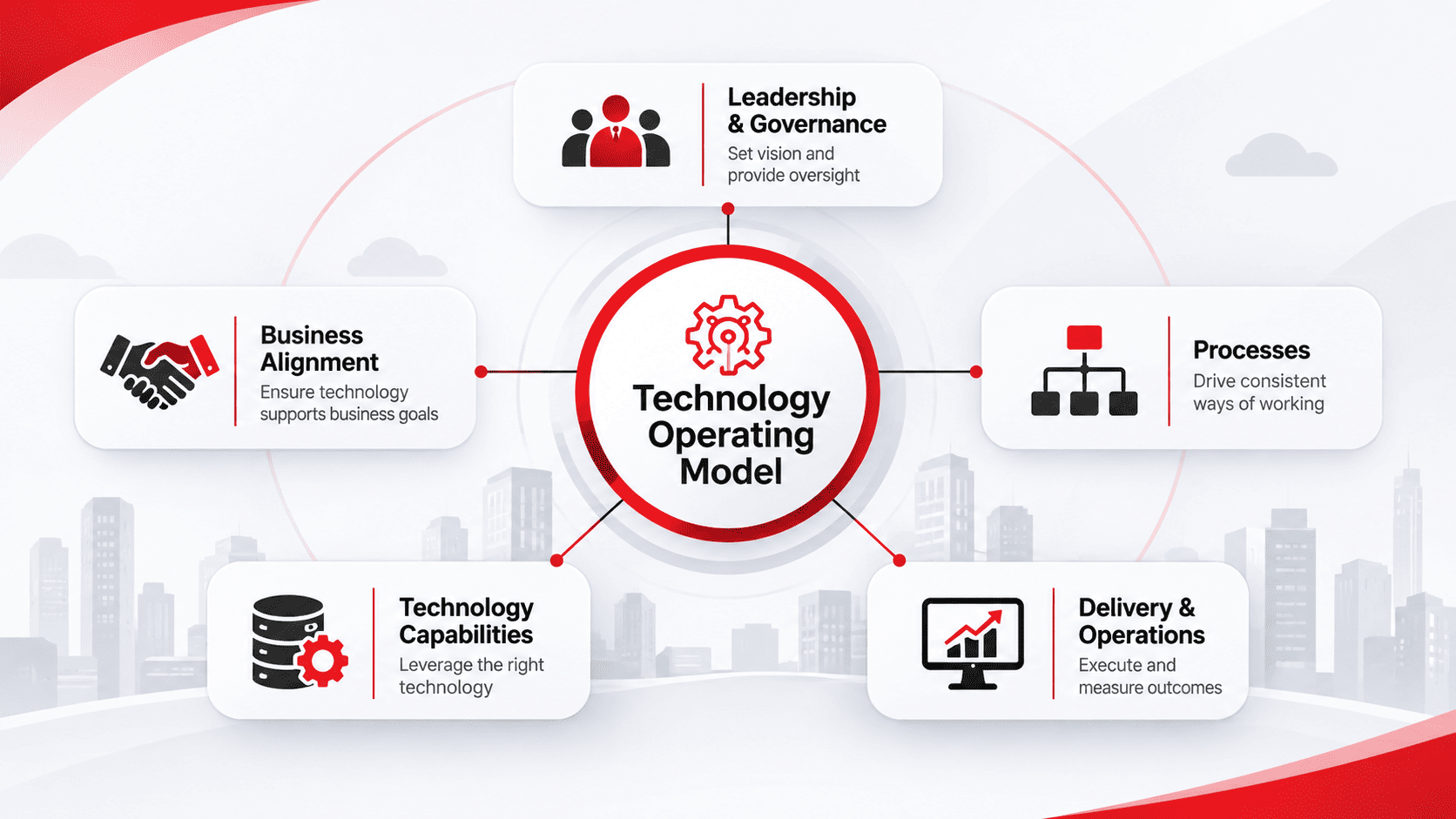












Organizations undergoing digital transformation often reach a stage where the primary challenge is no longer technology adoption or initial implementation. Core systems may already be deployed, operational processes may be more standardized, and governance mechanisms may be established across business units.
However, expanding transformation portfolios introduce a different level of organizational complexity. Initiatives increasingly share technology platforms, delivery teams, budgets, and operational dependencies. Leadership must coordinate more programs simultaneously while ensuring that existing operations continue to perform effectively.
In this environment, transformation success depends on more than having the right technology or a clear strategic direction. Organizations need the ability to translate priorities into coordinated execution, maintain delivery discipline, and adapt their operating structures as complexity increases.
This capability is known as enterprise execution maturity. It enables organizations to scale digital transformation while maintaining visibility, accountability, and predictable delivery performance across multiple initiatives.
What Is Enterprise Execution Maturity?
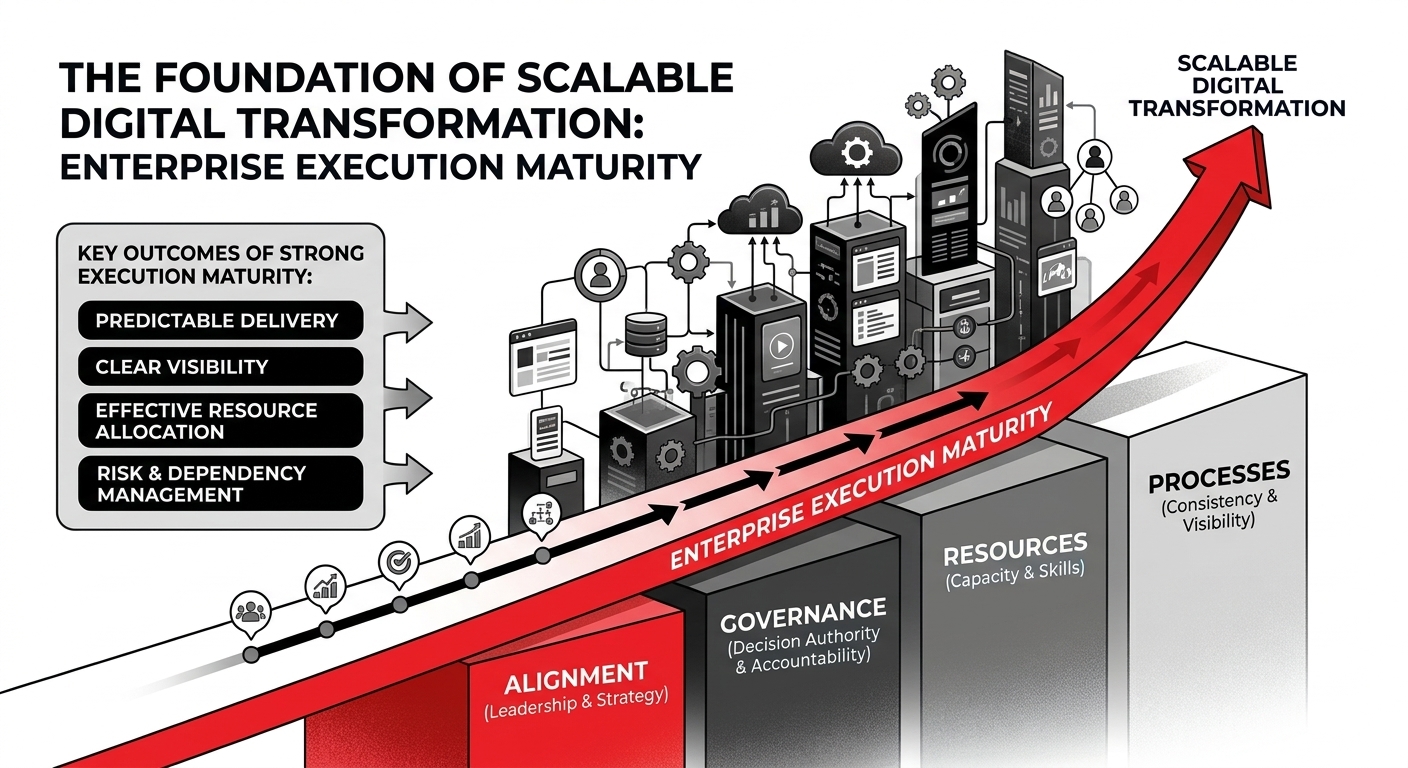
Enterprise execution maturity is an organization's ability to plan, coordinate, govern, and sustain delivery performance across complex transformation initiatives through aligned leadership, consistent processes, effective resource management, and measurable execution practices.
It goes beyond the successful completion of individual projects. A transformation program may achieve its milestones, but that does not necessarily mean the wider organization has the capabilities required to manage multiple initiatives consistently.
Mature execution environments connect strategic priorities with portfolio governance, resource capacity, operational processes, performance measurement, and decision-making. These elements operate as an integrated management system rather than separate functions working independently.
Enterprise execution maturity also does not mean eliminating all delivery challenges or applying identical procedures to every initiative. It means establishing sufficient consistency and accountability to manage complexity while retaining the flexibility to respond to changing business requirements.
Why Execution Maturity Determines Transformation Scalability
Launching a transformation initiative and sustaining execution across an expanding portfolio require different organizational capabilities.
During early implementation, a dedicated team may manage priorities closely, resolve issues directly, and maintain frequent coordination with leadership.
As transformation expands, these arrangements become more difficult to maintain. New programs introduce additional stakeholders, shared resources create competing demands, and dependencies increase across technology and business functions.
Without stronger execution structures, organizations may experience recurring problems such as:
Delivery commitments becoming less predictable across initiatives.
Decisions taking longer because authority and accountability are unclear.
Resource conflicts emerging between competing transformation programs.
Governance practices becoming inconsistent across business units.
Leadership spending more time resolving operational issues than managing strategic priorities.
These challenges can limit transformation scalability even when individual projects continue to deliver results.
Enterprise execution maturity addresses this gap by ensuring that organizational capabilities develop alongside portfolio complexity. It gives leadership a more consistent way to prioritize initiatives, coordinate delivery, manage dependencies, and assess whether execution capacity remains aligned with strategic ambitions.
Structural Characteristics of Mature Execution Organizations
Organizations with stronger execution maturity typically demonstrate several capabilities that support consistent delivery across transformation portfolios.
1. Consistent Governance and Clear Decision Authority
Mature organizations establish governance structures that define who makes decisions, who owns delivery outcomes, and how issues are escalated across initiatives.
Consistent governance reviews provide leadership with visibility into execution performance, operational risks, and cross-program dependencies. Clear decision authority also reduces delays caused by overlapping responsibilities or uncertainty about who can resolve an issue.
The objective is to ensure that decisions are made at the appropriate level, with escalation reserved for issues that require broader coordination or executive intervention.
2. Integrated Resource and Process Visibility
Execution maturity requires visibility into both how work is performed and whether the organization has sufficient capacity to deliver it.
Operational processes, resource allocation, and portfolio planning should provide a connected view of delivery commitments. This allows leadership to identify resource constraints, understand competing priorities, and evaluate whether existing teams can support additional initiatives.
The importance of this capability is explored in Enterprise IT Resource Management for Long Term Operational Efficiency, which examines how capacity planning and resource allocation help organizations align available expertise with portfolio demand.
3. Portfolio-Level Performance Transparency
Monitoring individual projects is not enough when transformation initiatives share resources, technology platforms, and business dependencies.
Mature organizations maintain consistent performance visibility across their portfolios. Leadership can review delivery predictability, milestone progress, unresolved dependencies, resource constraints, and risk exposure without relying entirely on separate project reports.
Common performance definitions also make it easier to compare initiatives and identify recurring problems that may require enterprise-level attention.
4. Leadership Alignment Around Execution Discipline
Execution maturity depends on leadership maintaining alignment between strategic priorities and operational decisions.
Senior leaders need a shared understanding of which initiatives matter most, what delivery outcomes are expected, and how trade-offs should be managed when resources or timelines become constrained.
When leadership expectations are inconsistent, teams may receive conflicting priorities and struggle to maintain accountability. A shared execution direction helps connect business objectives with the decisions and behaviors required to deliver them.
How Enterprises Can Strengthen Execution Maturity
Execution maturity develops through continuous improvement rather than a single governance redesign or transformation project. Organizations need to understand their current operating conditions, identify structural gaps, and strengthen the capabilities that have the greatest impact on delivery performance.
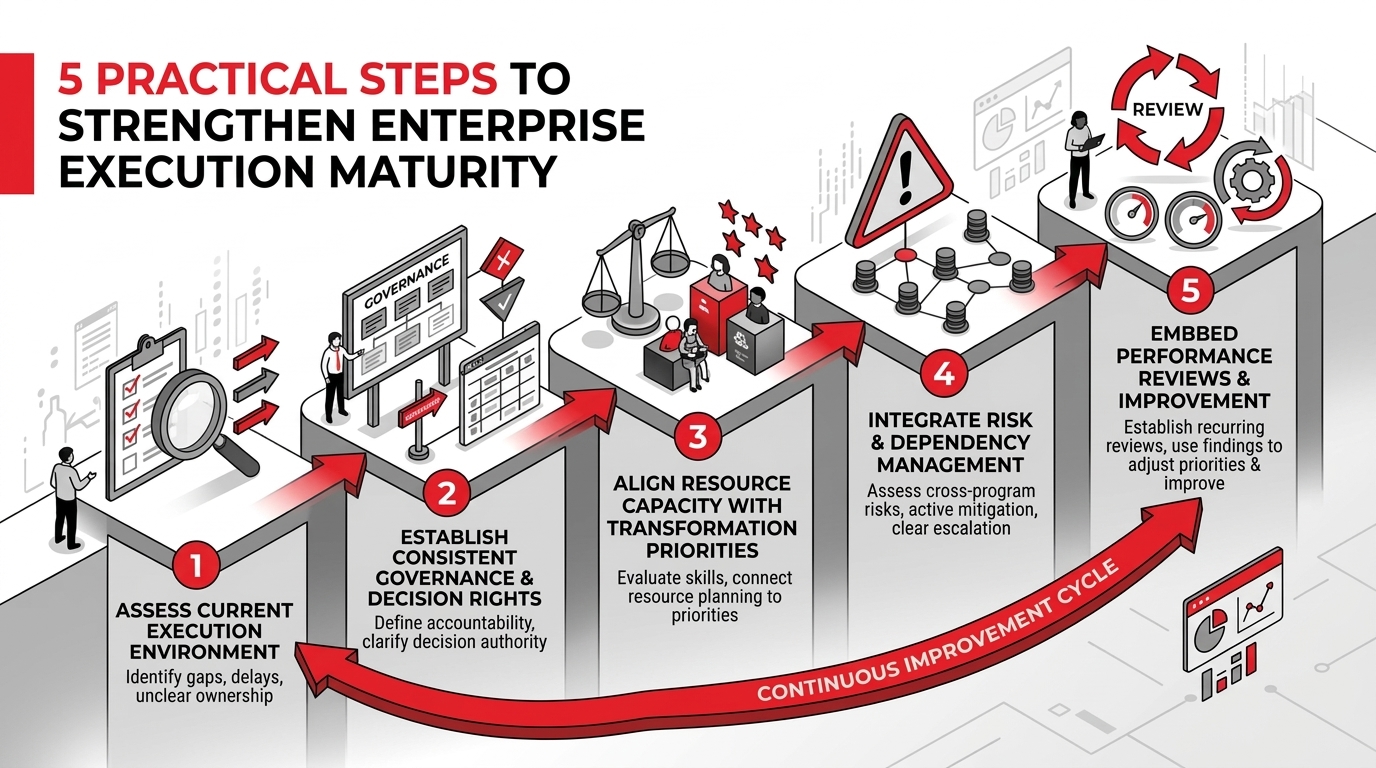
Five practices provide a practical foundation.
1. Assess the Current Execution Environment
Review how transformation initiatives are prioritized, governed, staffed, and measured. Identify recurring delays, unclear ownership, inconsistent processes, and dependencies that create friction across programs. This assessment provides a baseline for determining which capabilities require improvement.
2. Establish Consistent Governance and Decision Rights
Define accountability across portfolios, clarify decision authority, and establish escalation mechanisms for cross-functional issues. Governance requirements should be proportionate to initiative complexity and risk rather than creating unnecessary approval layers.
3. Align Resource Capacity With Transformation Priorities
Evaluate whether available skills, specialist capacity, and operational commitments support the active portfolio. Resource planning should be connected to initiative prioritization so that delivery expectations reflect realistic execution capability.
4. Integrate Risk and Dependency Management
Assess how risks in one initiative could affect other programs, shared platforms, or delivery commitments. As discussed in Enterprise Delivery Stability Through Risk Governance, portfolio-level risk visibility, accountable mitigation, and clear escalation mechanisms help organizations maintain predictable execution as transformation complexity increases.
5. Embed Performance Reviews and Continuous Improvement
Establish recurring reviews that evaluate delivery outcomes, resource alignment, governance effectiveness, and unresolved operational constraints. Use the findings to adjust priorities, improve processes, and strengthen execution practices as the portfolio evolves.
These practices should operate as a connected framework. Improving governance without addressing resource constraints, for example, may create better reporting without improving delivery outcomes. Execution maturity develops when leadership, processes, people, and performance management reinforce one another.
Assessing and Measuring Enterprise Execution Maturity
Organizations need a structured way to evaluate whether their execution capabilities are developing alongside transformation complexity. A practical assessment can examine four dimensions.
1. Governance and Accountability
Are decision rights clearly defined across transformation initiatives? Do material issues have accountable owners and established escalation paths?
2. Portfolio Coordination
Can leadership identify dependencies between initiatives, resolve competing priorities, and understand how changes in one program affect others?
3. Resource and Process Integration
Is available capacity aligned with approved priorities? Do teams follow sufficiently consistent processes while retaining flexibility for legitimate business requirements?
4. Performance Visibility
Can leadership access consistent information about delivery progress, resource constraints, operational risks, and performance trends across the portfolio?
These questions help organizations identify where execution structures are working effectively and where recurring gaps require attention. The assessment should reflect the organization's operating environment rather than rely on a universal maturity score or a fixed set of performance thresholds.
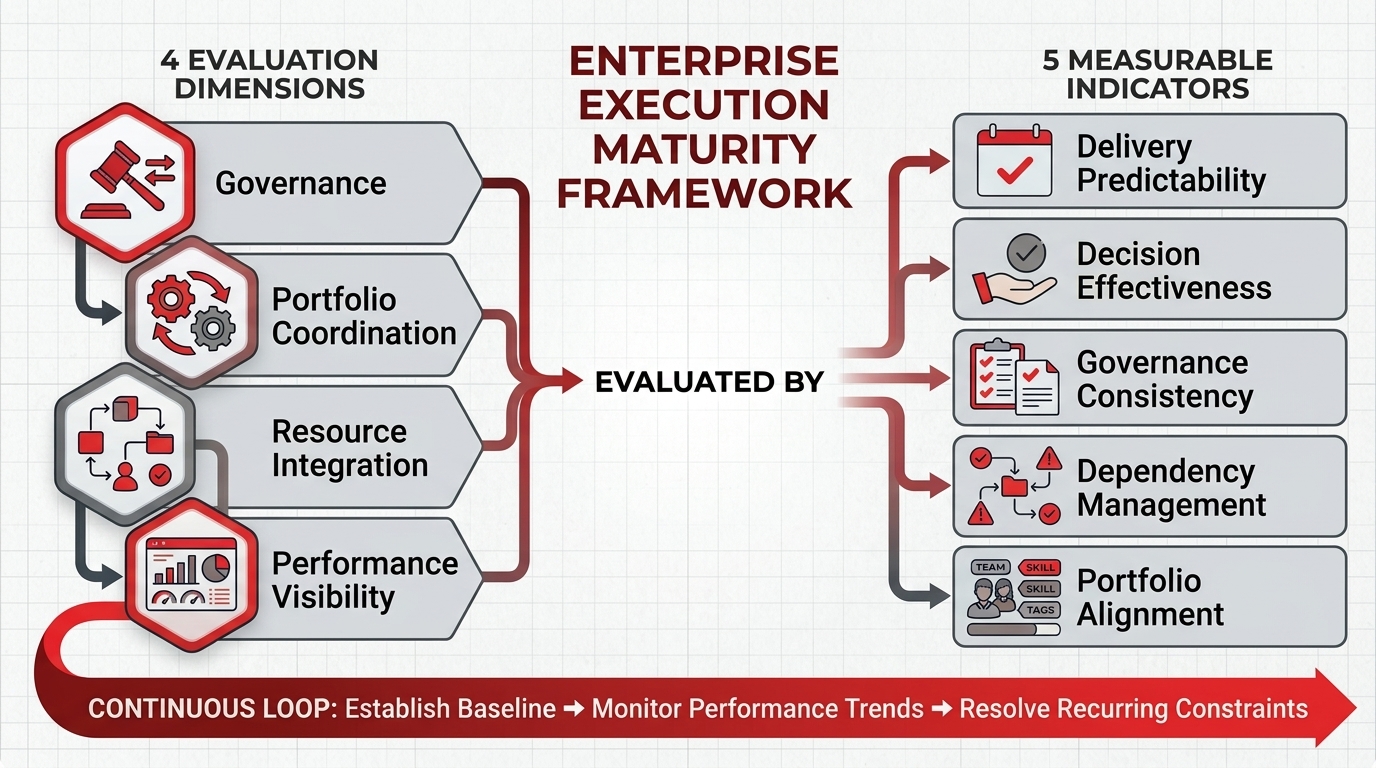
The evaluation can then be supported by measurable indicators such as:
Delivery predictability: How consistently initiatives meet agreed milestones or provide reliable forecasts when plans change.
Decision and escalation effectiveness: How quickly cross-functional issues reach the appropriate decision-makers and receive actionable resolution.
Governance consistency: Whether portfolio reviews, accountability structures, and escalation practices operate according to agreed standards.
Dependency management effectiveness: How well cross-program dependencies are identified, monitored, and resolved before they disrupt delivery.
Resource and portfolio alignment: Whether available capacity and specialist skills remain aligned with approved initiative priorities.
These indicators should be interpreted together rather than treated as isolated performance targets. Improving milestone completion rates, for example, may not indicate stronger execution maturity if teams rely on excessive overtime or repeated leadership intervention to achieve them.
Organizations should establish a baseline, monitor performance trends, and review recurring constraints across initiatives. This makes it easier to distinguish temporary project issues from structural weaknesses in the execution environment.
Building Execution Maturity as a Long-Term Enterprise Capability
Enterprise execution maturity is not a fixed state that organizations achieve once and maintain indefinitely. New technology investments, business priorities, organizational changes, and portfolio expansion continuously affect how transformation initiatives must be managed.
Organizations therefore need to treat execution maturity as an ongoing management capability. Governance structures should evolve as decision complexity increases, resource planning should reflect changing portfolio demand, and performance reviews should identify where established processes no longer support effective delivery.
The goal is not to introduce more administrative controls or standardize every activity across the organization. It is to build an execution environment where strategic priorities translate into coordinated action, accountability remains clear, and delivery performance can adapt as business requirements change.
When these capabilities develop together, enterprises are better positioned to scale digital transformation without allowing operational complexity to undermine long-term performance.
Key Takeaways
Enterprise execution maturity is an organization's ability to sustain disciplined delivery across complex transformation initiatives through aligned governance, resource management, processes, and performance measurement.
Scaling digital transformation increases coordination demands, resource dependencies, and the need for consistent portfolio-level oversight.
Mature execution environments require clear decision authority, integrated resource visibility, transparent performance measurement, and leadership alignment.
Strengthening execution maturity requires assessing operational gaps, improving governance, aligning capacity, managing risk, and continuously reviewing performance.
Execution maturity is an ongoing enterprise capability that must evolve as transformation portfolios and business priorities change.
Read More: Technology Operating Model for Enterprise Transformation
Frequently Asked Questions
What is enterprise execution maturity in digital transformation?
Enterprise execution maturity is an organization's ability to coordinate and sustain delivery performance across multiple transformation initiatives through aligned governance, effective resource management, consistent processes, and measurable execution practices.
Why is execution maturity important for scaling digital transformation?
Execution maturity helps organizations manage growing portfolio complexity, coordinate shared resources, resolve dependencies, and maintain visibility into delivery performance. It allows transformation initiatives to expand without creating unnecessary operational instability.
What are the characteristics of a mature execution organization?
Mature execution organizations typically demonstrate consistent governance, clear decision authority, integrated resource and process visibility, portfolio-level performance transparency, and leadership alignment around delivery priorities.
How can enterprises improve execution maturity?
Enterprises can improve execution maturity by assessing their current operating environment, clarifying governance and decision rights, aligning resource capacity with priorities, integrating risk management, and embedding continuous performance reviews.
How is enterprise execution maturity measured?
Execution maturity can be evaluated through delivery predictability, decision and escalation effectiveness, governance consistency, dependency management, and resource alignment. Reviewing these indicators together helps leadership identify structural improvements across the transformation portfolio.
Ready to Strengthen Enterprise Execution Maturity?
If your organization is scaling digital transformation initiatives and requires stronger execution discipline, GSCatalyst helps enterprises strengthen governance, align operational capabilities, and develop performance management structures that support scalable and sustainable transformation.