











Many enterprises have invested in new technology platforms, modernized their infrastructure, and expanded digital capabilities across business units. Yet having the right technology in place does not automatically mean the organization can manage and coordinate those capabilities effectively.
In practice, technology teams may operate under different business functions, departments may establish competing priorities, and responsibilities for architecture, delivery, and operations may overlap. Even when governance processes and execution practices are established, disconnected ways of working can make technology decisions increasingly difficult to coordinate.
These challenges often indicate a gap between the organization's transformation ambitions and the way its technology functions are structured and managed. The issue is not necessarily a lack of technical capability, but whether leadership, governance, people, processes, and delivery responsibilities operate within a coherent organizational structure.
For enterprises seeking to scale transformation effectively, a well-defined technology operating model provides the foundation for coordinating technology capabilities, maintaining accountability, and supporting consistent execution across the business.
What Is a Technology Operating Model?
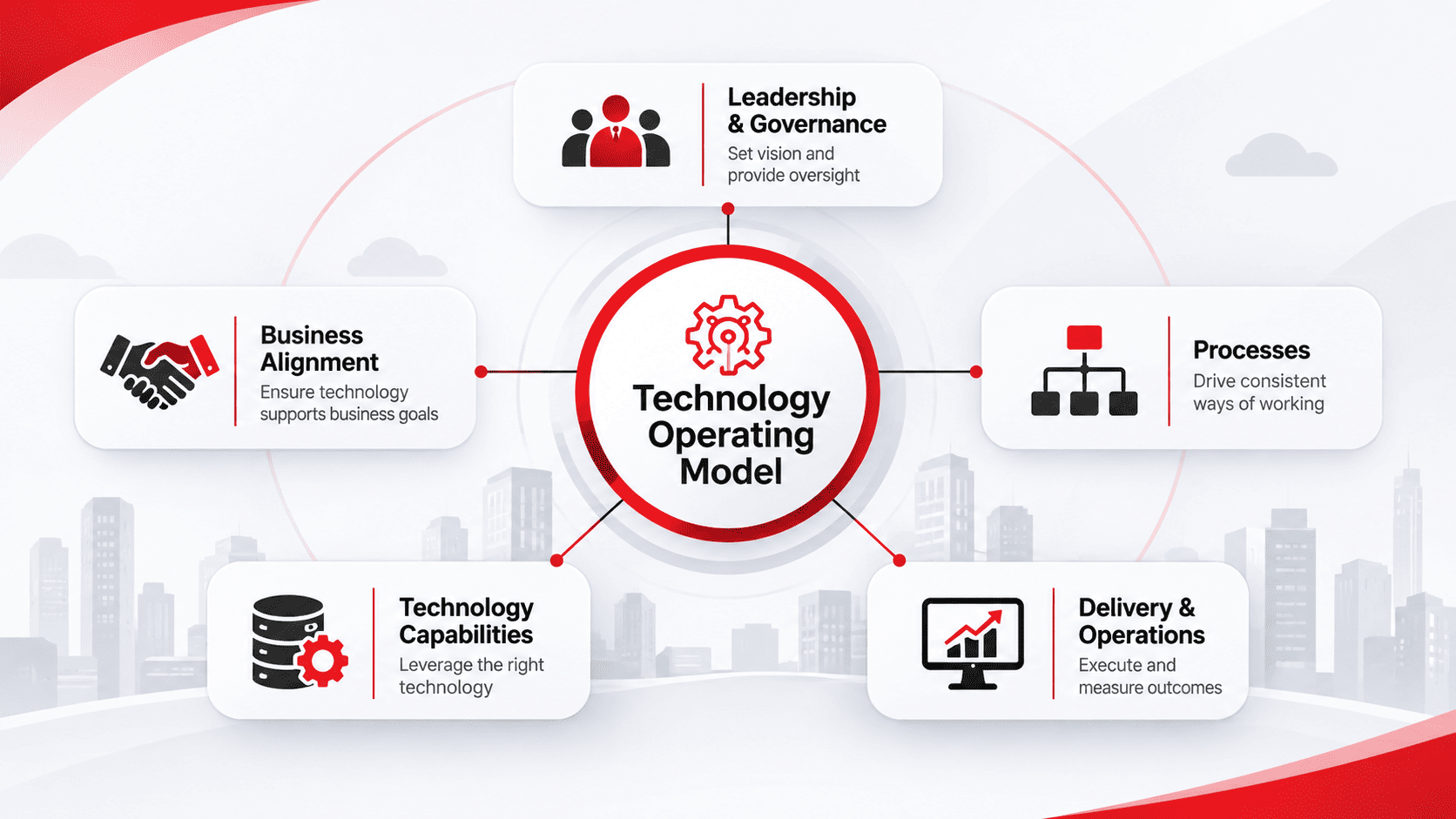
A technology operating model defines how an organization structures its technology leadership, governance mechanisms, delivery processes, capabilities, and operational responsibilities to support business and technology objectives.
It establishes how technology functions work with business units, how decisions are made, how resources are coordinated, and how technology services and transformation initiatives are delivered. The objective is to ensure that technology capabilities remain aligned with business priorities while maintaining clear accountability across the organization.
A technology operating model is more than an organizational chart or a governance framework. An organizational chart identifies reporting relationships and formal roles, while governance defines oversight and decision authority. The operating model connects these elements with the processes, people, capabilities, and delivery practices required to translate strategy into operational outcomes.
Without this broader structure, organizations may experience fragmented responsibilities, inconsistent delivery practices, duplicated activities, and limited coordination between business and technology teams.
Why a Technology Operating Model Supports Transformation Execution
Technology teams increasingly operate across multiple departments, platforms, and delivery environments. This cross-functional landscape requires an operating model that clarifies responsibilities, governance processes, and coordination mechanisms across the enterprise.
Without clear operating arrangements, business units may establish separate priorities, technology teams may receive competing requests, and leadership may struggle to determine who owns decisions that affect multiple departments. These issues can slow delivery even when individual teams have the necessary technical capabilities.
A well-structured technology operating model connects governance discipline, delivery management, and resource coordination within a unified organizational framework. This alignment helps enterprises maintain consistent execution while adapting to changing business priorities and operational demands.
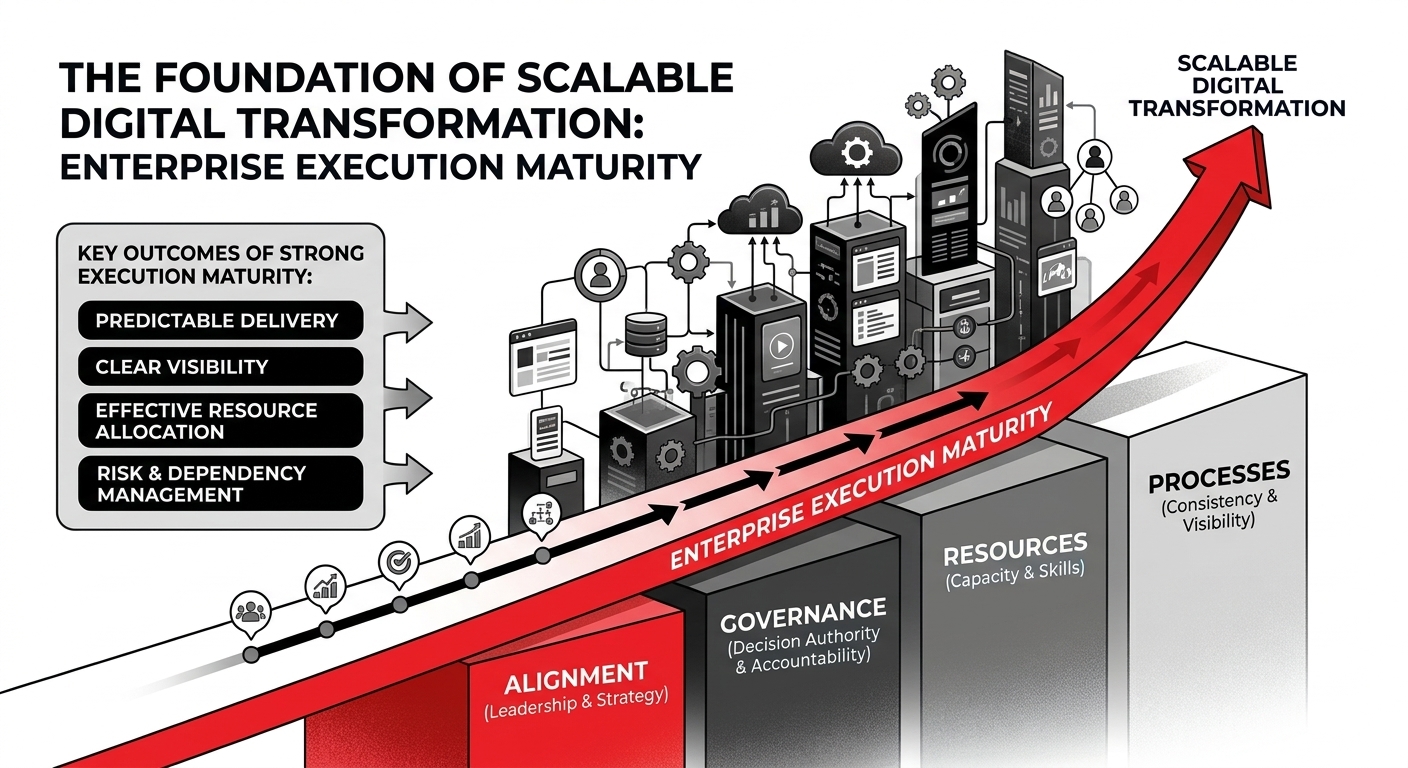
The relationship between organizational execution capability and operating model effectiveness is particularly important. As explored in Enterprise Execution Maturity for Scalable Digital Transformation, mature execution environments provide the governance discipline, resource visibility, and performance accountability needed to support transformation across increasingly complex portfolios.
An operating model translates these execution requirements into practical organizational arrangements. It defines how teams collaborate, where accountability sits, and how decisions move across the enterprise.
Structural Components of an Effective Technology Operating Model
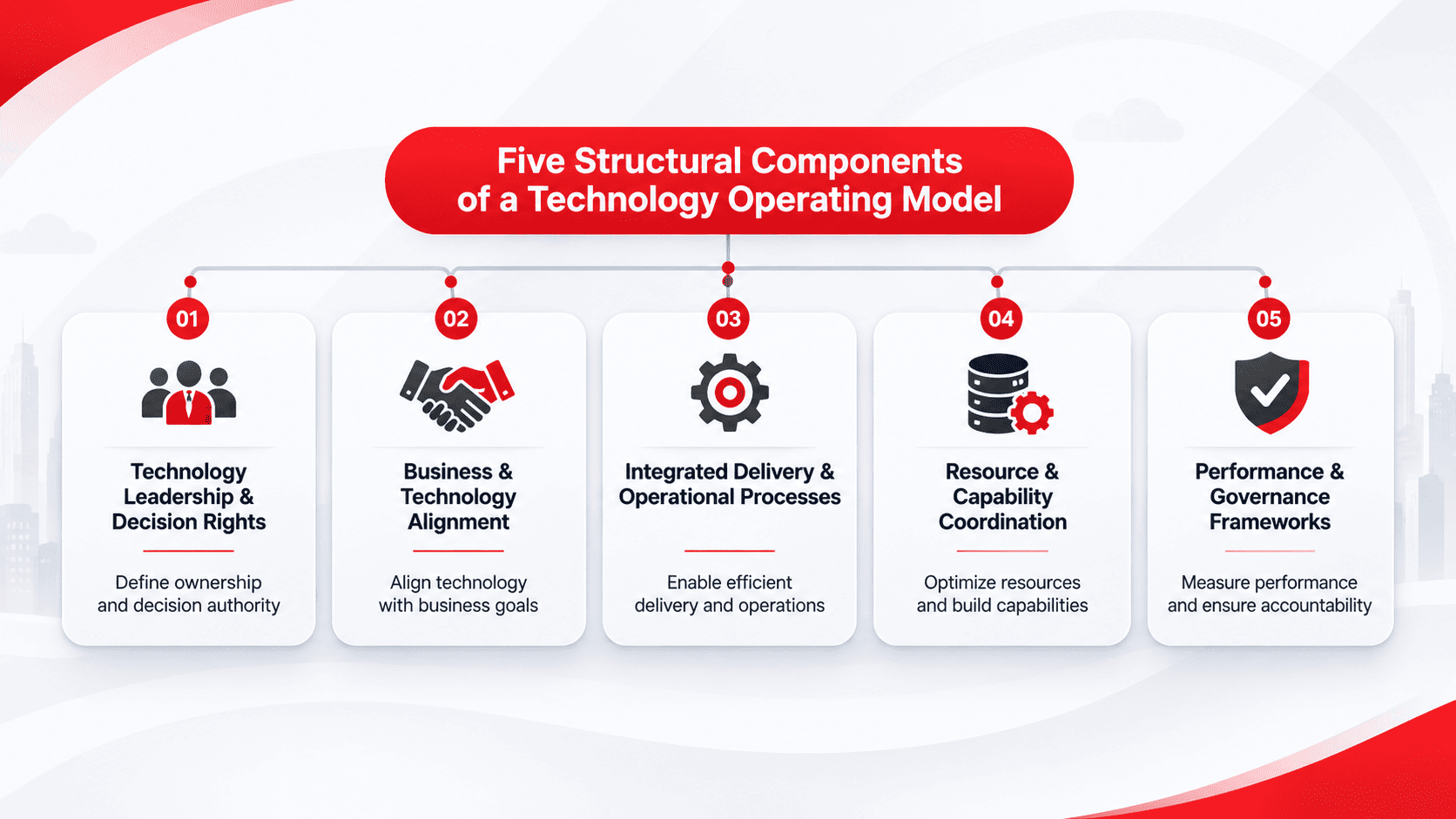
A scalable technology operating model requires several interconnected components. These structures should work together to support consistent decision-making, coordinated delivery, and operational accountability.
1. Clearly Defined Technology Leadership and Decision Rights
Technology leadership roles establish accountability for strategic direction, technology domains, operational performance, and transformation outcomes.
Enterprises need clarity around who owns technology decisions, who approves significant changes, and who is responsible for resolving conflicts between business priorities and technical requirements.
Clearly defined decision rights reduce overlapping responsibilities and help prevent decisions from becoming delayed as initiatives involve more stakeholders.
Consider an enterprise where business units independently manage technology initiatives while relying on shared IT infrastructure and support teams. Without clearly defined decision authority, technology changes may require repeated coordination between departments, delaying implementation and creating overlapping responsibilities.
A well-defined technology operating model establishes which decisions belong to individual business units, which require central technology oversight, and how shared resources are coordinated. This creates clearer accountability while allowing teams to manage routine activities without unnecessary escalation.
2. Business and Technology Alignment
Technology operating models need structured relationships between business units and technology functions. Business priorities should inform technology planning, while technology teams provide visibility into capabilities, constraints, dependencies, and implementation requirements.
This relationship requires shared planning, clear communication, and ongoing collaboration rather than treating technology as a separate operational function.
As discussed in How Enterprises Build Strong Business IT Alignment, aligning business objectives with technology capabilities helps organizations coordinate priorities and connect technology decisions with measurable business outcomes.
3. Integrated Delivery and Operational Processes
An effective operating model establishes how technology work moves from planning and prioritization into development, implementation, service delivery, and continuous improvement.
These processes should clarify responsibilities across technology teams and business stakeholders while defining appropriate handoffs, governance checkpoints, and escalation mechanisms.
Consistency is important, but processes should remain flexible enough to accommodate different technology domains, delivery methods, and operational requirements.
4. Resource and Capability Coordination
Technology operating models must account for the people, skills, and capabilities required to deliver transformation initiatives and maintain existing services.
This includes identifying critical technology competencies, coordinating capacity across teams, and managing competing demands between project delivery and operational responsibilities.
Without this coordination, organizations may have a well-defined organizational structure but still experience delivery bottlenecks because the required expertise is unavailable or concentrated within a small number of specialists.
5. Shared Performance and Governance Frameworks
Organizations need consistent performance indicators and governance mechanisms to evaluate whether their operating model is functioning effectively.
Leadership should have visibility into delivery performance, operational efficiency, resource constraints, service outcomes, and unresolved dependencies across relevant technology functions.
Shared measurement frameworks make it easier to identify recurring issues and determine whether organizational arrangements continue to support transformation priorities.
How Enterprises Can Design a Scalable Technology Operating Model
Designing a technology operating model requires more than reorganizing technology teams or introducing additional governance procedures. Organizations need to understand how their current operating environment works and determine which structural changes will improve coordination and delivery performance.
A technology operating model should be designed around how decisions, capabilities, and responsibilities connect, not simply around how technology teams are organized.
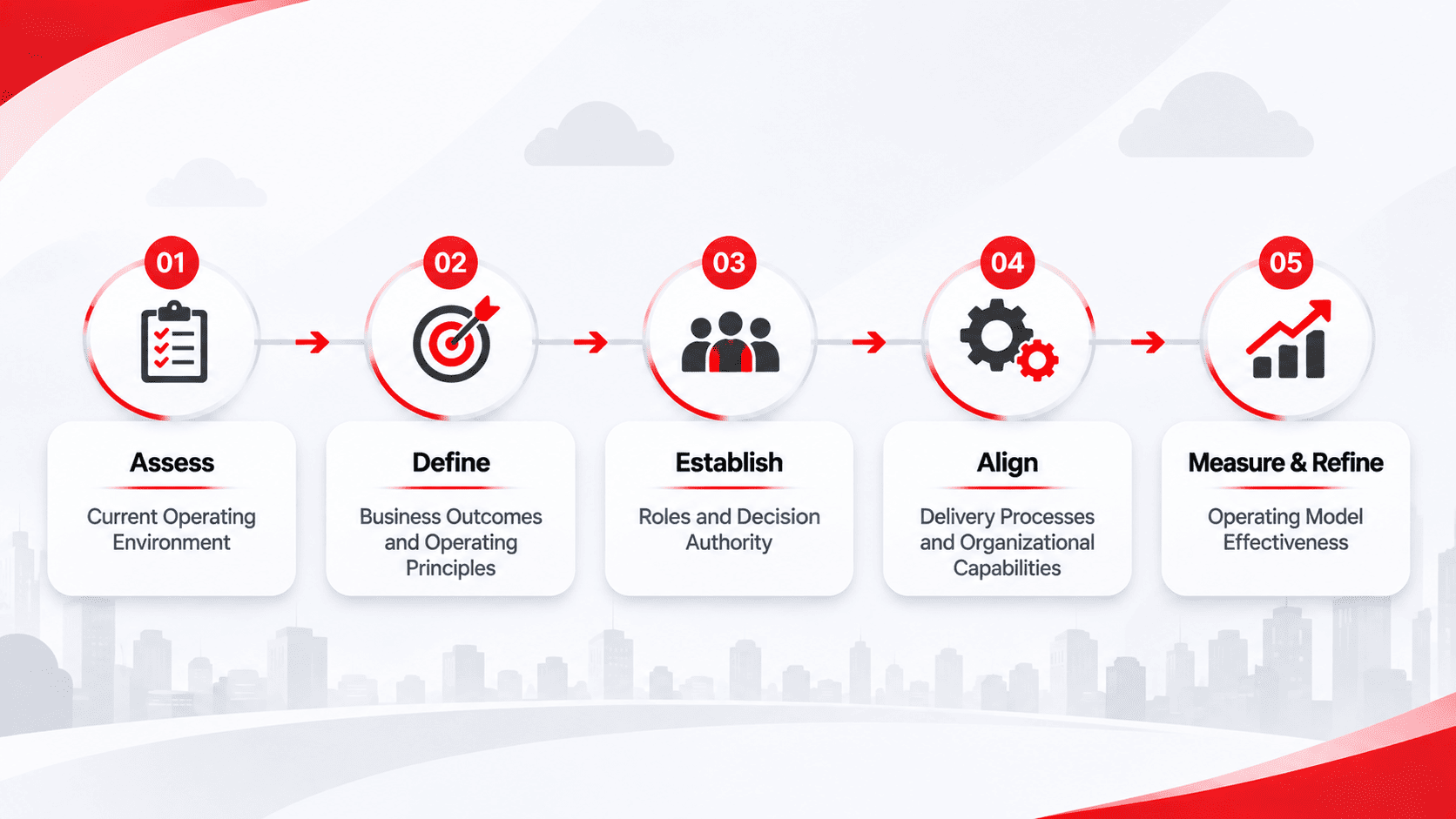
Five considerations provide a practical starting point.
1. Assess the Current Operating Environment.
Review existing technology structures, leadership responsibilities, decision-making processes, delivery practices, and relationships between business units and technology teams. Identify duplicated responsibilities, unclear ownership, and recurring coordination problems.
2. Define Business Outcomes and Operating Principles.
Determine what the operating model needs to support, such as faster decision-making, stronger accountability, improved service delivery, or more consistent transformation execution. These objectives should guide how organizational structures and processes are designed.
3. Establish Clear Roles and Decision Authority.
Define responsibilities across technology leadership, delivery teams, operational functions, and business stakeholders. Clarify which decisions can be made independently and which require cross-functional coordination or executive approval.
4. Align Delivery Processes and Organizational Capabilities.
Establish consistent approaches to planning, prioritization, delivery management, resource coordination, and operational support. Ensure that the structure provides sufficient flexibility for different technology functions while maintaining enterprise-wide accountability.
5. Measure Effectiveness and Refine the Model.
Monitor whether the operating model improves coordination, decision-making, resource alignment, and delivery outcomes. Use performance trends and feedback from business and technology teams to identify where further adjustments are needed.
These considerations should be addressed as part of one integrated design process. Changing reporting structures without reviewing decision rights, for example, may simply move existing coordination problems into a different organizational arrangement.
The most effective operating models establish a balance between standardization and flexibility. Enterprise-wide principles provide consistency, while technology functions retain the autonomy required to respond to their specific operational and technical requirements.
Measuring Technology Operating Model Effectiveness
A technology operating model should be evaluated through indicators that reveal whether organizational structures and working arrangements support effective delivery.
Leadership teams can monitor several areas:
Decision-making efficiency: How quickly technology and business decisions are made at the appropriate organizational level.
Cross-functional coordination: How effectively business units and technology teams collaborate on shared initiatives and operational priorities.
Governance effectiveness: Whether oversight mechanisms provide clear accountability and enable timely resolution of important issues.
Resource and capability alignment: Whether available skills and capacity support approved priorities and ongoing operational responsibilities.
Delivery accountability: Whether ownership of outcomes, dependencies, and operational responsibilities remains clear across teams.
These indicators should be interpreted together rather than treated as isolated targets. Faster decision-making, for example, does not necessarily indicate a more effective operating model if decisions bypass necessary risk controls or create additional operational rework.
Organizations should establish a baseline, review performance trends, and collect feedback from business stakeholders and technology teams. This helps leadership determine whether the operating model is improving organizational coordination and supporting transformation objectives.
Keeping the Technology Operating Model Aligned as the Enterprise Evolves
A technology operating model should not be treated as a static organizational design. New business priorities, technology investments, operating requirements, and organizational changes can all affect how technology functions need to work together.
As the enterprise evolves, leadership should periodically review whether responsibilities remain clear, decision authority is appropriate, and delivery processes continue to support the organization's transformation agenda.
The objective is not to introduce more organizational layers or enforce identical working practices across every technology function. It is to maintain a coherent structure that connects business priorities with technology capabilities while allowing teams to adapt as requirements change.
When leadership, governance, delivery processes, and capabilities operate within an aligned structure, organizations are better positioned to coordinate complex initiatives, maintain operational accountability, and support sustainable enterprise transformation.
Key Takeaways
A technology operating model defines how technology leadership, governance, people, processes, and capabilities work together to support enterprise objectives.
Effective operating models connect business priorities with technology decisions and delivery responsibilities.
Clear leadership roles, decision authority, resource coordination, and performance visibility support consistent execution across business units.
Designing a scalable operating model requires assessing existing structures, defining operating principles, clarifying accountability, and continuously measuring effectiveness.
Technology operating models must evolve alongside organizational priorities, technology capabilities, and transformation complexity.
Read More: Scaling Digital Delivery Capability for Enterprise Transformation
Frequently Asked Questions
What is a technology operating model?
A technology operating model defines how an organization structures its technology leadership, governance, delivery processes, capabilities, and operational responsibilities to support business and technology objectives.
Why is a technology operating model important for digital transformation?
A technology operating model helps organizations coordinate technology teams, business units, governance structures, and delivery responsibilities as transformation initiatives expand. It provides the organizational structure needed to maintain accountability and consistent execution.
What are the key components of a technology operating model?
The key components typically include technology leadership and decision rights, business and technology alignment, integrated delivery processes, resource and capability coordination, and shared performance and governance frameworks.
How can enterprises design a scalable technology operating model?
Enterprises can design a scalable technology operating model by assessing existing structures, defining business outcomes, clarifying decision authority, aligning delivery processes and capabilities, and measuring operating model effectiveness over time.
What is the difference between a technology operating model and an organizational structure?
An organizational structure defines formal roles, reporting relationships, and management hierarchy. A technology operating model has a broader scope, covering how people, processes, governance, capabilities, decision-making, and delivery responsibilities work together to support business and technology objectives. Organizational structure is therefore one component of a technology operating model, rather than the model itself.
Ready to Strengthen Your Technology Operating Model?
If your organization is scaling digital transformation initiatives and requires stronger coordination across technology teams and business units, GSCatalyst helps enterprises design technology operating models that align governance structures, delivery frameworks, and strategic priorities.