











The introduction of new technologies, expansion of delivery portfolios, and growing collaboration across business units can create significant opportunities for organizational growth. However, these developments also make operational risk management more complex, particularly when multiple programs and systems become increasingly interconnected.
A disruption affecting one initiative can quickly influence others when they share technology platforms, critical specialists, infrastructure, vendors, or delivery milestones. Governance arrangements that worked for a smaller portfolio may no longer provide sufficient visibility into these dependencies as the number of programs and decision points increases.
The consequences often appear as unpredictable delivery timelines, recurring escalations, unresolved dependencies, and conflicting priorities across teams. Maintaining enterprise delivery stability therefore requires more than monitoring individual project status. Organizations need a structured approach to risk governance that connects risk identification, accountability, mitigation, and decision-making across the transformation portfolio.

What Is Enterprise Delivery Stability?
Enterprise delivery stability is an organization's ability to maintain predictable delivery performance across digital initiatives while identifying and managing risks that could disrupt execution.
It does not mean that every initiative must follow an unchanged plan or that all risks can be eliminated. Business priorities, technical issues, resource constraints, and external dependencies will continue to change. Stability depends on how effectively an organization anticipates these changes, responds to disruptions, and protects its critical delivery commitments.
Risk governance provides the structures that support this capability. It defines how risks are identified, assessed, assigned to accountable owners, escalated when necessary, and monitored until appropriate action has been taken.
It also connects project-level risks with portfolio-wide priorities. A dependency that appears manageable within one initiative may become a significant enterprise concern when several programs rely on the same platform, team, or delivery milestone.
Why Governance Discipline Protects Execution Stability
As digital portfolios expand, risk information can become fragmented across projects. Leadership may receive regular status reports without having a consistent view of which risks threaten multiple initiatives, which mitigation actions are overdue, or where intervention is required.
Effective governance establishes a consistent approach to reviewing delivery health, assessing risk exposure, assigning mitigation responsibilities, and escalating issues that exceed the authority of individual teams. The objective is to ensure that material risks lead to appropriate decisions rather than remaining unresolved in project reports.
Governance also depends on clearly defined workflows and accountability. As explored in Enterprise Process Optimization for Sustainable Delivery Performance, consistent processes help organizations coordinate responsibilities and reduce delivery friction as operational complexity increases. Risk governance builds on this foundation by making emerging threats visible and ensuring that mitigation actions have clear owners.
The level of oversight should reflect the severity and potential impact of each risk. Routine issues should remain manageable within delivery teams, while significant risks involving shared dependencies, business-critical commitments, or substantial financial exposure require appropriate portfolio or executive attention.
Structural Risks That Undermine Delivery Stability
Even well-planned transformation programs can experience instability when risks are managed only within individual initiatives or when responsibility for mitigation is unclear. Four structural risks deserve particular attention.
1. Growing Interdependencies Between Initiatives
Digital initiatives increasingly depend on shared platforms, technical teams, infrastructure, vendors, and data environments. A delay or failure in one component can therefore affect multiple programs, even when the affected teams are meeting their own project-level responsibilities.
Organizations need visibility into critical dependencies and their potential impact across the portfolio. Without it, leadership may not recognize how a local issue could disrupt other delivery commitments until timelines have already been affected.
2. Inconsistent Governance Cadence
When programs use different risk review schedules, reporting definitions, or escalation thresholds, leadership receives an inconsistent view of portfolio health. A significant risk may be visible within one project but remain absent from enterprise-level discussions until its consequences become difficult to contain.
A consistent governance cadence allows organizations to review material risks and compare exposure across initiatives. Review frequency should reflect the complexity and risk of the portfolio rather than forcing every initiative into an identical reporting process.
3. Escalation Without Clear Ownership
Formal escalation procedures are not sufficient when no individual or function is accountable for resolving an issue. Risks can remain open across multiple review cycles while teams wait for decisions, additional resources, or direction from other departments.
Effective risk governance assigns an accountable owner to each material risk, defines the mitigation actions required, and clarifies who has the authority to make decisions when progress stalls. Escalation should lead to an agreed action, a decision, or an explicit acceptance of the remaining risk.
4. Risk Visibility Limited to Individual Projects
Project-level risk registers help delivery teams manage immediate concerns, but they may not reveal systemic exposure across the portfolio. Several initiatives may depend on the same specialist, rely on the same external provider, or face similar technical constraints without those shared risks being recognized centrally.
Portfolio-level oversight helps leadership identify these patterns and assess their combined impact. This is especially important when delivery depends on limited specialist capacity. The practices discussed in Enterprise IT Resource Management for Long-Term Operational Efficiency complement risk governance by helping organizations identify capacity constraints and manage dependencies that could disrupt delivery.
Building a Risk Governance Model That Sustains Stability
A sustainable governance model connects risk identification with clear decisions and measurable mitigation. Rather than treating risk management as a separate reporting activity, organizations should integrate it into portfolio planning, delivery reviews, and leadership decision-making.
Five practices provide a practical foundation.
1. Establish consistent risk assessment criteria. Define how risks are evaluated according to likelihood, business impact, delivery consequences, and urgency. Shared criteria help leadership compare exposure across initiatives and identify which risks require intervention.
2. Maintain portfolio-level risk and dependency visibility. Consolidate material risks, critical dependencies, mitigation owners, and expected resolution dates into a view that supports cross-program decisions. Delivery teams should retain the detail needed to manage individual projects, while leadership receives the information necessary to understand broader exposure.
3. Assign ownership and define escalation paths. Each material risk should have a clearly accountable owner, documented mitigation actions, and an agreed escalation route. Decision rights should clarify which issues delivery teams can resolve independently and which require portfolio leadership or executive intervention.
4. Align governance reviews with risk exposure. Establish recurring review cycles that reflect the scale, complexity, and criticality of initiatives. Significant changes in exposure should trigger additional assessment when necessary rather than waiting for the next scheduled meeting.
5. Integrate mitigation into delivery planning. Risk responses should translate into specific actions, resource requirements, dependencies, and milestones. Mitigation plans must account for actual capacity and delivery constraints; otherwise, risks may remain documented without being effectively addressed.
Consider an enterprise where several digital initiatives depend on the same core platform. One program encounters a technical delay that could affect integration testing and the launch dates of two other initiatives. If the issue remains within the original project's risk register, other teams may continue planning against timelines that are no longer realistic.
A portfolio-level governance process would make the dependency visible, assign an owner to coordinate the response, assess the impact on affected commitments, and involve the necessary decision-makers. Leadership could then adjust sequencing, allocate additional capacity where justified, or revise delivery dates before the disruption spreads further.
The objective is not to prevent every delay. It is to make shared risks visible early enough for the organization to respond deliberately rather than allowing separate project decisions to create avoidable instability.
Measuring Enterprise Delivery Stability
Risk governance should be evaluated through indicators that reveal whether delivery risks are becoming more visible, mitigation is progressing, and execution is becoming more predictable. The number of risk reviews conducted or the size of a risk register does not demonstrate that delivery stability has improved.
Relevant indicators include:
Delivery timeline predictability: The extent to which initiatives meet agreed milestones or provide timely, evidence-based forecasts when plans change.
Risk mitigation progress: Whether agreed actions are completed by their target dates and whether material risk exposure is reduced.
Escalation resolution time: How long material delivery issues take to reach a decision or an agreed resolution.
Dependency-related disruptions: How frequently unresolved cross-program dependencies affect delivery commitments.
Budget and schedule variance: How actual delivery performance compares with approved plans and updated forecasts.
Portfolio risk exposure: Whether significant risks are concentrated around shared platforms, critical resources, vendors, or other common dependencies.
These indicators should be interpreted together. A reduction in reported risks may indicate successful mitigation, but it could also reflect weaker reporting. Similarly, faster escalation resolution is not necessarily positive if decisions are rushed or important controls are bypassed.
Organizations should establish a baseline, review trends over time, and investigate recurring patterns across initiatives. This provides a more reliable view of whether mitigation is effective and whether the portfolio can maintain realistic delivery commitments as conditions change.
Sustaining Delivery Stability as Transformation Expands
Enterprise delivery stability is not achieved through a one-time governance redesign. As organizations introduce new initiatives, change operating models, and expand technology capabilities, their risk exposure and delivery dependencies also evolve.
Sustainable governance requires continuous review of risk ownership, escalation mechanisms, dependency visibility, and mitigation effectiveness. Leadership must also make explicit trade-offs when strategic priorities exceed available delivery capacity or when risk exposure becomes unacceptable.
When risk governance is integrated into portfolio management, organizations can recognize emerging threats earlier, coordinate responses across programs, and adjust plans before disruptions undermine broader transformation commitments. Delivery stability then becomes an ongoing enterprise capability rather than a temporary outcome of individual project success.
Key Takeaways
Enterprise delivery stability is the ability to maintain predictable execution while managing risks and dependencies across digital initiatives.
Fragmented risk visibility, inconsistent governance reviews, unclear ownership, and cross-program dependencies can undermine delivery performance.
Effective risk governance connects risk assessment with accountable mitigation, clear escalation paths, and portfolio-level decision-making.
Delivery predictability, mitigation progress, escalation resolution, and dependency-related disruptions help assess governance effectiveness.
Sustainable delivery stability requires governance practices to evolve alongside portfolio complexity, resource constraints, and changing business priorities.
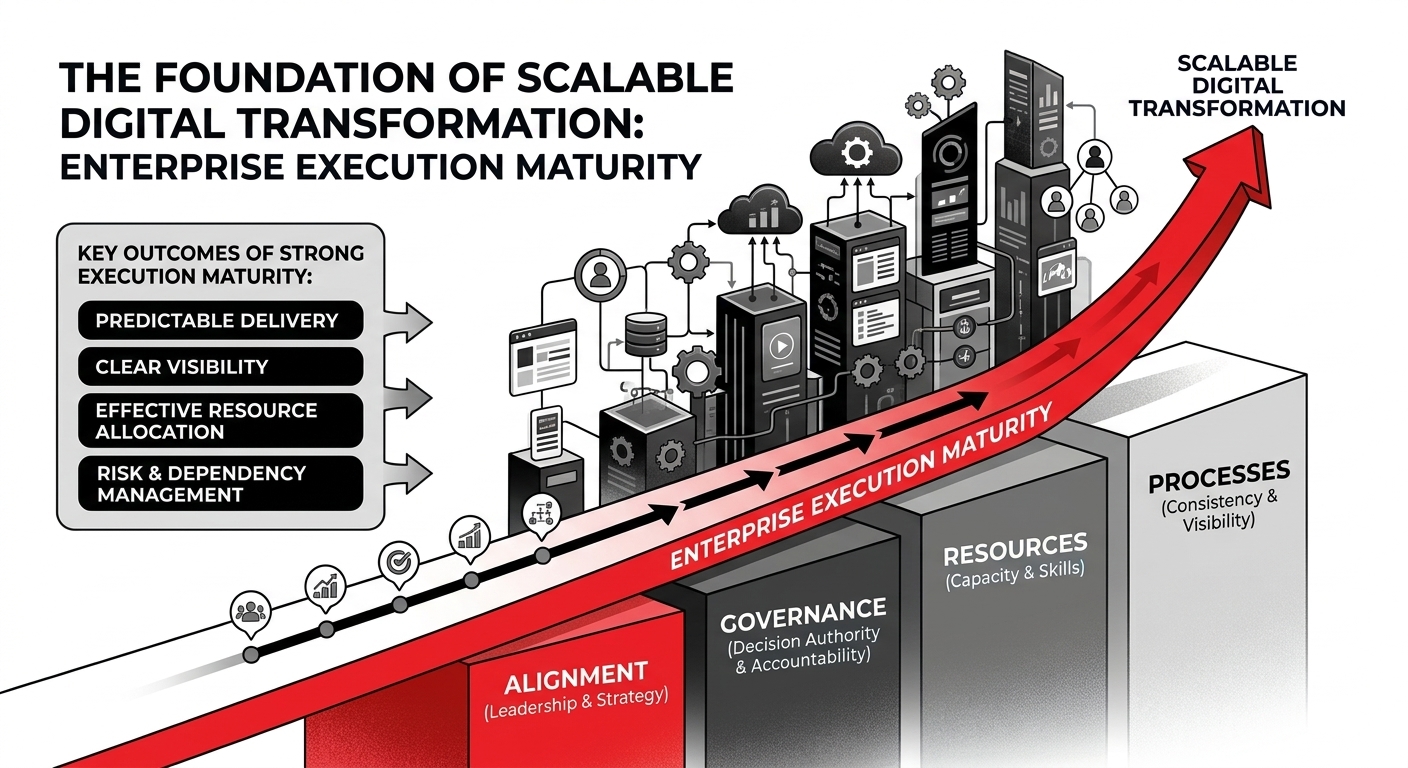
Read More: Enterprise Execution Maturity for Scalable Digital Transformation
Frequently Asked Questions
What is enterprise delivery stability in digital transformation?
Enterprise delivery stability is an organization's ability to maintain predictable delivery performance across digital initiatives while identifying and managing risks that could disrupt execution. It relies on clear accountability, effective mitigation, dependency management, and appropriate governance oversight.
Why is risk governance important for maintaining delivery stability?
Risk governance helps leadership identify emerging threats, coordinate dependencies between initiatives, assign accountability for mitigation, and make informed decisions when delivery conditions change. It makes material risks more visible and actionable before they disrupt broader commitments.
What risks commonly undermine enterprise delivery stability?
Common risks include growing interdependencies between initiatives, inconsistent governance reviews, unclear mitigation ownership, limited portfolio-level risk visibility, and constraints involving shared technology platforms or specialized resources.
How can enterprises measure delivery stability?
Enterprises can monitor delivery timeline predictability, risk mitigation progress, escalation resolution time, dependency-related disruptions, budget and schedule variance, and risk exposure across the portfolio. Reviewing these indicators together provides a more complete view of governance effectiveness.
How can organizations improve risk governance across digital portfolios?
Organizations can improve risk governance by establishing shared assessment criteria, maintaining portfolio-level risk visibility, assigning accountable owners, defining escalation paths, aligning reviews with risk exposure, and integrating mitigation actions into delivery planning.
Ready to Strengthen Enterprise Delivery Stability?
If your organization is experiencing execution volatility or increasing operational risk across transformation initiatives, GSCatalyst helps enterprises strengthen governance, improve risk visibility, and coordinate delivery oversight to support more stable and sustainable transformation outcomes.