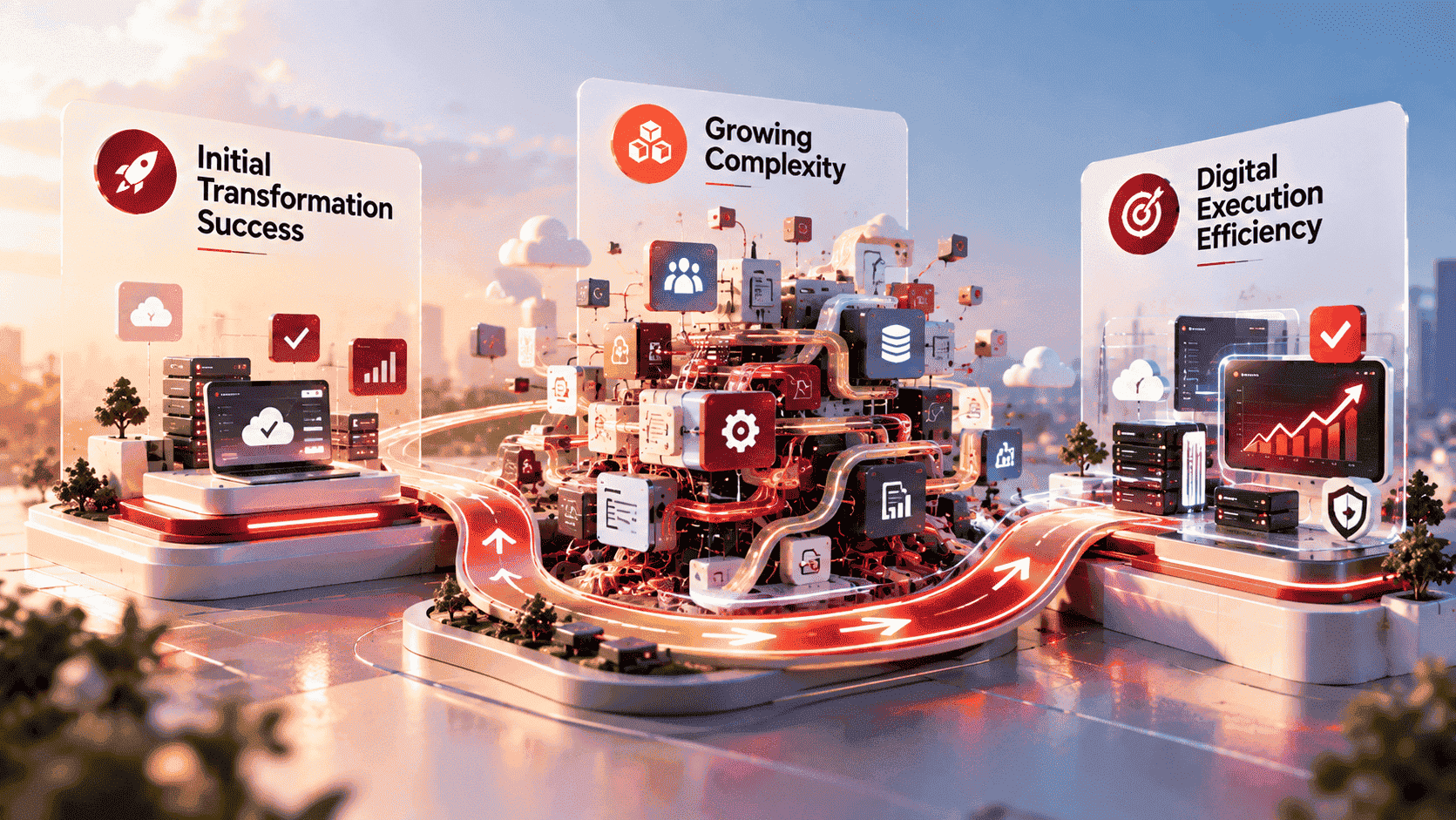












A strong technology strategy does not automatically translate into business results. Once strategic priorities move into implementation, organizations have to coordinate business functions, technology teams, vendors, budgets, operational dependencies, and changing requirements. This is where the difference between having a strategy and delivering on it becomes visible.
Digital transformation can therefore lose momentum even when the business case is sound and executive sponsorship is in place. Delayed decisions, fragmented ownership, competing priorities, and limited visibility can gradually weaken the connection between technology investment and business performance.
IT execution success refers to an organization’s ability to consistently translate technology strategy into coordinated delivery, measurable business outcomes, organizational adoption, and continuous improvement. It connects strategic intent with the governance, people, processes, technology, and decisions required to deliver results across the enterprise.
High performing organizations treat this capability as an organizational discipline rather than a temporary project activity. They create repeatable ways of working that help teams coordinate effectively, resolve issues, measure progress, manage change, and strengthen their ability to deliver over time.
Why Digital Transformation Programs Struggle to Deliver Results
Transformation programs can appear successful on paper while producing less value than expected in practice. A program may meet implementation milestones, consume its approved budget, and deploy the planned technology, yet still struggle to achieve the operational or business outcomes that justified the investment.
Several challenges commonly contribute to this gap:
Weak ownership and accountability
Poor cross functional coordination
Inconsistent governance
Limited performance visibility
Low user adoption
Competing priorities and resources
These challenges are interconnected. Unclear ownership can slow decisions, fragmented coordination can leave dependencies unresolved, and limited performance visibility can prevent leaders from identifying problems early enough to intervene.
As discussed in Why IT Strategy Execution Fails in Most Enterprises, the gap between strategy and results often emerges when strategic priorities are not translated into clear accountability, coordinated delivery, effective governance, and measurable outcomes.
The issue is therefore not always the quality of the strategy itself. In many cases, the organization needs a stronger operating capability for turning strategic priorities into sustained business results.
What Is IT Execution Success?
IT execution success refers to the ability of an organization to consistently translate technology strategy into effective delivery and measurable business outcomes.
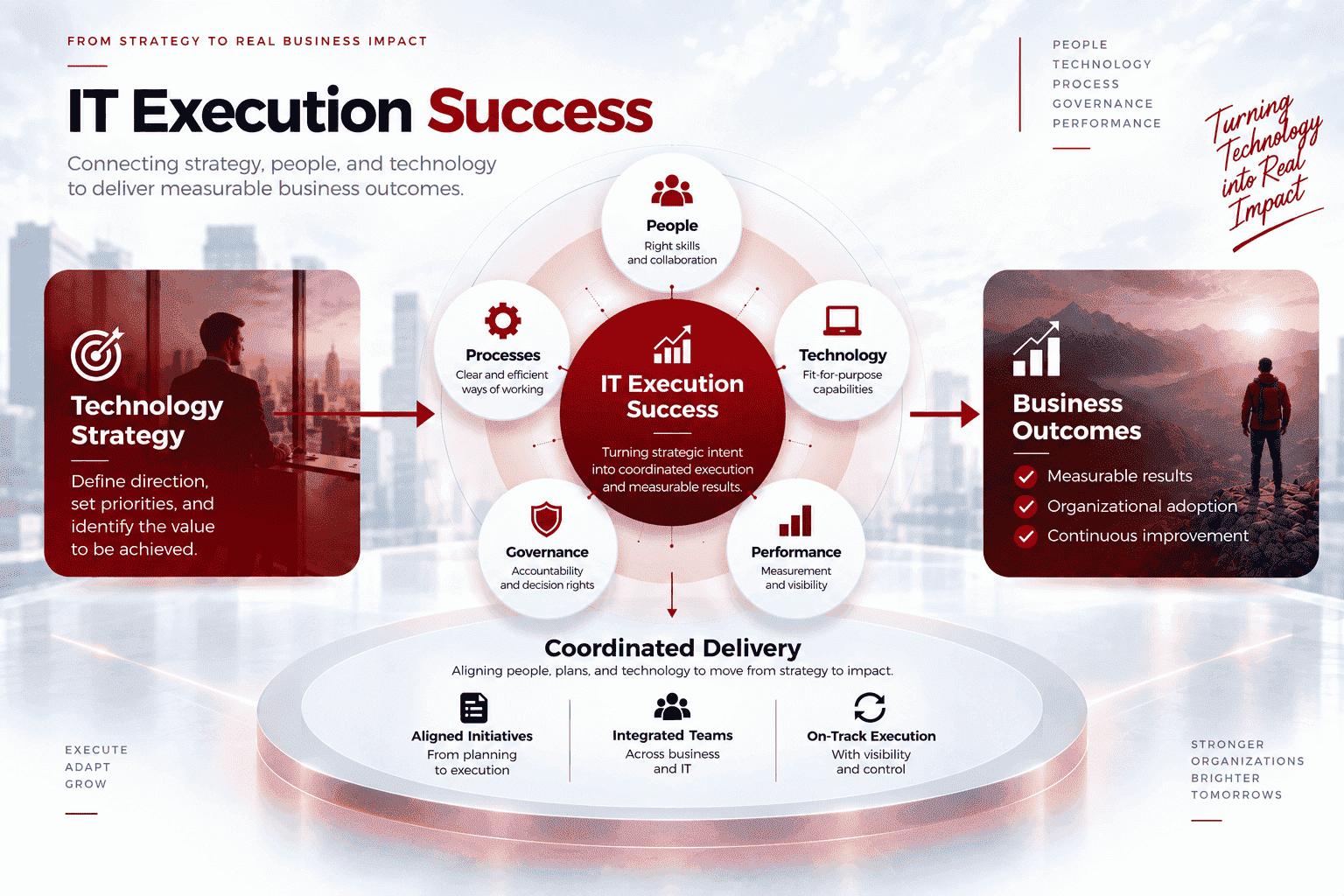
It includes more than completing technology projects. A successful approach connects:
Strategic priorities with technology initiatives
Leadership decisions with clear accountability
Delivery activities with measurable performance
Technology implementation with organizational adoption
Project outcomes with continuous improvement
This distinction matters because technology delivery can be technically successful without creating the expected business value. A new platform may launch on schedule, for example, but its impact may remain limited if adoption is low, processes are not redesigned, or expected efficiency improvements are not measured.
IT execution success therefore sits at the intersection of strategy, governance, delivery, people, and performance.
Technology strategy defines what the organization intends to achieve. Governance establishes who makes decisions and how priorities are managed. Delivery turns those priorities into implemented capabilities, while change management supports adoption. Performance measurement then determines whether those capabilities are producing the expected business outcomes.
What High Performing Organizations Do Differently
High performing organizations do not depend on individual teams to solve transformation challenges independently. They establish a connected operating approach that provides clarity across strategic priorities, governance, delivery, measurement, and organizational change.
Five capabilities are particularly important:
Strategic alignment keeps initiatives connected to business priorities and expected outcomes.
Governance and decision structures establish ownership, escalation paths, and decision rights.
Integrated delivery coordinates teams, partners, resources, risks, and dependencies.
Performance management connects delivery progress with measurable business outcomes.
Continuous improvement turns experience and performance data into stronger future practices.
These capabilities reinforce one another. Strategy establishes direction, governance provides decision clarity, integrated delivery coordinates implementation, performance management creates visibility, and continuous improvement strengthens the system over time.
This is what separates an enterprise IT execution capability from managing individual projects independently. The objective is to create a repeatable model that can support multiple transformation initiatives while maintaining alignment with business priorities.
For a deeper look at how these capabilities can be structured, see From Planning to Performance: A Practical IT Execution Framework for Enterprises.
What Does IT Execution Success Look Like?
IT execution success should be visible through both delivery performance and business outcomes. Organizations can assess the strength of their approach through indicators such as:
Strategic initiatives remain aligned with business priorities
Decisions are made within clear governance structures
Cross functional dependencies are identified and managed early
Technology capabilities are adopted by intended users
Performance data supports timely management decisions
Expected operational and business outcomes can be measured
These indicators help distinguish between technology delivery and genuine IT execution success.
Completing a project demonstrates implementation progress. Achieving the intended operational or business outcome demonstrates whether the technology investment is delivering the value the organization expected.
This distinction is particularly important in enterprise transformation, where a single program may involve multiple systems, business units, vendors, and operational changes. Success depends on how effectively these elements work together rather than on whether one implementation milestone has been completed.
A Real World Example: Connecting Technology Delivery With Business Outcomes
Consider a regional financial services organization undertaking a large scale transformation. The organization wanted to modernize core systems, improve customer experience, and strengthen regulatory compliance while addressing operational limitations in its existing environment.
Before the transformation, several issues were affecting performance:
Frequent system outages
Slow product development cycles
High operational costs
Fragmented customer data
The organization introduced a more structured delivery approach that connected leadership oversight, integrated program management, performance monitoring, and cross functional coordination.
Over time, the transformation focused on improving system reliability, accelerating product delivery, increasing operational efficiency, and creating a more consistent customer experience.
The example illustrates why digital transformation execution should be evaluated through outcomes rather than implementation activity alone.
Completing the technology program was only one part of the transformation. The more meaningful question was whether the new capabilities improved the operational and business outcomes the organization had originally identified.
This principle applies across industries. Technology investments create greater value when implementation is directly connected to measurable business priorities.
The Practices Behind Sustainable IT Execution Success
Consistent results rarely come from one process or tool. They emerge from several connected practices that reinforce accountability, coordination, measurement, and organizational adoption.
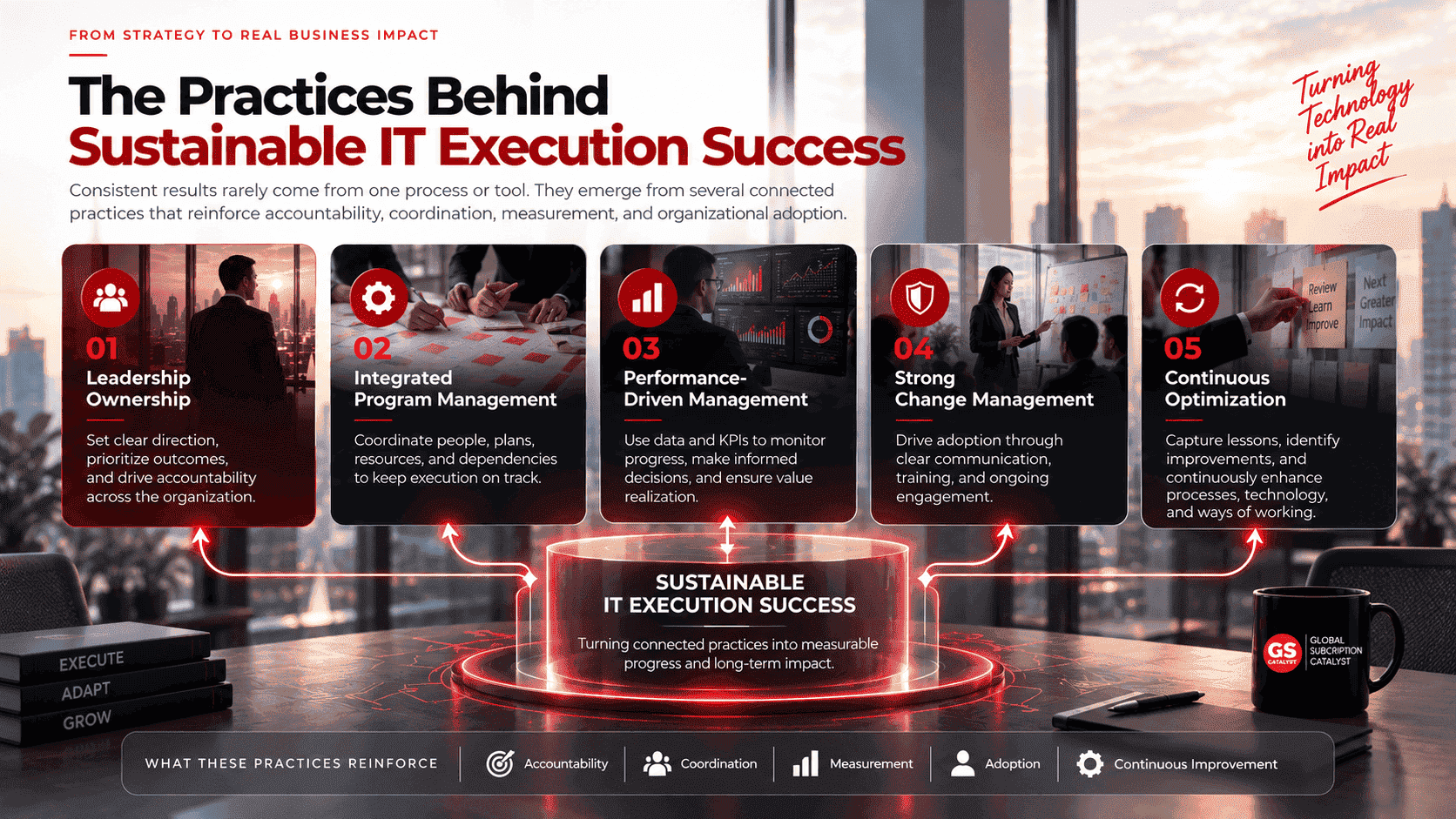
1. Leadership Ownership
Transformation requires active leadership involvement throughout delivery. Executive sponsors need to maintain strategic alignment, remove organizational barriers, resolve competing priorities, and reinforce accountability across departments.
Leadership ownership becomes particularly important when initiatives cross organizational boundaries. Without clear sponsorship, decisions can become fragmented and teams may prioritize local objectives over broader business outcomes.
Strong leadership therefore provides more than visibility. It creates the authority and organizational commitment required to maintain momentum when priorities compete or unexpected challenges emerge.
2. Integrated Program Management
Large transformation programs rarely operate as a single project. They involve multiple workstreams, vendors, technology teams, business functions, and dependencies that need to remain coordinated.
Integrated program management creates visibility across:
Multiple workstreams
Vendor activities
Resource allocation
Risk management
Cross functional dependencies
This allows teams to identify issues earlier and coordinate decisions across the broader portfolio rather than managing each workstream independently.
3. Performance Driven Management
Transformation becomes more measurable when performance management is embedded into normal operating routines.
High performing organizations use dashboards, KPIs, and regular review mechanisms to monitor both technical delivery and business outcomes. This gives leaders a consistent basis for identifying issues, reallocating resources, and determining whether initiatives remain aligned with their intended objectives.
The important distinction is that performance information should support decisions. Reporting that does not influence action can create visibility without improving results.
This is also where technology performance measurement becomes important. Metrics should show not only whether delivery is progressing, but whether the capabilities being delivered are producing the expected operational and business impact.
4. Strong Change Management
Technology adoption depends on people using new systems, processes, and capabilities effectively. A transformation can therefore achieve technical milestones while still falling short if employees are not prepared to adopt the changes.
Organizations with stronger delivery practices typically support adoption through:
Structured training programs
Clear communication strategies
Leadership engagement
Continuous user support
Change management connects technical implementation with operational adoption. It also provides a mechanism for identifying resistance and addressing adoption barriers before they affect expected business outcomes.
5. Continuous Optimization
Organizational capability should not remain static after implementation. High performing organizations use performance data, operational feedback, and lessons learned to identify where processes, governance structures, and capabilities can be improved.
Continuous optimization can involve refining delivery standards, improving workflows, strengthening governance, upgrading capabilities, and applying lessons from completed initiatives to future programs.
This creates a cycle in which each major initiative contributes not only to its immediate objectives, but also to stronger enterprise capability.
Common Pitfalls That Prevent Sustainable Transformation
Even well funded transformation programs can struggle when delivery is treated as a temporary project activity rather than a long term organizational capability.
Common pitfalls include:
Treating transformation as a one time project
Underestimating organizational change
Focusing only on technical delivery
Ignoring long term capability development
Lacking cross functional ownership
These patterns can create a situation where an organization completes implementation but struggles to sustain the expected benefits afterward.
Sustainable transformation requires organizations to think beyond launch. Operating structures, governance, performance management, delivery practices, and organizational capabilities need to remain effective as business requirements and technology environments evolve.
Why Performance Evidence Matters
Transformation success needs to be visible. Without evidence, leadership may find it difficult to determine whether technology investments are producing the outcomes that justified them.
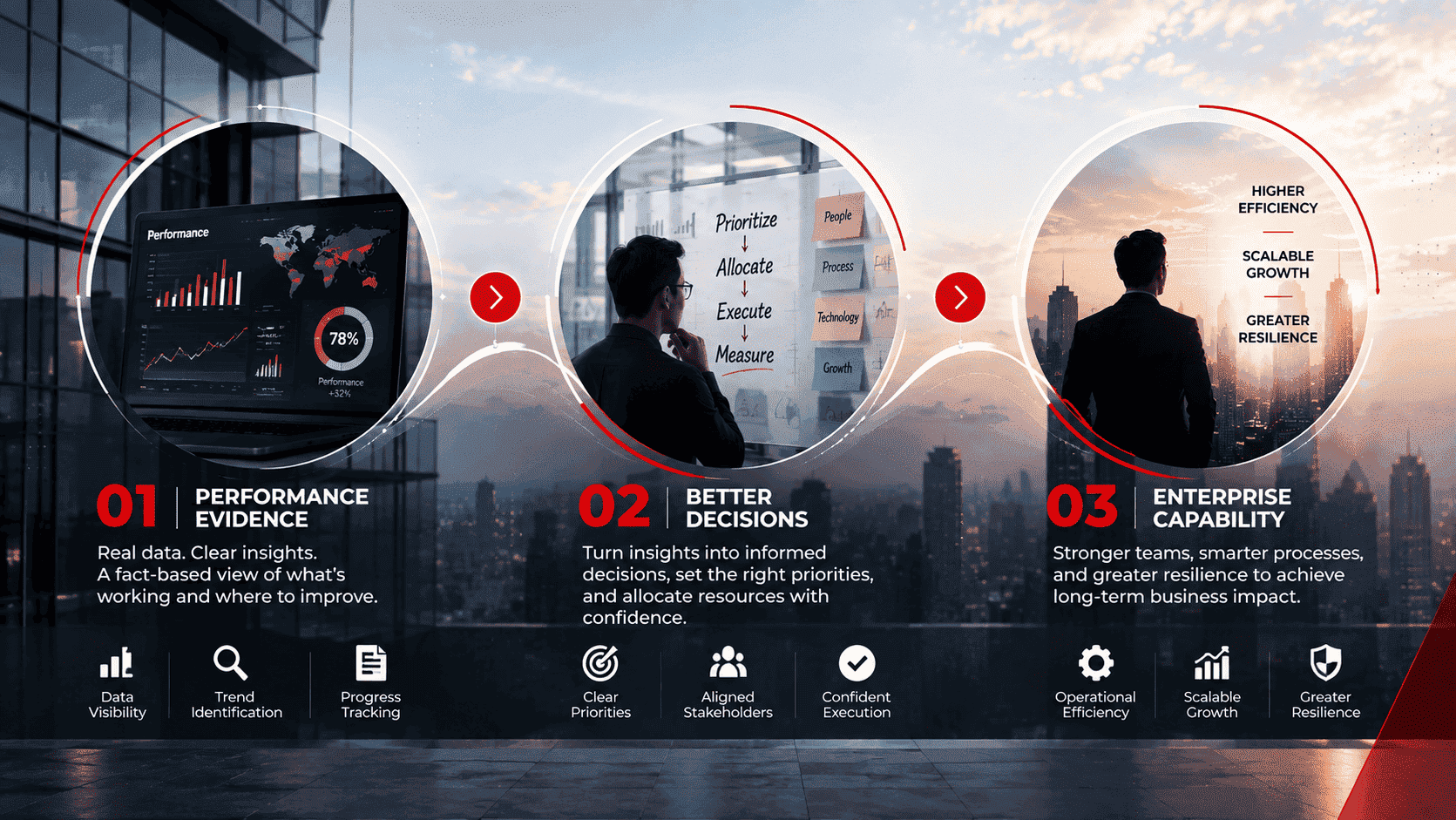
Performance data can help leaders:
Validate strategic decisions
Identify underperforming initiatives
Support future investment decisions
Demonstrate business impact
Build stakeholder confidence
Not every initiative needs to be measured through the same indicators. Depending on the transformation, relevant measures may include operational efficiency, customer experience, financial impact, adoption, quality, risk, resilience, or strategic business outcomes.
The important principle is establishing a clear relationship between delivery activity and the results the organization is trying to achieve.
This makes performance information useful beyond individual programs. At the enterprise level, leaders can identify recurring constraints, compare portfolio performance, and determine where additional resources or organizational intervention may be required.
From IT Execution Success to Enterprise Transformation Capability
Organizations that consistently achieve transformation outcomes develop more than successful projects. They build an enterprise transformation capability that can be applied across different technologies, business functions, and strategic priorities.
This creates several practical advantages. Leaders gain better visibility, teams have clearer accountability, dependencies become easier to manage, and performance information can inform future investment decisions.
Over time, this capability becomes an organizational asset. The business becomes less dependent on individual intervention and better equipped to translate new strategic priorities into measurable outcomes.
The broader objective is not simply to deliver more technology initiatives. It is to build an organization that can repeatedly connect technology strategy with business performance while adapting to changing market conditions, operating requirements, and technology priorities.
Read More: Enterprise Execution Maturity for Scalable Digital Transformation
Key Takeaways
IT execution success is the ability to translate technology strategy into coordinated delivery, organizational adoption, measurable outcomes, and continuous improvement.
High performing organizations establish repeatable capabilities across strategy, governance, delivery, performance management, and change.
Successful transformation connects technical implementation with operational and business outcomes rather than measuring progress through project milestones alone.
Leadership ownership, integrated program management, performance measurement, and continuous optimization help create more consistent results.
Long term transformation capability depends on turning experience and performance evidence into stronger practices for future initiatives.
Frequently Asked Questions
What is IT execution success?
IT execution success is the ability to consistently translate technology strategy into coordinated delivery, measurable business outcomes, organizational adoption, and continuous improvement across the enterprise.
What is an IT execution framework?
An IT execution framework provides a structured approach for aligning technology priorities, governance, delivery, performance measurement, and continuous improvement across multiple initiatives.
Why does digital transformation fail during execution?
Digital transformation can struggle when ownership is unclear, cross functional coordination is weak, governance is inconsistent, performance visibility is limited, or employees are not adequately prepared to adopt new technologies and processes.
How can enterprises improve IT execution success?
Enterprises can strengthen IT execution by establishing clear accountability, integrated program management, measurable performance indicators, effective change management, and continuous improvement mechanisms that connect technology delivery with business outcomes.
Ready to Strengthen Your IT Execution Capability?
GSCatalyst helps enterprises build practical capabilities that connect technology strategy, governance, delivery, organizational change, and measurable business performance.
Let’s turn technology strategy into sustained performance.