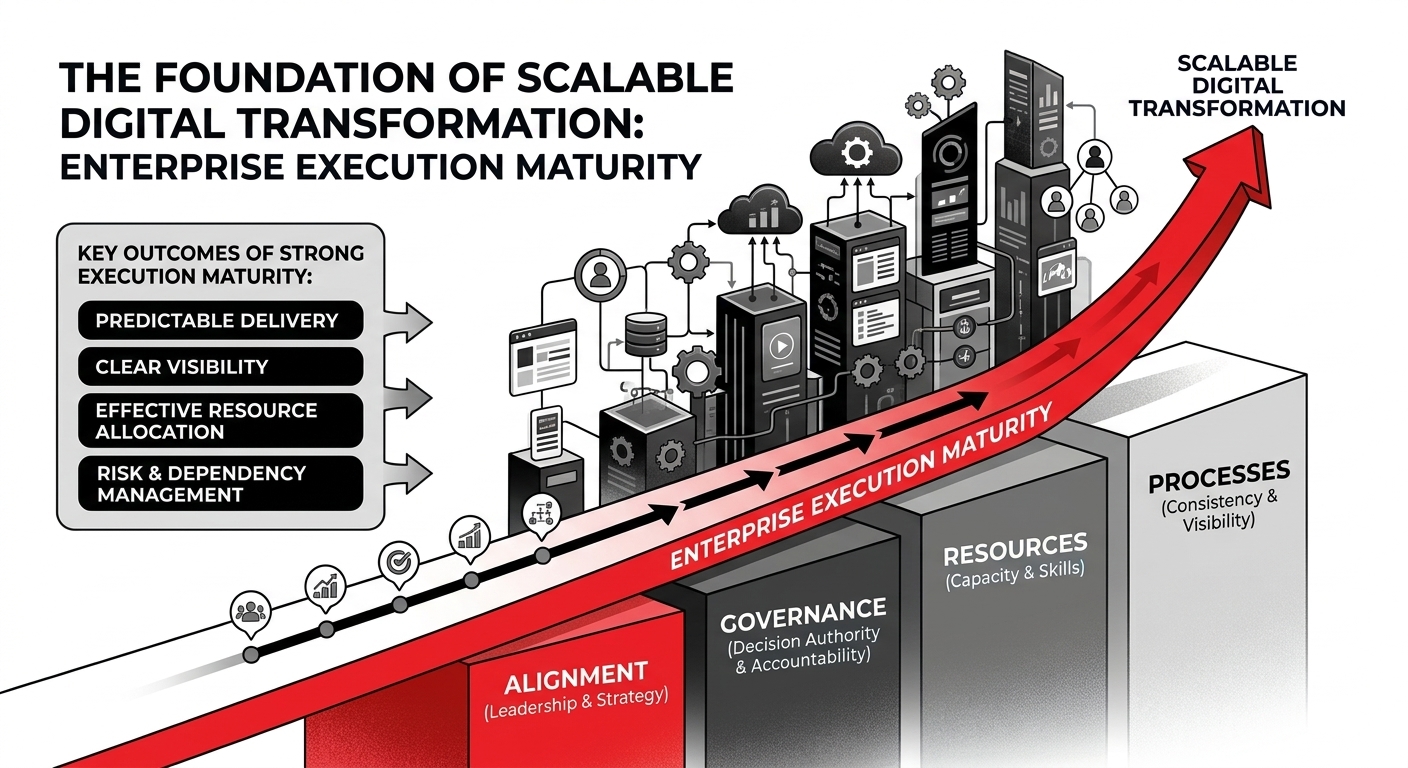












A portfolio can contain several successful digital projects and still struggle to deliver transformation consistently across the enterprise. Individual teams may meet their project milestones, but shared platforms, competing resource demands, and dependencies between departments can create bottlenecks that affect overall delivery performance.
The challenge becomes more visible when organizations move beyond a small number of transformation initiatives. Delivery teams must coordinate work across different business functions, technology environments, and operational requirements while maintaining consistent standards and governance.
Without sufficient digital delivery capability, organizations may find it difficult to sustain transformation momentum. Work becomes fragmented, delivery practices vary between teams, and leadership loses visibility into whether the organization can support its growing portfolio.
Scaling digital transformation therefore requires more than increasing the number of projects or delivery resources. Enterprises need the structures, processes, people, and coordination mechanisms to deliver digital initiatives repeatedly and reliably across the organization.
What Is Digital Delivery Capability?
Digital delivery capability refers to an organization's ability to plan, coordinate, execute, and sustain digital initiatives across multiple teams and operational environments while maintaining delivery quality, governance discipline, and performance visibility.
It involves more than the technical ability to develop or implement technology solutions. Effective delivery capability also depends on how teams manage dependencies, allocate resources, coordinate business requirements, resolve delivery issues, and maintain accountability throughout the delivery lifecycle.
A mature digital delivery capability connects several organizational elements:
Delivery frameworks: Shared processes, standards, and practices that guide how initiatives are planned and delivered.
Cross-functional coordination: Collaboration between technology teams, business stakeholders, and delivery functions.
Governance and accountability: Clear decision authority, ownership, escalation mechanisms, and oversight.
Resource and skills management: Alignment between delivery demand, available capacity, and technical expertise.
Performance visibility: Consistent indicators that help leadership evaluate delivery progress and identify operational constraints.
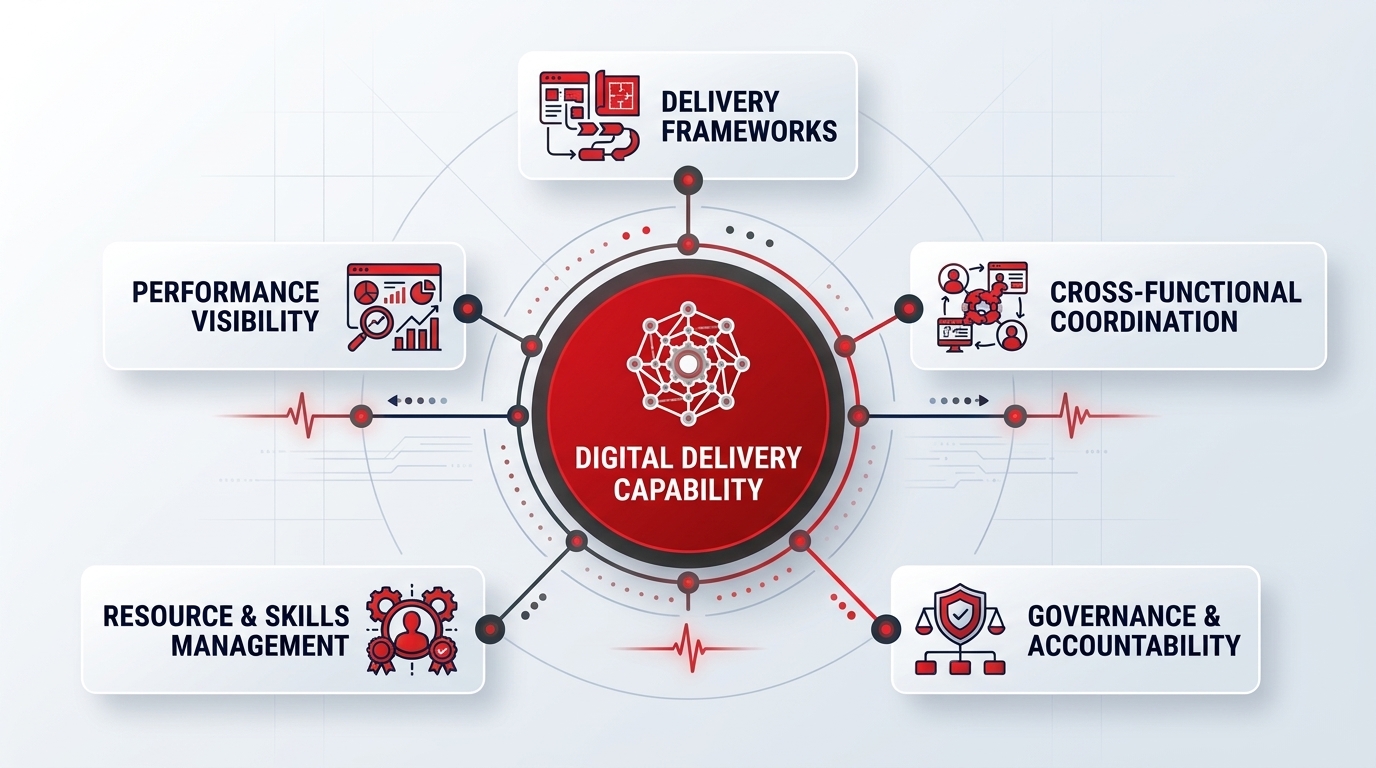
Together, these elements allow enterprises to manage multiple initiatives without relying entirely on individual teams or temporary delivery arrangements.
Why Delivery Capability Determines Transformation Scale
Successful delivery of an individual project does not automatically demonstrate that an organization can sustain transformation across a larger portfolio.
As the number of initiatives grows, delivery environments become more interconnected. Programs may share technical specialists, infrastructure, vendors, platforms, and business stakeholders. A delay in one workstream can therefore affect several other initiatives.
Organizations with limited delivery capability often encounter three recurring challenges.
Inconsistent delivery practices. Different teams may use different planning methods, reporting standards, governance checkpoints, and escalation procedures. This makes enterprise-wide coordination and performance comparison more difficult.
Competing resource demands. Multiple initiatives may require the same specialists or technical capabilities. Without coordinated capacity planning, delivery commitments can exceed available resources.
Limited portfolio visibility. Leadership may receive updates from individual projects without having a clear view of dependencies, delivery constraints, or overall transformation progress.
These challenges can reduce delivery predictability even when individual teams perform effectively. A scalable digital delivery model addresses them by establishing shared delivery practices, clear accountability, and coordinated resource management across the enterprise.
Structural Components of Scalable Digital Delivery
Enterprises need several interconnected capabilities to support reliable delivery across expanding transformation portfolios.
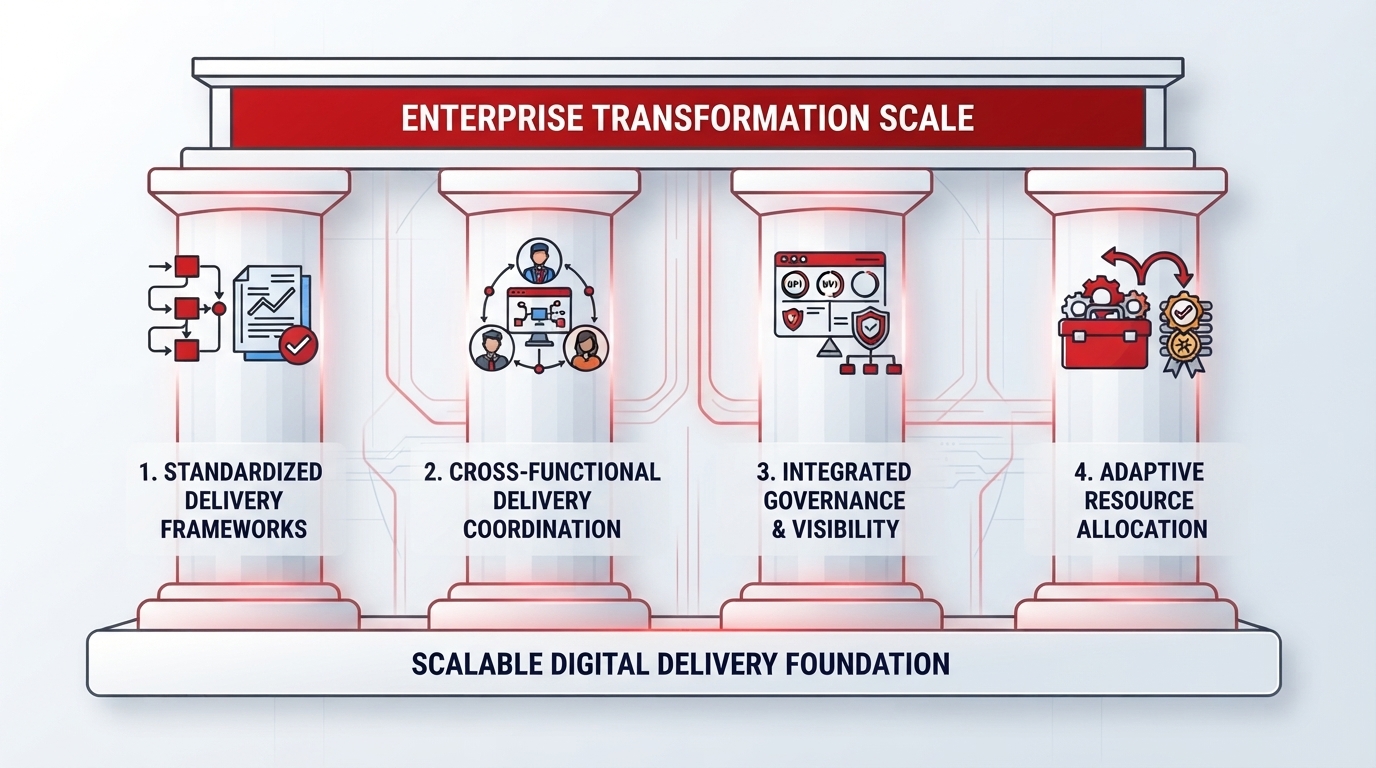
1. Standardized Delivery Frameworks
Shared delivery frameworks establish consistent approaches to planning, prioritization, execution, reporting, and issue resolution across initiatives.
These frameworks help teams understand how work should progress, what governance requirements apply, and which delivery information must be reported. They also make it easier for leadership to compare progress and identify issues across different programs.
Standardization should not eliminate flexibility. Different initiatives may require different delivery methods depending on their technical complexity, risk, and business requirements. The objective is to maintain consistent principles and accountability while allowing teams to adapt their execution practices where necessary.
2. Cross-Functional Delivery Coordination
Enterprise transformation rarely operates within a single department. Technology teams must work with business stakeholders, product owners, operations, security functions, and other delivery participants to coordinate requirements and manage dependencies.
Clear ownership is essential when initiatives cross organizational boundaries. Teams need to understand who provides input, who makes decisions, who owns delivery outcomes, and how cross-functional issues should be resolved.
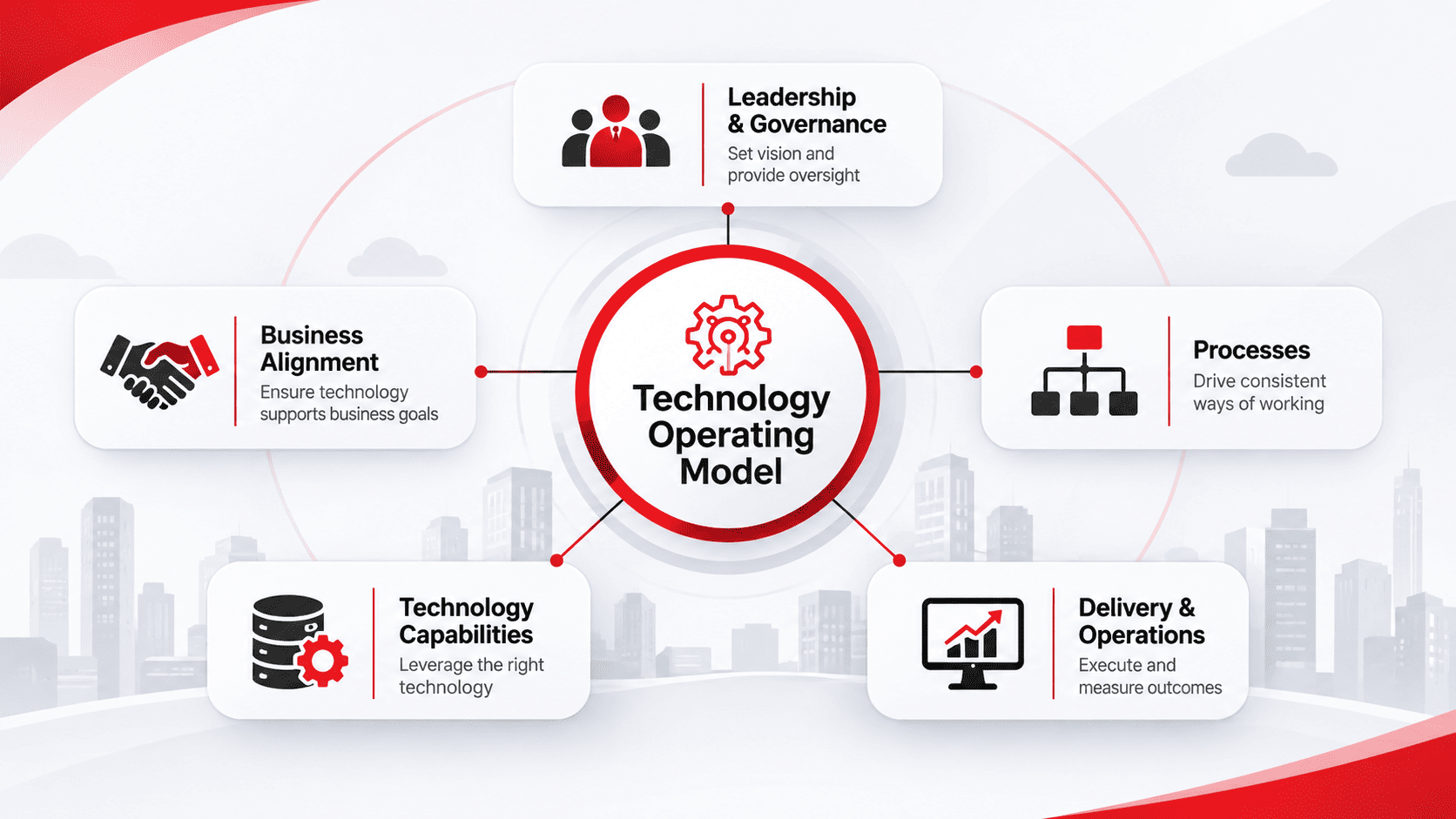
This coordination is closely connected to the way technology functions are organized and managed. As explored in Technology Operating Model for Enterprise Transformation, defined leadership responsibilities, governance mechanisms, and delivery processes help organizations coordinate technology capabilities across business units.
3. Integrated Governance and Delivery Visibility
Scalable delivery requires governance mechanisms that provide leadership with a consistent view of progress, risk, dependencies, and delivery performance.
Project-level reporting remains important, but leadership also needs portfolio-level information to understand how initiatives interact and where delivery constraints may require intervention.
Useful visibility includes milestone performance, unresolved dependencies, resource constraints, delivery risks, and changes in priorities. Shared reporting definitions help ensure that information from different teams can be interpreted consistently.
Governance should support timely decisions rather than create unnecessary approval layers. Routine delivery issues should remain with the appropriate teams, while matters involving significant dependencies, risk, or competing enterprise priorities receive broader oversight.
4. Adaptive Resource Allocation
Delivery capability depends on whether organizations can align available capacity and expertise with the work required across their transformation portfolios.
As initiatives compete for shared specialists, infrastructure, and operational support, resource allocation must reflect both planned project demand and ongoing business responsibilities. Without this visibility, organizations may overcommit teams, repeatedly reassign personnel, or create bottlenecks around critical technical skills.
This is why resource coordination needs to be integrated into delivery planning. Enterprise IT Resource Management for Long-Term Operational Efficiency explores how capacity planning and resource allocation help enterprises align available expertise with competing delivery commitments.
A scalable delivery environment should also account for skills development, knowledge sharing, and operational resilience rather than focusing exclusively on resource utilization.
How Enterprises Can Build Scalable Digital Delivery Capability
Building digital delivery capability requires organizations to strengthen the systems and practices that support execution across multiple initiatives. Instead of focusing only on individual project improvements, leadership should address the structural conditions that influence enterprise-wide delivery performance.
Five practices provide a practical starting point.
1. Assess the Existing Delivery Environment.
Review how initiatives are planned, prioritized, governed, staffed, and monitored. Identify recurring delays, inconsistent delivery practices, unclear ownership, and dependencies that create friction between teams. This assessment helps establish where delivery capability needs to improve.
2. Establish Shared Delivery Standards.
Define common principles for planning, reporting, governance, quality control, and issue escalation. These standards should provide consistency without forcing every initiative to follow an identical delivery approach regardless of its complexity or requirements.
3. Strengthen Cross-Functional Ownership.
Clarify responsibilities between technology teams, business stakeholders, product owners, and operational functions. Establish decision authority and escalation mechanisms for issues that affect multiple teams or delivery commitments.
4. Align Resource Capacity With Portfolio Priorities.
Evaluate whether available skills, technical capacity, and operational resources can support approved initiatives. Resource planning should consider competing commitments and ongoing operational responsibilities before delivery timelines are confirmed.
5. Embed Performance Monitoring and Continuous Improvement.
Establish recurring reviews that evaluate delivery outcomes, unresolved dependencies, capacity constraints, governance effectiveness, and recurring operational issues. Use these findings to refine delivery practices as the transformation portfolio evolves.
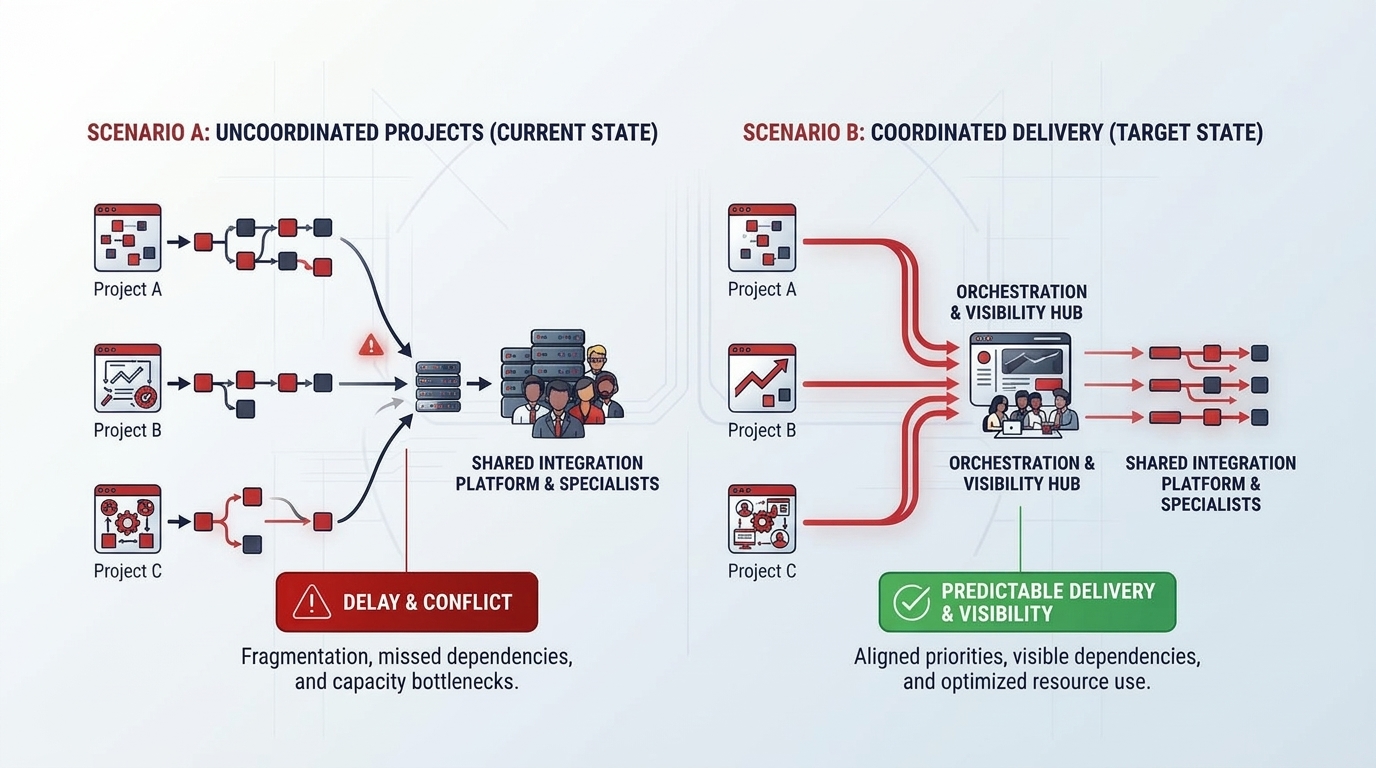
Consider an enterprise managing several digital initiatives that depend on the same integration platform and technical specialists. Each project may have its own delivery schedule, but without a shared view of dependencies and resource availability, teams can unknowingly plan work that competes for the same capacity.
A coordinated delivery approach would make shared dependencies visible, establish clear ownership for cross-team decisions, and align resource commitments with portfolio priorities. Leadership could then adjust sequencing or delivery expectations before capacity conflicts create wider delays.
The objective is not to centralize every delivery decision. It is to establish enough coordination and visibility for teams to deliver independently where appropriate while maintaining alignment across the enterprise.
Measuring Digital Delivery Capability
Organizations need measurable indicators to determine whether their delivery capability can support the scale and complexity of their transformation portfolios.
Rather than relying exclusively on project completion rates, leadership should monitor how consistently teams deliver work, coordinate dependencies, and manage available capacity.
Relevant indicators include:
Delivery cycle consistency: Whether comparable initiatives maintain predictable delivery timelines and milestone performance.
Cross-team coordination efficiency: How effectively teams resolve dependencies, coordinate handoffs, and address cross-functional delivery issues.
Resource allocation responsiveness: How quickly resource requirements and competing capacity needs are evaluated and addressed.
Governance visibility: Whether leadership receives consistent information about delivery progress, risks, dependencies, and accountability.
Capacity-to-demand alignment: Whether available skills and delivery resources remain aligned with the requirements of the active transformation portfolio.
These indicators should be evaluated together. Faster delivery, for example, does not necessarily demonstrate stronger capability if it results in reduced quality, unresolved technical issues, or unsustainable workloads.
Organizations should establish performance baselines and review trends across multiple initiatives. This makes it easier to distinguish isolated project delays from recurring structural problems that require improvements to the broader delivery model.
Sustaining Delivery Capability as Enterprise Transformation Evolves
Digital delivery capability is not established through a one-time framework implementation or organizational change. As technology requirements, business priorities, and transformation portfolios evolve, delivery structures must adapt to support new operational demands.
Organizations should periodically review whether delivery standards remain relevant, governance mechanisms provide sufficient visibility, and resource capacity can support current priorities. Feedback from delivery teams and business stakeholders should also inform adjustments to processes and coordination practices.
The objective is to create a delivery environment that combines consistency with adaptability. Shared frameworks provide structure, while teams retain the flexibility to respond to different technology and business requirements.
When delivery practices, governance, cross-functional coordination, and resource planning operate together, enterprises are better positioned to scale digital initiatives while maintaining predictable and sustainable delivery performance.
Key Takeaways
Digital delivery capability is an organization's ability to plan, coordinate, and sustain digital initiatives across teams and operational environments.
Standardized delivery frameworks, cross-functional coordination, governance visibility, and adaptive resource allocation support enterprise-scale delivery.
Scaling transformation requires shared delivery standards, clear ownership, coordinated resource planning, and continuous performance monitoring.
Delivery cycle consistency, coordination efficiency, resource responsiveness, and capacity alignment help assess delivery capability.
Sustainable digital delivery depends on continuously adapting organizational structures and practices as transformation priorities evolve.
Read More: Transformation Performance Management for Enterprise Digital Initiatives
Frequently Asked Questions
What is digital delivery capability?
Digital delivery capability is an organization's ability to plan, coordinate, execute, and sustain digital initiatives across multiple teams and operational environments while maintaining delivery quality, governance discipline, and performance visibility.
Why is digital delivery capability important for enterprise transformation?
Digital delivery capability helps organizations coordinate multiple initiatives, manage shared resources, resolve cross-functional dependencies, and maintain consistent delivery performance as transformation portfolios grow.
What are the key components of scalable digital delivery capability?
Key components include standardized delivery frameworks, cross-functional coordination, integrated governance and delivery visibility, and adaptive resource allocation. These capabilities help organizations maintain accountability and coordinate work across multiple initiatives.
How can enterprises improve digital delivery capability?
Enterprises can improve digital delivery capability by assessing existing delivery practices, establishing shared standards, clarifying cross-functional ownership, aligning resource capacity with portfolio priorities, and continuously monitoring delivery performance.
How do organizations measure digital delivery capability?
Organizations can evaluate digital delivery capability through delivery cycle consistency, cross-team coordination efficiency, resource allocation responsiveness, governance visibility, and alignment between delivery capacity and portfolio demand.
Ready to Scale Your Digital Delivery Capability
If your organization is expanding digital transformation initiatives and requires stronger coordination across technology teams and business units, GSCatalyst helps enterprises strengthen delivery frameworks, improve cross-functional coordination, and align delivery capabilities with enterprise transformation priorities.