












The reliability of an AI system depends heavily on the quality, ownership, and governance of the data that supports it. As organizations move from AI experimentation toward enterprise deployment, managing data effectively becomes increasingly important because AI systems often depend on information collected from multiple platforms, business units, applications, and external sources.
Data that appears reliable in one operational context may be incomplete, inconsistent, outdated, or unsuitable for another AI use case. When these differences are not governed systematically, organizations can experience unreliable model outputs, limited traceability, compliance concerns, and difficulty explaining how AI-driven decisions are produced.
This is why AI data governance has become an important foundation for trustworthy AI adoption. It defines how data used by AI systems is owned, managed, protected, monitored, and maintained throughout its lifecycle so that organizations can establish greater confidence in the information behind AI-driven outcomes.
As AI adoption expands across the enterprise, effective AI data governance helps organizations move beyond simply having access to large volumes of data toward building data environments that are reliable, traceable, secure, and suitable for responsible AI use.
What Is AI Data Governance
AI data governance is the structured approach organizations use to establish ownership, quality standards, access controls, lineage, security requirements, and lifecycle management for data that supports artificial intelligence systems.
Unlike general data management, AI data governance places particular emphasis on the characteristics that influence AI performance and trustworthiness. Organizations need to understand not only where data comes from, but also whether it is appropriate for a specific AI use case, how it has been transformed, who is accountable for its quality, and whether its use complies with organizational and regulatory requirements.
An effective AI data governance approach answers practical questions such as:
Who owns the data used by an AI system?
How is data quality measured and maintained?
Where did the data originate and how has it been transformed?
Who is authorized to access and use sensitive datasets?
How are changes to data monitored over time?
When should datasets be retained, archived, or removed?
By establishing clear answers to these questions, organizations create a more reliable foundation for developing and operating trustworthy AI systems.
Why Data Quality Directly Affects AI Trust
Trust in AI does not come from model accuracy alone. Users and decision-makers also need confidence that the data entering the model is accurate, relevant, complete, and governed appropriately.
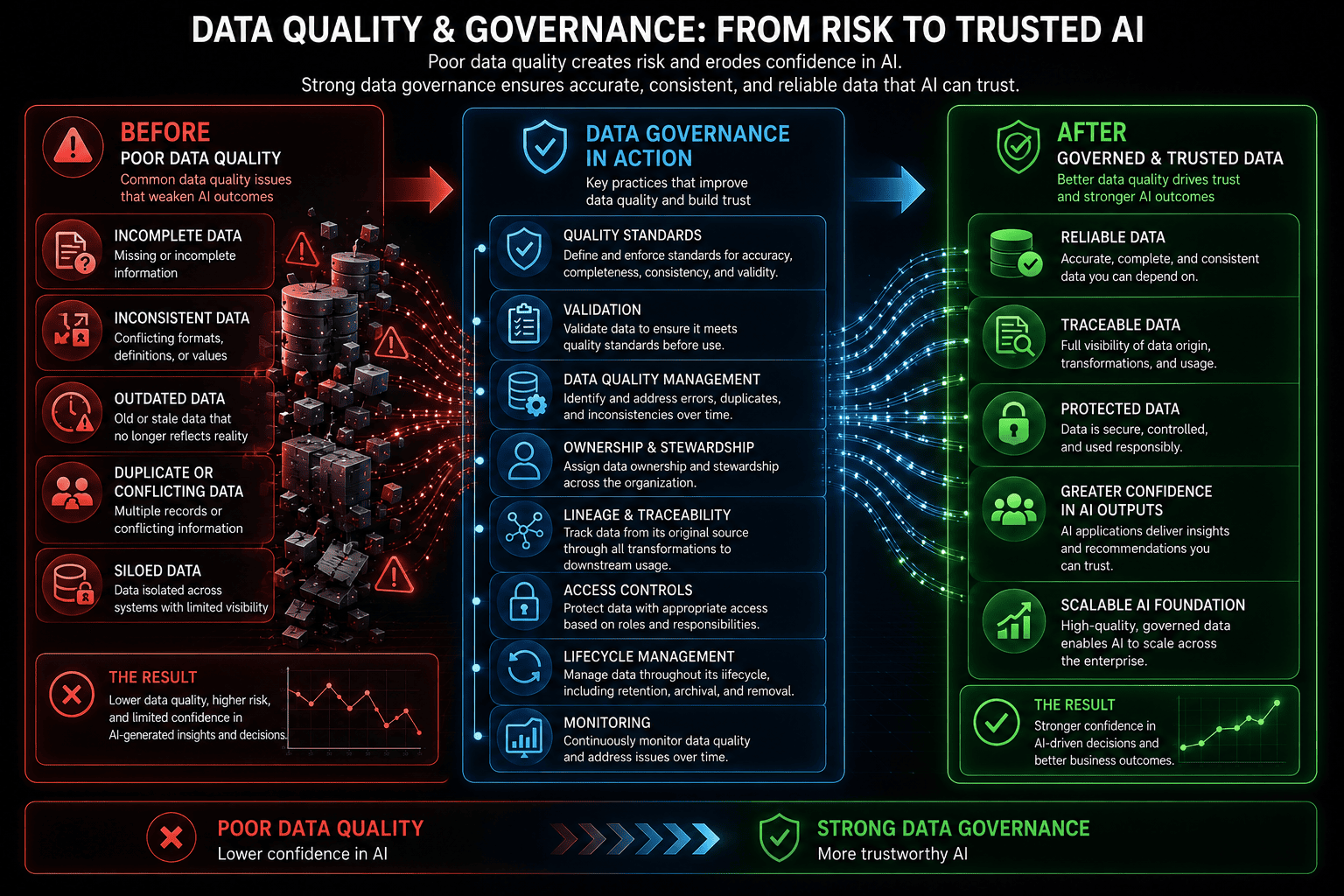
Poor data quality can introduce problems before a model even begins processing information. Missing records can distort analysis, inconsistent definitions can produce conflicting results, and outdated information can cause AI systems to generate recommendations that no longer reflect current business conditions.
These problems become more difficult to detect when data originates from multiple systems with different ownership structures and quality standards.
A strong data governance for AI approach therefore establishes consistent controls around:
Data accuracy and completeness
Consistency across business systems
Validation and quality monitoring
Data ownership and stewardship
Appropriate use of datasets for specific AI applications
Organizations that strengthen these foundations are better positioned to validate AI outputs and understand the information supporting important decisions.
The broader role of data quality, architecture, and readiness is explored in Data Foundation for AI and Why It Matters for AI Success, which explains why organizations need reliable data foundations before attempting to scale AI initiatives.
The Complexity of Managing Data Across Enterprise AI Environments
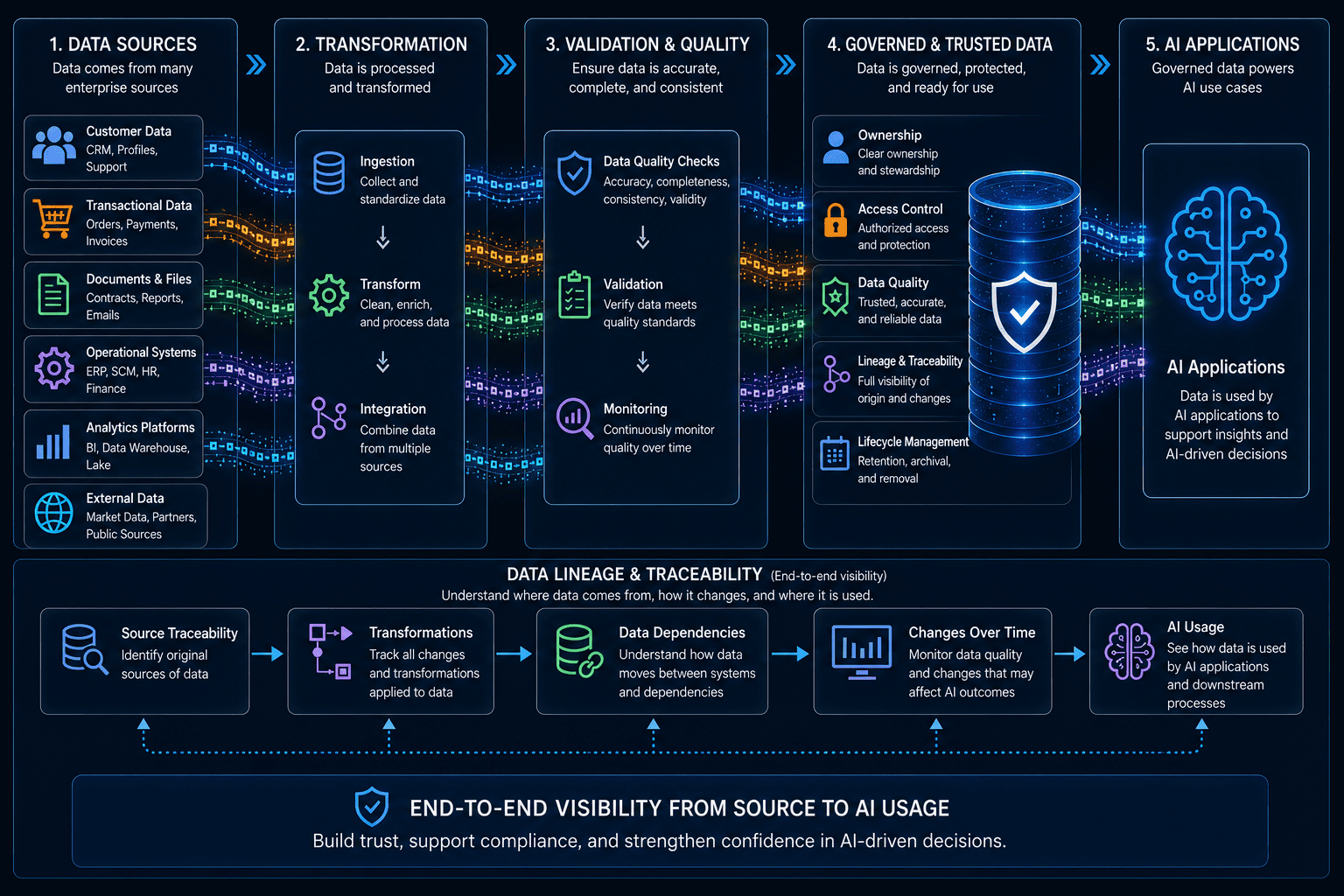
Enterprise AI systems rarely depend on a single source of information. A single use case may combine customer records, transactional data, documents, operational systems, analytics platforms, and external datasets.
Each source can have different formats, definitions, owners, retention policies, access requirements, and quality characteristics. As more sources are connected, the organization must maintain visibility into how information moves between systems and how those changes affect downstream AI applications.
Without coordinated AI data management, organizations can encounter:
Inconsistent definitions of critical business data
Duplicate or conflicting records across systems
Unclear ownership of datasets and pipelines
Limited visibility into data transformations
Increasing effort to validate information before AI use
These challenges become more significant as AI portfolios expand because every additional use case can introduce new dependencies across the organization's data environment.
A scalable governance approach therefore needs to address enterprise data relationships rather than treating each AI project as an isolated implementation.
How Poor Data Governance Can Undermine AI Performance
Weak governance can affect AI systems at multiple stages, from model development and training through deployment and ongoing operations. When organizations cannot establish confidence in the underlying data, they also face greater difficulty validating whether AI outputs remain reliable.
1. Reduced Model Reliability
AI models depend on the information used during training and operation. Incomplete, inconsistent, or poorly structured datasets can introduce patterns that reduce model reliability and make outcomes more difficult to predict.
As business conditions change, outdated datasets can also reduce the relevance of AI outputs even when the underlying model continues operating as designed.
2. Limited Explainability and Traceability
Organizations need to understand where important information originated and how it was transformed before reaching an AI system.
When data lineage is unclear, teams may struggle to explain why an AI system produced a particular outcome. This becomes particularly important when AI is used in business processes where decisions must be reviewed, challenged, or audited.
3. Increased Operational and Compliance Risk
Poorly governed data can create operational problems when errors propagate across connected systems. Sensitive information may also be accessed or used outside its intended purpose when ownership and access controls are unclear.
As AI becomes more integrated into business processes, these weaknesses can create additional compliance and operational exposure.
Strong AI data governance reduces these risks by creating consistent standards for data quality, ownership, traceability, access, and lifecycle management.
The Connection Between AI Data Governance and AI Security
Data governance and AI security cannot be treated as completely separate disciplines. AI systems can process sensitive information, depend on complex data pipelines, and expose new attack surfaces throughout the data and model lifecycle.
Weak governance can therefore increase security exposure when organizations lack visibility into who can access datasets, where information is stored, or how data is transferred between systems.
Common risks include:
Unauthorized access to sensitive AI datasets
Manipulation of data used in model development
Compromised or poorly protected data pipelines
Inappropriate use of information outside its approved purpose
Limited visibility into changes affecting AI inputs
Effective AI security requires governance mechanisms that establish appropriate ownership, access controls, monitoring, and accountability across the data environment.
The relationship between governance, risk, and enterprise AI controls is further explored in AI Governance Framework for Managing Enterprise AI Risk, which explains how organizations can establish broader governance structures for managing AI throughout its lifecycle.
The Core Elements of Effective AI Data Governance
A mature AI data governance framework establishes consistent practices across the data lifecycle while remaining practical enough to support business and technology teams. Although governance requirements vary by organization, several foundational capabilities are particularly important for enterprise AI.
1. Data Ownership and Accountability
Organizations need clear accountability for the datasets, pipelines, and information products used by AI systems. Ownership should not stop at identifying which department stores the data because responsibility also needs to cover data quality, appropriate usage, access, and ongoing maintenance.
Organizations should establish:
Accountable data owners for critical datasets
Data stewardship responsibilities
Ownership for data pipelines and integrations
Defined escalation paths for data quality issues
Accountability for appropriate data usage
Clear ownership prevents data governance from becoming an undefined responsibility shared across multiple teams without a clear decision-maker.
2. Data Quality Standards
AI-ready data requires measurable quality standards rather than assumptions that existing datasets are sufficiently reliable.
Organizations should establish criteria for:
Accuracy
Completeness
Consistency
Timeliness
Validity
Quality standards should also be monitored continuously because data quality can change as source systems, business processes, and operational conditions evolve.
Consistent quality management helps organizations identify problems before they affect AI models and business decisions.
3. Data Lineage and Traceability
Data lineage provides visibility into where information originates, how it moves through systems, and what transformations occur before it reaches an AI application.
This capability becomes particularly important when AI systems depend on multiple datasets or automated data pipelines.
Organizations should maintain visibility into:
Original data sources
Transformations and processing steps
Downstream systems and AI applications
Dependencies between datasets
Changes that could affect AI outcomes
Strong lineage enables organizations to investigate data-related issues more efficiently and provides greater transparency when AI outputs need to be reviewed.
4. Access Control and Data Protection
AI data environments often contain sensitive customer, employee, financial, operational, or proprietary information. Governance therefore needs to define not only who owns data, but also who can access and use it.
Organizations should implement:
Role-based access controls
Appropriate authorization processes
Monitoring of sensitive data access
Controls for data sharing between systems
Policies for handling restricted information
These mechanisms reduce the risk of unauthorized access and support more responsible use of data within AI workflows.
5. Data Lifecycle Management
Data governance should extend from data creation and collection through active use, retention, archival, and eventual disposal.
Organizations need clear rules for determining:
How long data should be retained
When datasets should be archived
When outdated information should no longer support AI use cases
How sensitive information should be securely removed
How lifecycle decisions are documented and governed
Effective lifecycle management reduces unnecessary data exposure while helping organizations maintain data environments that remain relevant and manageable as AI adoption grows.
Together, these capabilities establish the foundation required to build and maintain trustworthy AI systems across complex enterprise environments.
Why AI Scaling Becomes Difficult Without Strong Data Governance
AI pilots can sometimes operate successfully despite imperfect data governance because they often involve limited datasets, small user groups, and closely involved project teams.
Scaling introduces a different level of complexity. More users, more data sources, more models, and more business processes create additional dependencies that must be governed consistently.
Without strong governance, organizations may experience:
Increasing effort to validate datasets before deployment
Inconsistent AI outputs across business units
Growing costs associated with data remediation
Difficulty meeting regulatory and audit requirements
Reduced confidence in AI-driven decisions
This is why organizations should strengthen AI data governance before data complexity becomes a major constraint on enterprise AI adoption.
Turning Data Governance Into an AI Capability
Data governance should not exist solely as a compliance function or documentation exercise. When implemented effectively, it becomes an operational capability that enables organizations to use data more consistently across analytics, automation, and AI initiatives.
Organizations with mature governance can establish reusable standards for data ownership, quality, access, lineage, and lifecycle management. These standards reduce the need to solve the same data problems repeatedly for every new AI initiative.
Over time, this creates several advantages:
Faster preparation of data for new AI use cases
Greater confidence in AI-generated insights
Lower risk associated with sensitive information
Reduced duplication across data initiatives
Stronger foundations for scaling AI across business functions
Data governance therefore contributes not only to risk management but also to the speed, consistency, and sustainability of AI adoption.
Common AI Data Governance Mistakes
Even organizations that recognize the importance of data governance can struggle to operationalize it effectively. Several recurring patterns can weaken the foundation of enterprise AI.
Common mistakes include:
Treating governance primarily as documentation rather than an operational discipline
Assigning data accountability only to IT while business teams remain disconnected
Implementing quality controls without measurable standards or ongoing monitoring
Overlooking legacy system limitations when designing AI data architectures
Separating data governance from security, compliance, and AI risk management
These issues often appear manageable at the beginning of an AI program but become increasingly expensive as the number of use cases and data dependencies grows.
A mature approach connects governance with the broader operating environment so that data quality, security, ownership, and compliance are considered throughout the AI lifecycle.
How GS Catalyst Helps Organizations Strengthen AI Data Governance
Building effective AI data governance requires coordinated improvements across technology, data management, business processes, security, and organizational accountability.
GSCatalyst helps organizations establish the foundations required to manage data effectively for enterprise AI initiatives through:
Designing practical enterprise data governance models
Establishing clear ownership and accountability for critical data
Strengthening data quality and lifecycle management practices
Integrating security and compliance controls into AI data workflows
Improving visibility across data sources, pipelines, and dependencies
Enabling scalable data environments that support responsible AI adoption
This approach helps organizations build data foundations that are reliable enough to support AI while maintaining the governance and control required for sustainable enterprise adoption.
Signs Your AI Data Governance Needs to Mature
Organizations can often identify weaknesses in their AI data governance before they become major barriers to AI adoption. The signals usually appear through recurring operational, technical, or business problems.
Common indicators include:
Repeated data quality issues affecting AI initiatives
Uncertainty about who owns critical datasets
Difficulty tracing AI outputs back to their underlying data
Inconsistent access controls across data environments
Increasing manual effort required to prepare data for AI
Recurring compliance concerns related to data usage
When these signals become common, organizations may need to strengthen their governance model before expanding AI deployment further.
Read More: Enterprise IT Resource Management for Long Term Operational Efficiency
Key Takeaways
Strong AI data governance provides the foundation required for organizations to build trustworthy AI systems that can operate reliably across complex enterprise environments.
Effective governance goes beyond data policies and documentation. Organizations need clear ownership, measurable quality standards, traceable data lineage, appropriate access controls, and lifecycle management practices that remain effective as data environments and AI portfolios evolve.
By strengthening these capabilities, organizations can improve confidence in AI outputs, reduce operational and compliance risk, and create more scalable foundations for responsible enterprise AI adoption.
Frequently Asked Questions
What is AI data governance?
AI data governance is the structured approach organizations use to manage the ownership, quality, security, accessibility, lineage, and lifecycle of data used by artificial intelligence systems. It helps ensure that AI applications rely on data that is reliable, traceable, appropriately protected, and suitable for its intended business purpose.
Why is AI data governance important?
AI data governance is important because the quality and integrity of data directly influence the reliability of AI outputs. Strong governance helps organizations reduce data quality problems, improve traceability, protect sensitive information, support compliance, and maintain greater confidence in AI-driven decisions.
What does an AI data governance framework include?
An AI data governance framework typically includes clear data ownership, measurable quality standards, data lineage and traceability, access controls, security requirements, and lifecycle management. These capabilities provide the structure needed to manage data consistently throughout the AI lifecycle.
Build a Data Foundation for Trustworthy AI
Trustworthy AI requires more than advanced models and scalable infrastructure. Organizations need reliable data environments where ownership, quality, security, lineage, and lifecycle management are clearly defined and consistently maintained.
GSCatalyst helps enterprises strengthen AI data governance and build scalable data foundations that support responsible AI adoption, improve confidence in AI outputs, and reduce operational and compliance risks.
👉 Looking to strengthen the data foundation behind your AI initiatives? Explore how GSCatalyst can help establish AI data governance that supports trustworthy and scalable AI systems.