













Artificial intelligence has moved beyond experimentation. Across industries, organizations are deploying AI to improve decision-making, automate business processes, enhance customer experiences, and increase operational efficiency. The conversation is no longer about whether AI works, it is about how organizations can adopt AI in a way that delivers sustainable business value.
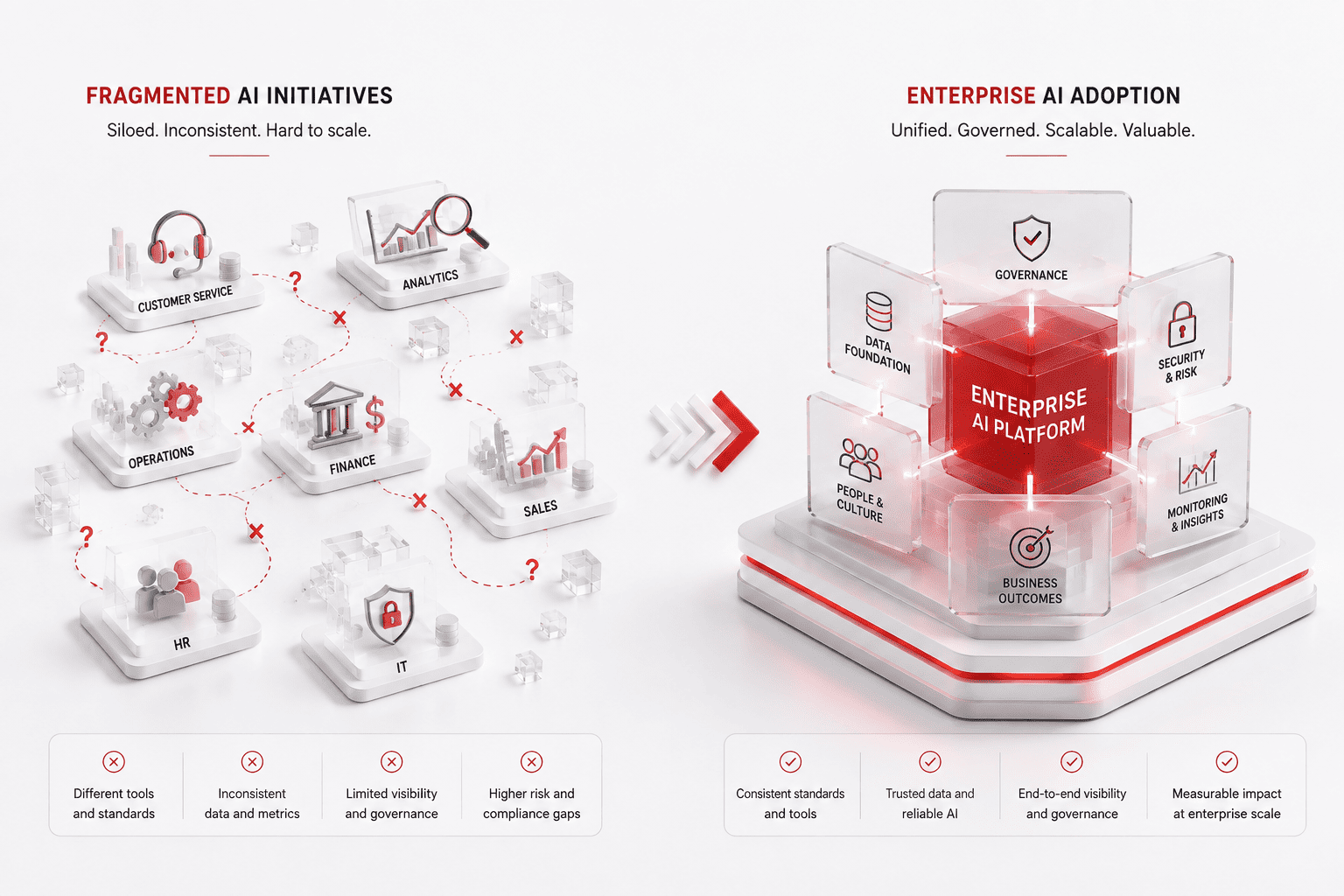
Many enterprises begin their AI journey with individual pilots developed by different business units. Customer service teams deploy virtual assistants, operations introduce intelligent automation, while analytics teams experiment with predictive models. Although these initiatives often generate positive early results, they frequently evolve independently, using different governance practices, data standards, and success metrics.
As the number of AI initiatives grows, organizations often discover that scaling AI is significantly more challenging than launching individual use cases. What began as isolated innovation gradually becomes a fragmented portfolio of models, tools, and processes that are difficult to manage consistently.
An effective AI adoption strategy provides the structure required to move beyond isolated experimentation. By aligning governance, data, business priorities, and operating models, organizations can scale AI responsibly while ensuring every initiative contributes to measurable business outcomes.
What Is an AI Adoption Strategy
An AI adoption strategy is a structured approach that enables organizations to plan, govern, implement, and scale artificial intelligence across the enterprise while aligning AI initiatives with business objectives.
Rather than focusing on individual AI projects, an adoption strategy defines how AI should be introduced, governed, monitored, and continuously improved throughout the organization. It establishes consistent standards for decision-making, data management, risk oversight, accountability, and investment prioritization.
A mature AI adoption strategy helps organizations answer critical questions such as:
Which business problems should AI solve?
Which AI initiatives should receive investment priority?
How should AI models be governed across departments?
Who is accountable for AI performance and outcomes?
How should AI risks be monitored over time?
Without a structured strategy, AI initiatives often remain isolated pilots that generate local improvements but fail to create sustainable enterprise-wide value.
Why AI Adoption Becomes More Complex as Organizations Scale

Launching an AI pilot is relatively straightforward. Scaling artificial intelligence across an enterprise is considerably more complex.
Early AI initiatives usually involve limited datasets, a small number of users, and clearly defined business objectives. Teams can experiment quickly because governance requirements are relatively simple and organizational dependencies remain limited.
As adoption expands, however, AI becomes integrated into multiple business functions, operational processes, customer interactions, and technology platforms. Each additional implementation introduces new dependencies involving data quality, security, compliance, ownership, and operational governance.
Organizations often discover that technical capability is no longer the primary challenge. Instead, success depends on whether the organization has established the governance, operating model, and leadership discipline necessary to coordinate AI across the enterprise.
This challenge often begins long before the first AI model is deployed. Organizations that lack strong digital foundations frequently encounter similar obstacles when introducing AI at scale. As discussed in AI Readiness: Preparing Your Organization for AI Adoption, enterprise AI success depends on organizational readiness as much as technical capability.
Without that foundation, AI adoption becomes increasingly fragmented as new initiatives continue to emerge across different business units.
Using AI Is Not the Same as Enterprise AI Adoption
Many organizations believe they have adopted artificial intelligence because employees regularly use AI-powered tools or individual teams deploy machine learning models. In reality, using AI and adopting AI are fundamentally different stages of organizational maturity.
Using AI focuses on solving isolated business problems. Individual departments deploy models that improve productivity or automate specific tasks without necessarily considering how those initiatives fit into the broader enterprise landscape.
Enterprise AI adoption takes a much broader perspective. It embeds AI into organizational governance, business processes, operating models, investment planning, and strategic decision-making. Rather than optimizing isolated use cases, organizations establish consistent standards that enable AI to scale safely and sustainably across multiple business functions.
Responsible enterprise AI adoption typically requires:
Clearly defined ownership for AI models and outcomes
Standardized governance across business units
Transparent accountability for data quality
Consistent decision-making processes
Integrated risk management throughout the AI lifecycle
Without these foundations, organizations may successfully deploy dozens of AI initiatives while still struggling to realize enterprise-wide business value.
Common Challenges That Prevent Enterprise AI Adoption
As organizations expand their AI initiatives, technical challenges become increasingly intertwined with organizational complexity. Most barriers to enterprise AI adoption originate not from algorithms or infrastructure, but from inconsistent governance and fragmented operating practices.
Several challenges commonly prevent organizations from scaling AI successfully.
1. Fragmented AI Initiatives
AI projects frequently emerge independently across different business functions. Marketing, operations, finance, and customer service teams often pursue their own priorities, technologies, and implementation approaches.
While each initiative may generate positive local outcomes, the overall AI landscape becomes increasingly fragmented. Organizations struggle to understand which initiatives should continue, where investments overlap, and how enterprise-wide priorities should be coordinated.
2. Inconsistent Data Readiness
Artificial intelligence depends on reliable, well-governed data. However, many enterprises continue operating with inconsistent data definitions, disconnected systems, and varying quality standards across departments.
Poor data governance reduces model reliability, limits scalability, and increases the likelihood of inconsistent business outcomes.
3. Unclear Governance and Accountability
As AI portfolios expand, ownership often becomes unclear. Business leaders may assume technology teams own AI initiatives, while IT expects business units to manage outcomes.
Without clearly defined governance, organizations frequently experience:
Inconsistent model management
Unclear accountability for AI decisions
Duplicated development efforts
Inconsistent ethical standards
Strong governance is essential for responsible enterprise AI adoption. As discussed in AI Governance Framework for Managing Enterprise AI Risk, organizations need structured governance that defines ownership, oversight, and accountability throughout the AI lifecycle.
4. Difficulty Demonstrating Business Value
Many AI initiatives begin with enthusiasm but struggle to demonstrate measurable business outcomes over time.
Organizations often monitor technical metrics such as model accuracy or processing speed while overlooking broader measures such as productivity improvements, customer experience, operational efficiency, or financial performance.
Without consistent value measurement, executive confidence declines and future AI investment becomes increasingly difficult to justify.
Core Components of an AI Adoption Strategy
Organizations that successfully scale AI establish governance capabilities that support artificial intelligence throughout the entire lifecycle. Rather than relying on individual projects, they build repeatable operating practices that enable AI to expand consistently across the enterprise.
1. Strategic Business Alignment
Artificial intelligence should always support clearly defined business objectives rather than being implemented simply because new technology is available. Successful organizations begin by identifying where AI can create measurable business value and prioritize initiatives according to strategic importance.
Without clear alignment, AI portfolios often become collections of disconnected experiments that consume resources without contributing meaningfully to organizational priorities.
Organizations should establish:
AI investment priorities aligned with business strategy
Measurable business outcomes before development begins
Executive sponsorship for enterprise AI initiatives
Regular portfolio reviews to validate continued strategic relevance
Strategic alignment ensures AI remains focused on solving business problems rather than pursuing technology for its own sake.
2. AI Governance and Accountability
Enterprise AI requires governance that extends beyond traditional IT management. Organizations must clearly define who owns AI models, who approves deployments, who monitors performance, and who is responsible when AI decisions affect business outcomes.
Strong governance creates consistency across departments while reducing operational and regulatory risk.
Organizations should establish:
Clearly assigned ownership for AI models
Standardized governance policies
Transparent decision-making responsibilities
Executive oversight for high-impact AI initiatives
Effective governance transforms AI from isolated innovation into an enterprise capability that can scale responsibly.
3. Data and Model Management
Reliable AI depends on reliable data. As organizations scale AI, maintaining consistent data quality, model performance, documentation, and lifecycle management becomes increasingly important.
A mature AI adoption strategy treats data and models as long-term enterprise assets rather than individual project deliverables.
Organizations should establish:
Standardized data quality controls
Centralized model documentation
Lifecycle management for AI models
Continuous monitoring for model performance and drift
Strong data and model management improves AI reliability while supporting sustainable enterprise-wide adoption.
4. Responsible AI and Risk Management
As AI becomes embedded in business operations, organizations face new categories of risk that extend beyond traditional IT governance. AI systems influence business decisions, customer interactions, financial outcomes, and regulatory compliance, making responsible oversight essential throughout the AI lifecycle.
Many organizations address AI risk only after models have been deployed. However, managing AI risk reactively often leads to inconsistent governance, higher compliance costs, and increased reputational exposure. A mature AI adoption strategy incorporates risk management from the earliest planning stages, ensuring that governance evolves alongside AI capabilities rather than attempting to catch up later.
Organizations should establish:
Risk assessments before AI deployment
Documented ethical AI principles
Governance for explainability and transparency
Regular compliance and regulatory reviews
Continuous monitoring for model bias and unintended outcomes
Embedding responsible AI practices into everyday governance enables organizations to innovate with greater confidence while reducing operational, legal, and reputational risks.
5. Continuous Monitoring and Optimization
Enterprise AI should never be treated as a one-time implementation project. Business priorities evolve, customer expectations change, regulations are updated, and machine learning models naturally lose accuracy as underlying data patterns shift.
Without continuous monitoring, AI initiatives that once delivered measurable value may gradually become less effective or even introduce new operational risks. Successful organizations therefore establish governance processes that continuously evaluate AI performance throughout its operational lifecycle.
Organizations should establish:
Ongoing monitoring of model performance and business outcomes
Periodic reviews of AI investments across the enterprise portfolio
Structured processes for retraining, improving, or retiring models
Continuous measurement of value realization
Regular reassessment of business priorities and AI opportunities
Continuous optimization ensures AI remains aligned with changing organizational objectives while enabling enterprises to maximize long-term business value from their AI investments.
Why AI Adoption Depends on Technology Value Governance
Successful AI adoption does not begin with artificial intelligence. It begins with disciplined technology governance.
Organizations that struggle to govern technology investments often experience the same challenges when scaling AI. Unclear ownership, inconsistent performance measurement, fragmented reporting, and weak investment oversight become even more difficult to manage as AI initiatives multiply across the enterprise.
Artificial intelligence increases both the speed and complexity of decision-making. Without strong governance, organizations may deploy increasingly sophisticated AI capabilities while simultaneously reducing visibility into whether those investments are delivering meaningful business outcomes.
This relationship highlights why AI adoption should be viewed as an extension of broader technology governance rather than an isolated innovation initiative. As discussed in Technology Value Framework for Clear and Measurable ROI, organizations that establish structured approaches for measuring value, assigning accountability, and governing technology investments create a stronger foundation for enterprise AI adoption.
Strong AI adoption strategies typically build upon:
Portfolio-level technology governance
Performance measurement disciplines
Benefit realization management
Structured investment prioritization
Executive accountability for business outcomes
When these governance capabilities already exist, AI becomes significantly easier to scale because organizations have an established framework for evaluating performance, managing risk, and making investment decisions consistently.
Signs Your Organization Needs a Stronger AI Adoption Strategy
Organizations rarely recognize weaknesses in AI adoption during the first few pilot projects. The challenges usually become visible as AI initiatives expand across multiple departments and business processes.
Several indicators suggest that a more structured AI adoption strategy may be required.
Common signs include:
Multiple AI initiatives solving similar problems independently
Inconsistent governance standards across business units
Uncertainty regarding ownership of AI models and outcomes
Difficulty demonstrating measurable business value from AI investments
Increasing regulatory, compliance, or ethical concerns
Executive uncertainty when prioritizing future AI investments
When these patterns emerge, the underlying issue is often organizational rather than technical. Establishing a structured AI adoption strategy helps enterprises coordinate initiatives, improve governance, and maximize long-term business value.
Read More: Scaling AI in Enterprises with Sustainable Operating Models
Key Takeaways
An AI adoption strategy enables organizations to move beyond isolated AI pilots by establishing the governance, accountability, and operating practices required to scale artificial intelligence across the enterprise. Rather than treating AI as a collection of individual projects, organizations develop a consistent framework that aligns AI investments with strategic business objectives while managing operational and regulatory risks.
Successful enterprise AI adoption depends on more than advanced technology. It requires strong governance, reliable data, measurable business outcomes, and continuous oversight throughout the AI lifecycle. Organizations that invest in these capabilities are better positioned to scale AI responsibly while creating sustainable business value across increasingly complex technology portfolios.
Frequently Asked Questions
What is an AI adoption strategy?
An AI adoption strategy is a structured framework that guides how organizations plan, govern, implement, and scale artificial intelligence while aligning AI initiatives with business objectives, governance requirements, and long-term value creation.
Why do AI pilots often fail to scale across an enterprise?
Most AI pilots fail to scale because organizations focus on technology while overlooking governance, data quality, ownership, and operating models. As AI initiatives expand, these organizational challenges become significantly more complex than the underlying technology itself.
How can organizations scale AI responsibly?
Organizations can scale AI responsibly by establishing clear governance, assigning accountability, managing AI risks proactively, standardizing data and model management, and continuously measuring business outcomes to ensure AI investments remain aligned with strategic objectives.
Build an AI Adoption Strategy That Scales with Your Business
Successful AI adoption requires more than deploying new technologies. It requires a structured strategy that aligns AI initiatives with business priorities, governance, and measurable outcomes.
GSCatalyst helps organizations design enterprise AI adoption strategies, establish governance frameworks, strengthen AI risk management, and build scalable operating models that support responsible, long-term AI adoption.
Explore how GSCatalyst can help your organization move from AI experimentation to enterprise-scale adoption with confidence.