











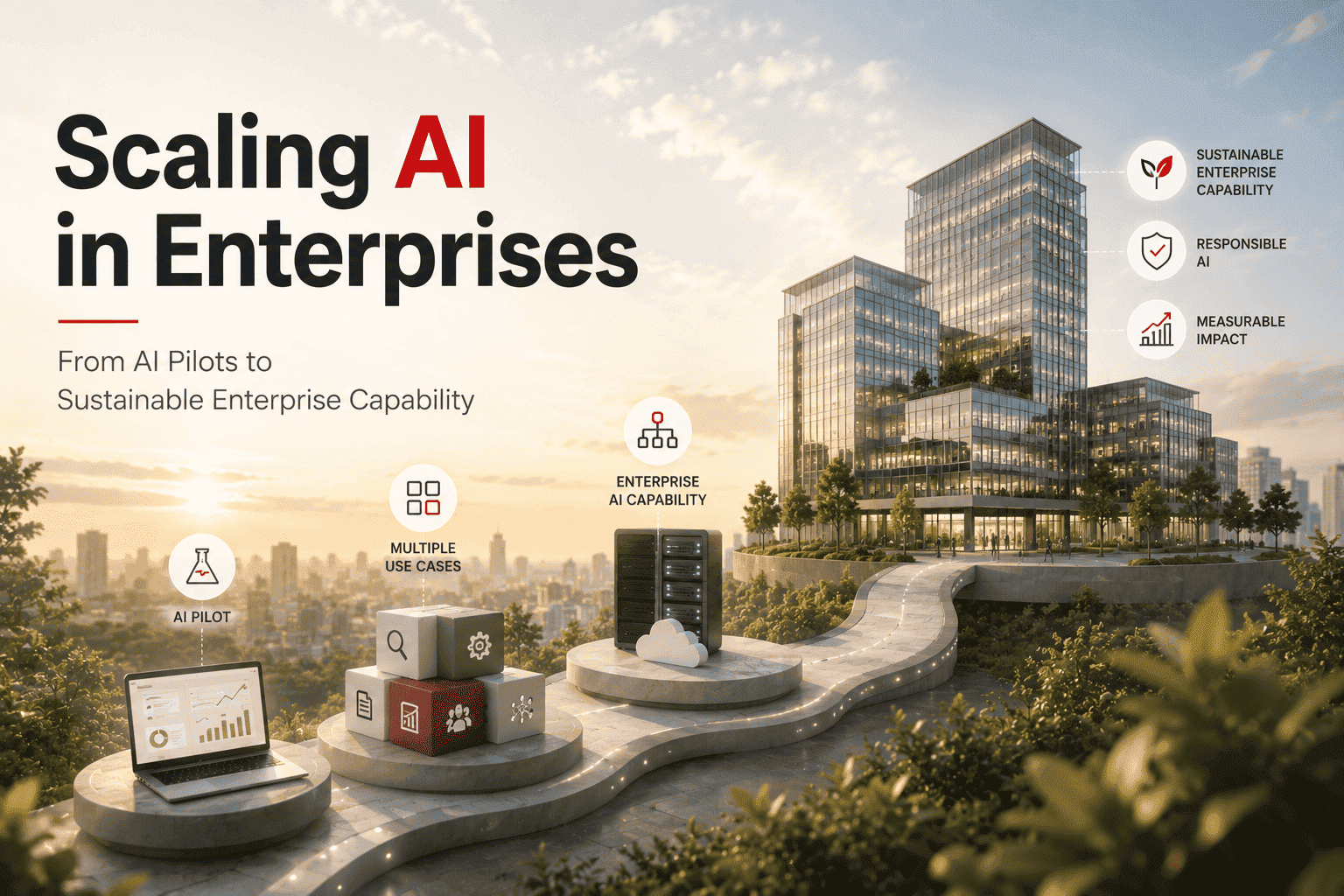
Moving an AI initiative from a successful pilot into an enterprise capability requires a fundamentally different approach to technology, governance, people, and operations. What works effectively for a small team or isolated business function does not necessarily work when AI systems begin supporting multiple departments, regions, business processes, and customer-facing operations.
This transition is where many organizations encounter difficulty. AI pilots may demonstrate strong technical performance and generate positive early results, yet expansion introduces new dependencies, larger data environments, more stakeholders, increased governance requirements, and greater operational responsibility.
Scaling AI in enterprises therefore means more than deploying additional AI models. It means establishing the organizational structures, operating processes, governance mechanisms, technology foundations, and capabilities required to operate AI consistently as adoption expands.
A sustainable approach to enterprise AI transformation ensures that AI growth does not outpace the organization's ability to govern, operate, measure, and improve the systems being deployed.
What Does Scaling AI in Enterprises Mean
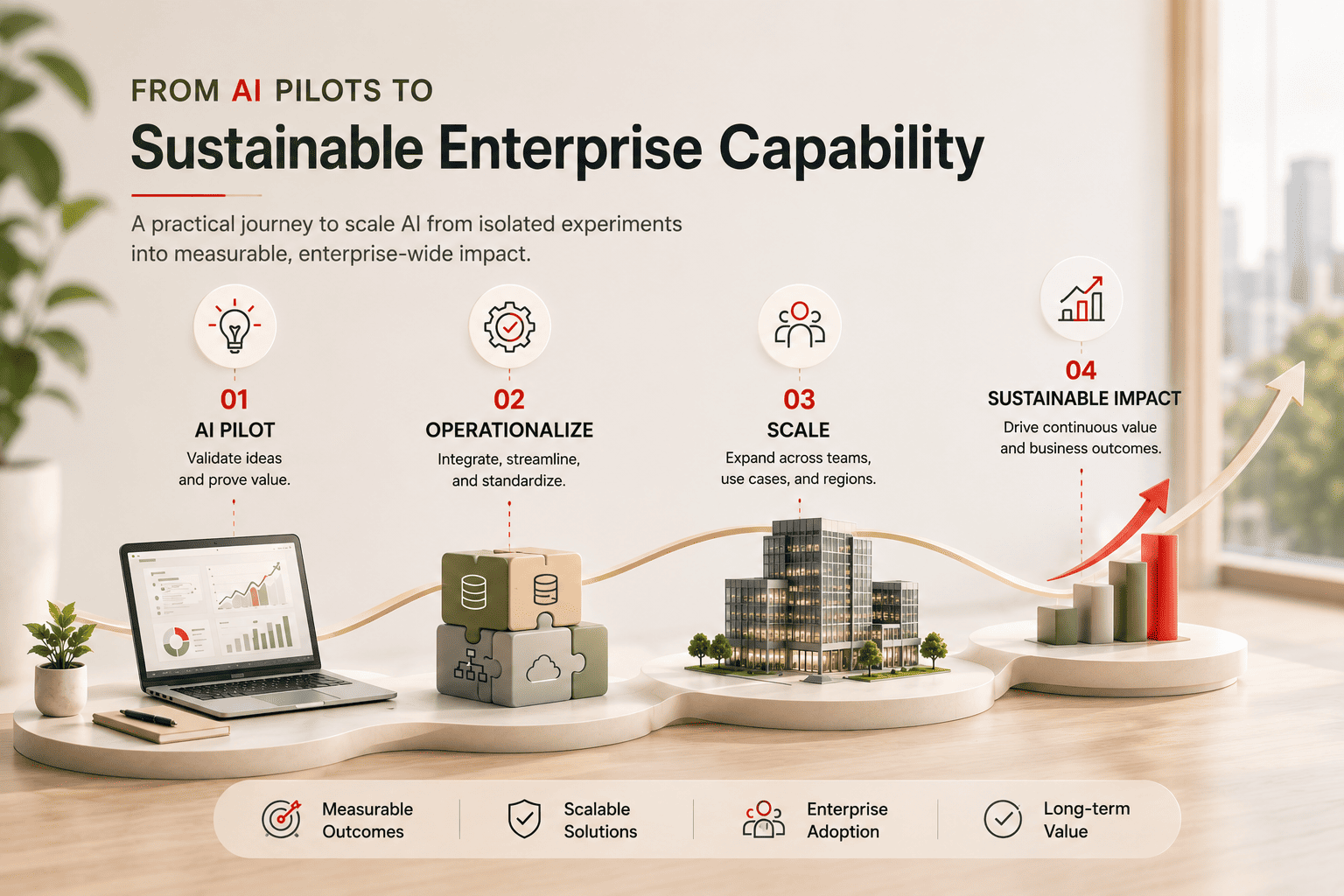
Scaling AI in enterprises refers to the process of expanding artificial intelligence from isolated experiments and individual use cases into repeatable, governed, and sustainable capabilities across multiple business functions and operational environments.
Enterprise AI scaling involves more than increasing the number of AI models. Organizations must also establish common standards for data, development, deployment, security, governance, performance management, and accountability so that AI capabilities can operate consistently across different parts of the organization.
At an enterprise level, successful AI scaling requires organizations to answer several practical questions:
Which AI use cases should be prioritized across the organization?
Who owns AI outcomes across business and technology functions?
How should AI solutions move from experimentation into production?
What governance requirements should apply to different levels of AI risk?
How should AI performance and business value be measured over time?
What operating capabilities are required to support AI as adoption grows?
When these questions remain unresolved, organizations can expand AI activity without developing the operational maturity required to sustain it.
Why Scaling AI Is Fundamentally Different from Launching AI
Launching an AI initiative usually involves a relatively contained environment where a small team can experiment with a specific dataset, use case, technology platform, and success metric while maintaining close control over the project.
Scaling changes that environment significantly. More business units become involved, data sources become more diverse, integrations increase, and AI systems begin influencing operational processes that cannot easily tolerate instability or inconsistent decision-making.
Organizations must therefore transition from experimentation-oriented practices toward repeatable enterprise capabilities that can be governed and operated consistently.
This requires greater consistency across technology architecture and platforms, data standards and governance, model development and deployment, security and risk management, operational support, performance measurement, and business ownership.
The difference is important because an AI pilot can succeed through concentrated expertise and intensive support, while an enterprise AI capability must continue operating reliably even when teams, priorities, systems, and business conditions change.
From AI Pilots to Repeatable Enterprise Capabilities
Many organizations begin AI adoption through isolated use cases because this allows teams to demonstrate value quickly and learn without making significant enterprise-wide commitments.
However, successful pilots can create a new challenge. As more teams recognize the potential of AI, individual initiatives may begin to multiply without a common architecture or governance structure.
This can result in duplicated AI investments across business units, inconsistent development and deployment practices, multiple vendors performing similar functions, fragmented data and model environments, different definitions of AI success, and increasing difficulty coordinating enterprise AI initiatives.
The objective of scaling is therefore not simply to increase the number of AI projects. Organizations need to create reusable capabilities that allow successful approaches to be replicated while maintaining appropriate governance and operational control.
The transition from experimentation toward structured enterprise adoption is explored in AI Adoption Strategy for Enterprises From Pilots to Scale, which explains how organizations can move AI initiatives from individual experimentation toward a coordinated enterprise strategy.
Why Operating Models Become Critical as AI Scales
AI scaling creates organizational complexity that cannot be solved through technology platforms alone. As AI becomes embedded into business processes, organizations need clear structures for deciding who owns AI capabilities, how teams collaborate, how investments are prioritized, and how operational issues are managed.
This is where an AI operating model becomes important.
An AI operating model defines how AI capabilities are organized, governed, funded, delivered, supported, and improved across the enterprise. It connects strategic priorities with the people, processes, technology, and governance mechanisms required to execute them consistently.
A scalable operating model helps clarify decision authority for AI investments and use cases, responsibilities between business, data, technology, and risk teams, processes for moving AI solutions into production, accountability for AI performance and business outcomes, and mechanisms for monitoring operational and regulatory risk.
The broader role of operating models in enterprise transformation is explored in Technology Operating Model for Enterprise Transformation, which examines how organizations can structure technology capabilities to support transformation at scale.
Without this structure, organizations often rely on informal coordination and individual expertise. That approach may work during early experimentation but becomes increasingly fragile as AI adoption expands.
The Five Capabilities Required for Sustainable AI Scaling
Sustainable AI scaling depends on several capabilities working together. Organizations that focus exclusively on technology often discover that organizational and operational limitations become the real barriers to expansion.
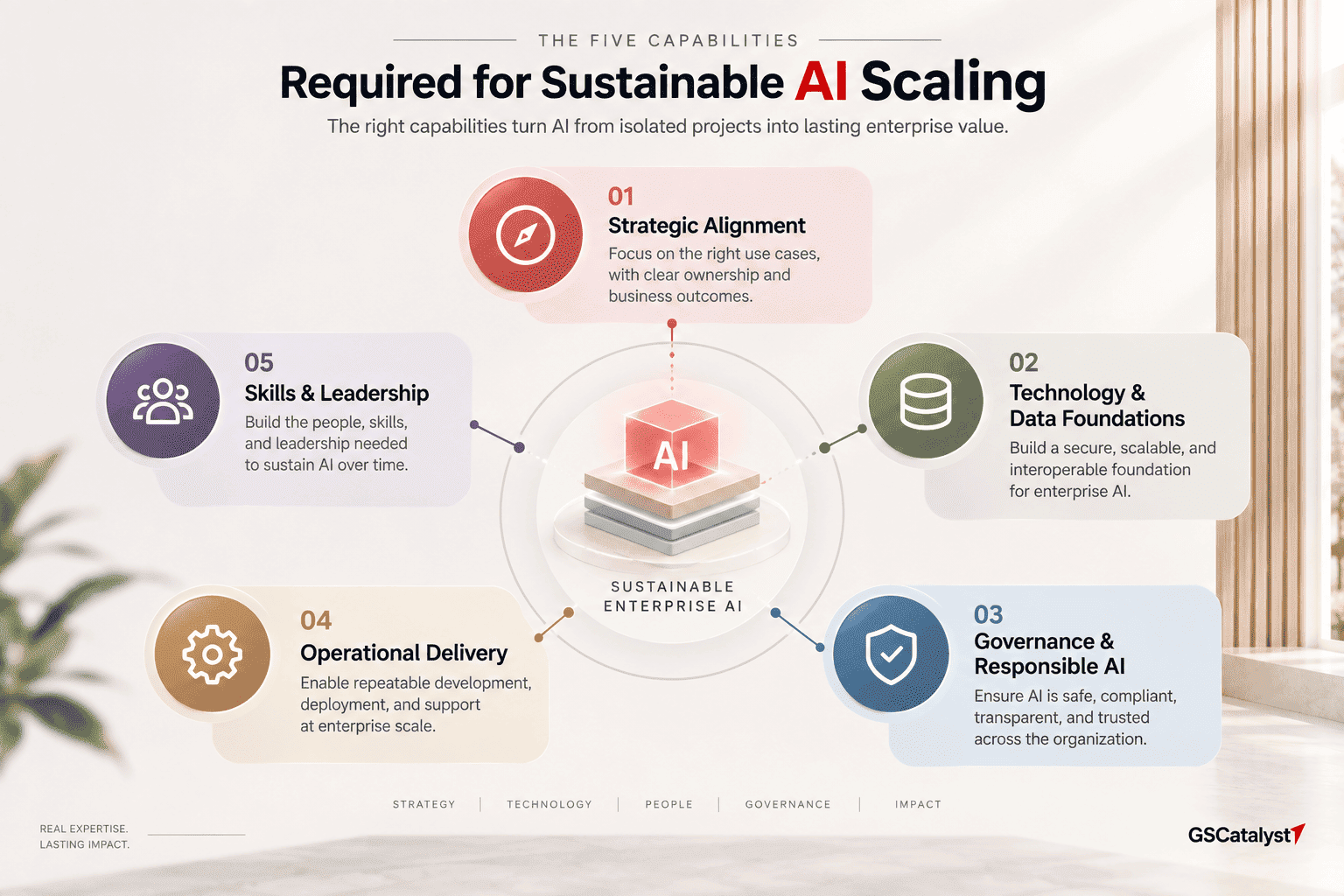
1. Strategic Alignment and Portfolio Prioritization
AI initiatives should be connected to clearly defined business priorities rather than being selected primarily because a technology appears promising.
As the number of AI opportunities increases, organizations need a structured way to determine which initiatives deserve investment, which should remain experimental, and which should be discontinued.
A scalable approach should establish:
Clear criteria for evaluating AI use cases
Alignment between AI initiatives and business objectives
Portfolio-level prioritization across competing opportunities
Defined expectations for business value and outcomes
Regular reviews of whether AI initiatives remain strategically relevant
Portfolio discipline prevents AI investment from becoming fragmented across departments and helps leadership focus resources on initiatives with the strongest strategic potential.
2. Standardized Technology and Data Foundations
AI cannot scale reliably when every business unit builds its own technology and data environment.
Organizations need reusable platforms, common architectural principles, and consistent data practices that reduce duplication while allowing teams to develop solutions efficiently.
A scalable foundation should address:
Shared AI and data platforms where appropriate
Consistent data quality and governance standards
Reusable integration and deployment capabilities
Security controls across AI environments
Architecture that supports future AI workloads
Standardization does not mean every AI use case must use identical technology. Instead, it establishes common foundations that allow different teams to innovate without creating unnecessary fragmentation.
3. Governance, Risk, and Responsible AI
As AI adoption expands, governance must become more structured without becoming unnecessarily restrictive.
Different AI use cases create different levels of business, regulatory, ethical, and operational risk. Organizations therefore need risk-based governance mechanisms that apply appropriate controls according to the characteristics and potential impact of each use case.
Effective governance should establish:
Risk classification for AI applications
Approval requirements based on risk level
Clear ownership for models and outcomes
Monitoring requirements after deployment
Procedures for addressing incidents and unexpected outcomes
Appropriate human oversight for higher-impact applications
This allows organizations to maintain control while preserving the flexibility required for innovation.
4. Operational Delivery and Lifecycle Management
Scaling AI requires a reliable process for moving solutions from experimentation into production and then maintaining them over time.
Without structured delivery and lifecycle management, organizations can accumulate models that are technically functional but difficult to operate, monitor, update, or retire.
A mature AI delivery capability should address:
Development and testing standards
Deployment and release processes
Model performance monitoring
Incident and issue management
Model updates and retraining
Retirement of obsolete AI systems
These practices transform AI from project-based experimentation into an operational capability that can be maintained consistently across the enterprise.
5. Skills, Leadership, and Organizational Capability
Technology and governance structures cannot create sustainable AI adoption without people who understand how to operate them.
Organizations need capabilities across technical disciplines, business functions, risk management, data management, and leadership. They also need clear accountability so that AI does not become an initiative owned exclusively by a specialized technology team.
Organizations should consider:
Technical and data skills required to operate AI platforms
Business capabilities needed to identify valuable use cases
Leadership understanding of AI opportunities and risks
Training and change management requirements
Clear accountability for AI outcomes
Developing these capabilities contributes to broader enterprise AI maturity, allowing organizations to manage AI as an organizational capability rather than a collection of technology projects.
Balancing Innovation with Governance at Enterprise Scale
One of the most difficult challenges in scaling AI in enterprises is maintaining innovation speed while introducing sufficient control.
Excessive governance can create long approval cycles that discourage experimentation and slow business teams. Insufficient governance creates the opposite problem by allowing inconsistent practices, unmanaged risk, and fragmented AI environments to grow rapidly.
A practical approach is to apply governance proportionally. Low-risk use cases can follow lightweight review processes, while high-impact AI systems can require more extensive assessment, documentation, monitoring, and human oversight.
This approach allows organizations to create controlled pathways for experimentation while maintaining stronger governance around applications that could materially affect customers, employees, financial outcomes, or regulatory obligations.
The goal is not to eliminate risk from AI adoption. The goal is to make risk visible, measurable, and manageable while allowing responsible innovation to continue.
Measuring Whether AI Scaling Is Actually Working
Increasing the number of AI initiatives does not necessarily indicate successful enterprise AI transformation. Organizations need to understand whether scaling is producing sustainable improvements in business performance, operational efficiency, and organizational capability.
AI scaling should therefore be evaluated across multiple dimensions, including business value generated by AI initiatives, adoption across target business processes, operational reliability, model performance, AI platform efficiency, risk and compliance performance, reuse of shared technology and data capabilities, and the speed at which AI initiatives move from experimentation into production.
These measures provide leadership with a broader view of AI capability maturity than simply counting the number of models deployed.
A mature organization should be able to demonstrate not only that AI is being deployed, but also that AI capabilities are becoming more repeatable, governable, measurable, and valuable over time.
Signs Your Organization Is Not Ready to Scale AI
Organizations often recognize scaling problems only after their AI portfolio has already become difficult to manage.
Several signals can indicate that operating foundations are not keeping pace with AI adoption.
Common indicators include:
Multiple teams building similar AI capabilities independently
Increasing difficulty governing AI initiatives consistently
Unclear ownership of AI models and business outcomes
Growing operational effort required to maintain AI systems
Inconsistent data and technology standards across use cases
Difficulty measuring business value beyond technical performance
Increasing executive concern about AI risk and investment priorities
These signals do not necessarily mean AI adoption should stop. Instead, they indicate that organizational capabilities and operating structures may need to mature before further expansion.
👉 Read More: Enterprise Execution Maturity for Scalable Digital Transformation
From AI Scaling to Sustainable Enterprise Capability
Successful AI scaling ultimately changes the role of AI within the organization. Instead of operating as a collection of individual projects, AI becomes embedded within business processes, technology platforms, governance mechanisms, and management routines.
This transition requires organizations to institutionalize capabilities that can survive changes in leadership, technology, and business priorities.
Sustainable enterprise AI capabilities typically demonstrate:
Repeatable delivery processes
Reusable technology and data foundations
Consistent governance standards
Clear accountability for outcomes
Continuous performance and value measurement
Ongoing capability development
This institutionalization is what separates temporary AI momentum from sustainable enterprise AI transformation.
Common Mistakes That Limit Enterprise AI Scalability
Organizations frequently encounter the same structural mistakes when attempting to expand AI.
Common examples include treating AI expansion primarily as a technology implementation, allowing every business unit to develop independent standards, expanding AI use cases without strengthening governance, underinvesting in operating models and operational support, measuring success primarily through model performance, and delaying capability development until AI adoption is already widespread.
These patterns may accelerate initial experimentation, but they create additional complexity that becomes increasingly expensive to resolve at scale.
Organizations that recognize these limitations early can strengthen their operating foundations before fragmentation becomes difficult to reverse.
How GS Catalyst Helps Organizations Scale AI Sustainably
Scaling AI requires coordinated transformation across technology, data, governance, operating models, and organizational capabilities.
GS Catalyst helps enterprises establish the structures required to move from successful AI experimentation toward sustainable enterprise capability through:
Designing AI operating models aligned with business priorities
Assessing enterprise AI maturity and identifying capability gaps
Establishing governance and risk management structures
Strengthening AI delivery and operational capabilities
Aligning business, technology, data, and leadership stakeholders
Creating practical frameworks for measuring AI performance and value
This approach helps organizations scale AI with greater consistency while maintaining the governance, operational resilience, and strategic alignment required for long-term transformation.
Build the Operating Foundation for Sustainable AI Scaling
Scaling AI successfully requires more than deploying additional models or expanding technology infrastructure. Organizations need operating structures that allow AI capabilities to be governed, delivered, supported, measured, and improved consistently as adoption grows.
GSCatalyst helps enterprises design the operating models, governance structures, and organizational capabilities required to scale AI responsibly while maintaining business alignment and long-term operational resilience.
👉 Preparing to scale AI across your organization? Explore how GS Catalyst helps enterprises build sustainable operating models for responsible and scalable AI transformation.
Key Takeaways
Scaling AI in enterprises requires organizations to move beyond individual pilots and build repeatable capabilities that can operate across business functions, technology environments, and organizational structures.
Sustainable scaling depends on strategic prioritization, shared technology and data foundations, risk-based governance, reliable delivery processes, lifecycle management, and continuous capability development.
Organizations that strengthen these foundations can expand AI adoption without allowing complexity, fragmented governance, or operational dependencies to undermine long-term business value.
Frequently Asked Questions
What does scaling AI in enterprises mean?
Scaling AI in enterprises means expanding artificial intelligence from isolated pilots and individual use cases into repeatable, governed, and sustainable capabilities across multiple business functions. It requires organizations to establish the technology, data, governance, operating models, and skills needed to support AI reliably at greater scale.
Why do AI pilots often fail to scale across enterprises?
AI pilots often fail to scale because the conditions that support experimentation are different from those required for enterprise operations. Scaling introduces greater data complexity, governance requirements, integration dependencies, operational responsibilities, and organizational coordination. Without scalable operating structures, successful pilots can become fragmented and difficult to maintain.
What is an AI operating model?
An AI operating model defines how an organization organizes, governs, funds, delivers, operates, and improves AI capabilities across the enterprise. It establishes decision rights, accountability, collaboration structures, delivery processes, governance mechanisms, and performance management practices needed to scale AI sustainably.