











Organizations are rapidly adopting artificial intelligence agents to support knowledge driven work across the enterprise. These agents help employees answer questions based on internal data, generate code, and automate complex workflows. However, while many advanced AI models deliver strong results, they often come with high inference costs and slower response times that make large scale deployment challenging.
To address these challenges, Databricks introduced KARL, an enterprise knowledge agent designed to deliver faster responses, higher quality answers, and significantly lower operational cost. KARL is built using reinforcement learning techniques that allow the model to optimize how it reasons, searches for information, and validates answers.
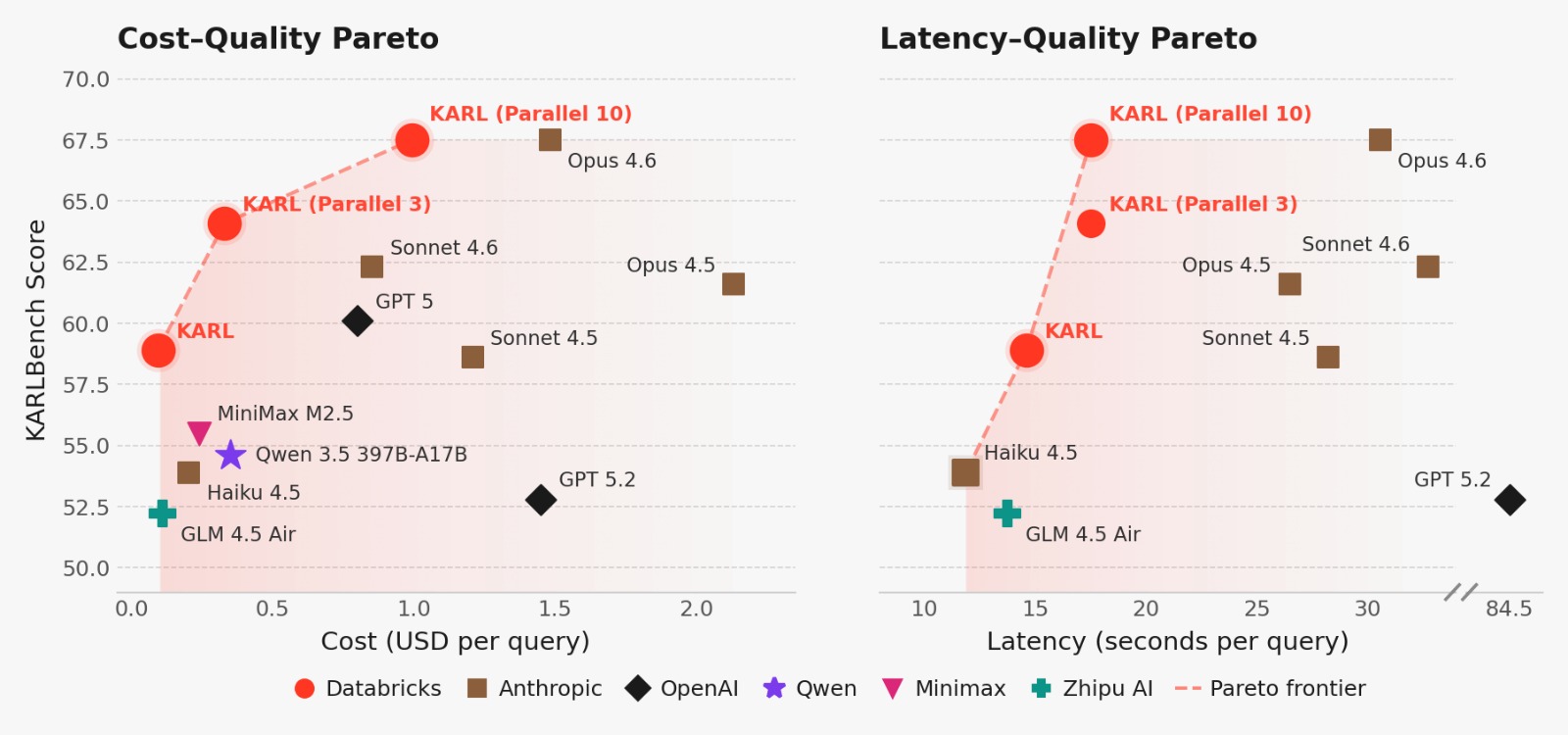
This approach demonstrates that specialized enterprise AI models can outperform large frontier models in quality, latency, and cost efficiency.
What Is KARL and Why It Matters for Enterprise Knowledge
KARL is an enterprise knowledge agent developed by Databricks to support grounded reasoning. Grounded reasoning means the model answers questions by actively searching documents, validating facts, cross referencing information, and performing multi step reasoning tasks.
Many enterprise questions do not have a single clear answer. These are often described as hard to verify tasks. For example, employees may need to gather information from multiple internal systems, interpret documents, and combine several sources of data before producing a final answer.
Traditional AI training methods struggle with these types of tasks because evaluating whether the answer is correct can be difficult. Databricks addressed this challenge by applying advanced reinforcement learning infrastructure that allows KARL to learn how to reason more effectively even when tasks are complex and ambiguous.
Reinforcement Learning Makes KARL More Efficient
Reinforcement learning played a key role in the development of KARL. Instead of relying only on large scale pretraining, the model improves by learning from feedback during task execution.
Using internal reinforcement learning infrastructure, Databricks trained KARL on synthetic data using only a few thousand GPU hours. Despite the relatively small training footprint, the model achieved performance comparable to leading proprietary frontier models on grounded reasoning tasks.
More importantly, KARL operates at a fraction of the inference cost and latency typically required by large general purpose models. This makes it significantly more practical for enterprise environments where AI agents may need to process thousands or millions of requests per day.
Human Evaluations Show Higher Quality Answers
During human evaluations, KARL produced answers that were more complete, accurate, and helpful compared with both existing Databricks agents and several frontier models.
The system was particularly effective when working with enterprise knowledge sources such as internal documents, structured databases, and operational workflows. By grounding responses in trusted enterprise data, KARL reduces hallucinations and improves reliability.
This research is already being integrated into Databricks agents, including the Agent Bricks Knowledge Assistant. These solutions allow organizations to deploy AI assistants that understand both structured and unstructured data stored in the Databricks Lakehouse.
Reinforcement Learning Infrastructure Now Available to Customers
One of the most important outcomes of the KARL project is that the reinforcement learning infrastructure used to build the model is now becoming available to Databricks customers.
Through a Custom Reinforcement Learning private preview, organizations can use the same infrastructure to train their own domain specific AI agents. This capability is particularly valuable for enterprises whose AI agents are growing rapidly and need to improve both performance and cost efficiency.
The system is powered by Databricks Serverless GPU Compute, allowing companies to scale reinforcement learning experiments without managing complex infrastructure.
Why Custom AI Agents Are the Future of Enterprise AI
Most real world enterprise tasks involve domain knowledge, internal workflows, and proprietary data. Generic models often struggle to deliver the level of accuracy and efficiency required in these environments.
By enabling organizations to train specialized AI agents using reinforcement learning, Databricks is helping companies build AI systems that are better aligned with their data, processes, and performance expectations.
As AI adoption continues to grow, custom optimized agents like KARL may become a key component of enterprise knowledge systems, enabling faster decisions, better answers, and more scalable automation.
Frequently Asked Questions
What is KARL in Databricks AI?
KARL is an enterprise knowledge agent developed by Databricks that uses reinforcement learning to improve how artificial intelligence systems answer questions based on enterprise data. The system focuses on grounded reasoning, which means it searches documents, validates facts, and cross references information before generating answers. KARL is designed to deliver high quality responses while reducing inference cost and latency.
How does KARL improve enterprise knowledge systems?
KARL improves enterprise knowledge systems by enabling AI agents to reason over multiple sources of information. Instead of generating answers based only on general training data, KARL retrieves relevant documents, verifies facts, and combines structured and unstructured data. This approach helps organizations obtain more accurate and reliable answers from their internal knowledge sources.
What is grounded reasoning in enterprise AI?
Grounded reasoning is an approach in artificial intelligence where models generate answers based on verified sources of information. The system retrieves documents, validates facts, and analyzes multiple data points before producing a response. This process helps reduce hallucinations and improves the reliability of AI generated insights in enterprise environments.
Why is reinforcement learning important for AI agents?
Reinforcement learning helps AI agents improve their reasoning ability by learning from feedback during task execution. Instead of relying only on static training data, the model continuously learns how to produce better answers through reward based optimization. This technique allows enterprise AI systems to handle complex tasks that do not have a single clearly correct answer.
How does KARL reduce AI inference cost and latency?
KARL reduces inference cost and latency by using a specialized model trained specifically for enterprise knowledge tasks. Because the model is optimized for grounded reasoning and document retrieval, it can perform these tasks more efficiently than large general purpose models. This allows organizations to scale AI agents across large workloads without significantly increasing infrastructure costs.
Can organizations build their own AI agents using Databricks reinforcement learning infrastructure?
Yes. Databricks now offers reinforcement learning infrastructure that customers can use to build and optimize their own AI agents. Through the Custom Reinforcement Learning private preview powered by serverless GPU compute, organizations can create domain specific models that reflect their internal data, workflows, and performance requirements.
How is KARL used in the Databricks ecosystem?
KARL is being integrated into Databricks AI agents such as the Agent Bricks Knowledge Assistant. These agents help enterprises interact with their data stored in the Databricks Lakehouse, enabling employees to ask questions, retrieve insights, and automate knowledge related tasks using artificial intelligence.